With the Nodding Trilliums (Trillium cernuum) coming into bloom this week along Bog Meadow Brook Nature Trail in Saratoga Springs, the trillium season around this area has reached its culmination. I feared yesterday I had arrived too early to find this elusive wildflower already in bloom, especially when I spied dozens of small trillium leaves bearing neither flowers nor buds. But after a closer look -- and the lifting of leaves -- I found many in full bloom like the one pictured above. It looks to be a great year for Nodding Trillium, a wildflower some botanists believe may be becoming more rare in its former range. But I'm happy to report I found more here than ever before: around 150 specimens (counting seedlings like the tiny ones pictured below) along both sides of the trail.
I probably shouldn't count the Snow Trillium (T. nivale) in this sequence of trillium blooms, since it's not really native to anywhere in New York State. Its native range is in states more to the south and west of New York. But a famed local naturalist, Orra Phelps, once planted a few on her wooded property in neighboring Wilton, and this diminutive and delightful trillium has naturalized there, blooming sometimes as early as late March, while snow still lies in the hollows of the woods. Ordinarily, we New Yorkers would never get to lay eyes on this wee little beauty around here, and I feel very grateful to Orra Phelps that we can.
Our native trillium season started in mid-April this year, when I found the first Red Trillium (T. erectum) dangling its deep-red flowers beneath its trio of bright-green leaves. Granted, the place I found it was down along Shenantaha Creek near Ballston Lake, in a deep ravine noted as our go-to spot for finding the earliest bloomers. Although by now, most Red Trilliums have passed their prime, I still occasionally find one in almost-perfect bloom.
It took almost a month after the Red Trillium first made it appearance before the Large-flowered White Trillium (T. grandiflorum) opened its showy blooms in the Skidmore woods here in Saratoga Springs. When this lime-loving trillium finds a place it likes, it doesn't hold back, but spreads its beauty in almost uncountable numbers. An interesting thing about this flower is that its pristine white petals will turn a lovely shade of pink, after pollination and before the flowers fade.
Here's what the Large-flowered White Trillium will look like after turning pink, a few weeks later:
The same mid-May week we found hundreds of T. grandiflorum abounding in the Skidmore woods, my friend Sue Pierce and I set off to explore the rocky hemlock woods along the north-facing shore of Lake Bonita in Moreau Lake State Park. If there's any wildflower that can tolerate the deep shade and unfavorable soils of a hemlock forest, it is the Painted Trillium (T. undulatum). And we were not disappointed. We did not find abundant numbers, but plenty to make the more-than-two-mile somewhat rugged hike around Lake Bonita worth the effort. Most were just coming into bloom, but in one sunny spot we found quite a few lifting their beautiful rose-blushed white faces to the light.
I'm aware that other species of trillium are native to other parts of our country, but these four -- the Red, the Large-flowered, the Painted, and the Nodding -- are the species native to Saratoga County. And just in recent years, I have found some trilliums along Bog Meadow Brook Nature Trail that don't exactly fit the guidebook descriptions of any of these four. But they DO exhibit characteristics of both the Red Trillium and the Nodding Trillium, two species that share the Bog Meadow habitat and which do have some overlap in blooming time. Several professional botanists have suggested that these are quite likely a hybrid of these two species, and I have found several specimens that exhibit these characteristics quite differently. I've found snowy-white flowers with a dark-red pistil, pale-pink flowers that are yellow on the backs of the petals, and this one pictured below, with deep-rose petals suggestive of the Red Trillium, combined with the white pistil and long-filamented anthers that are diagnostic for a Nodding Trillium. An interesting phenomenon!
I haven't yet found any trillium hybrids this year. But some of the trilliums sharing the Nodding Trillium location along Bog Meadow are still in tight bud. Perhaps they will yet prove to be our hybrids, finally bringing our official trillium season to a close.
For more than thirty years I've been wandering the woods and waterways of Saratoga County, New York, and regions nearby, looking closely, listening carefully, and recording what I experience. We are blessed in this region with an amazing amount of wilderness right at hand. With this blog I share my year-round adventures here, seeking out what wonders await in my own Madagascar close to home.
Sunday, May 17, 2020
Wednesday, May 13, 2020
A Post-freeze Walk in the Skidmore Woods
My friends Dan and Sue and I put on our masks and practiced "social distancing" as we walked in the Skidmore woods today. Luckily, there was lots to see and photograph separately, so we could keep plenty of distance among ourselves, even while we delighted to share our enthusiasm for wildflowers.
Many of the wildflowers looked rather wizened today, after a night when temps fell well below freezing. But the spectacular Large-flowered White Trilliums (Trillium grandiflorum) looked none the worse, and oh my, did we find a LOT of them!
There were even a few of the Red Trilliums (T. erectum) still holding their dark-red blooms.
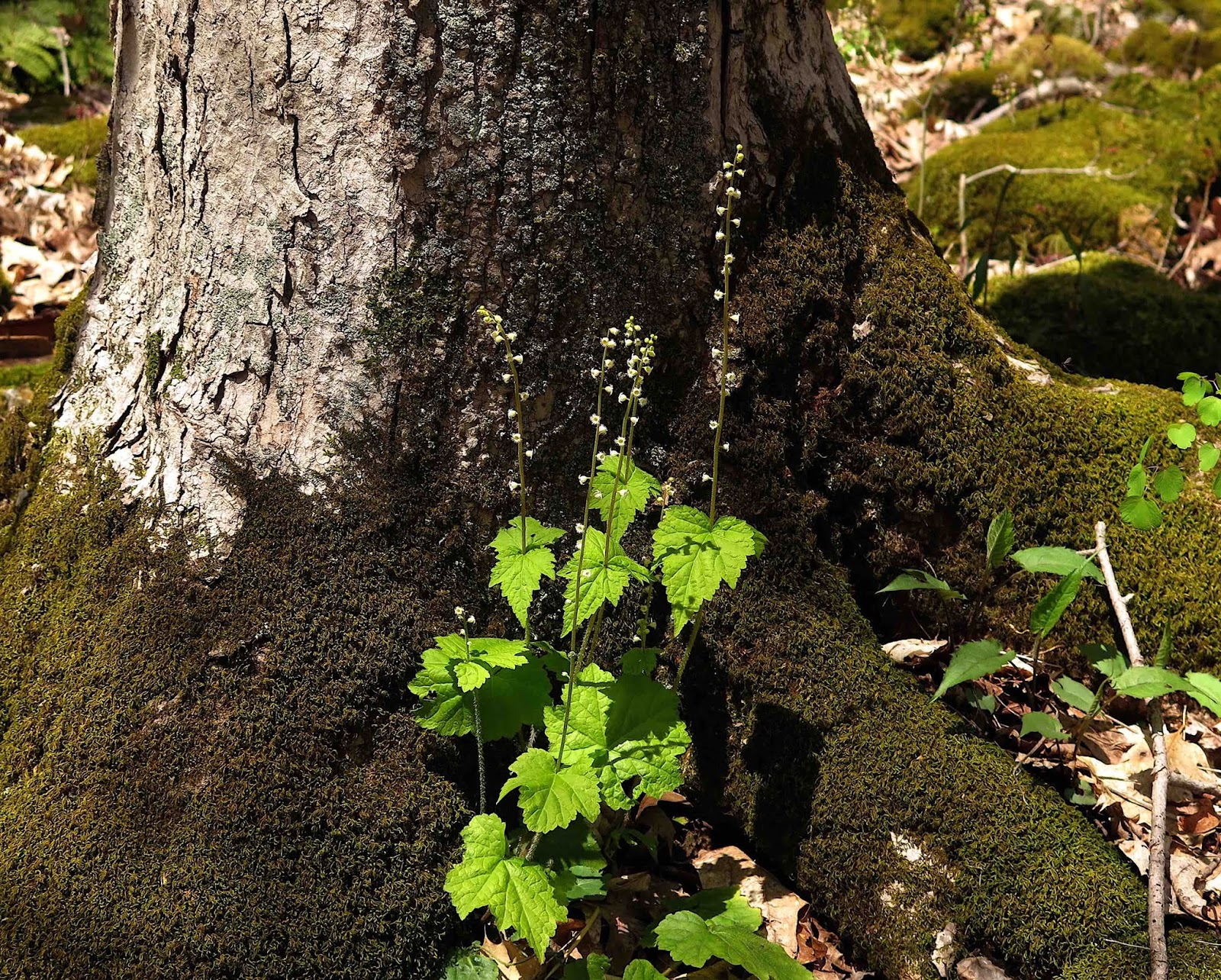
We also found abundant numbers of the tiny-flowered Miterwort (Mitella diphylla) blooming throughout the woods, some of it looking a bit desiccated. But this particular cluster of stems had found shelter among the roots of a tree and looked as perky as ever.
I'm sure that many of our native shrubs have evolved to tolerate late-season freezes. These gracefully floating leaves of an Alternate-leaved Dogwood shrub (Cornus alternifolia) showed no signs at all of having been nipped by the cold.
This spring's plants of Sharp-lobed Hepatica (Hepatica acutiloba) are sporting fresh new leaves, now that the flowers are fading. But many of last summer's now-year-old leaves still persist on the ground surrounding the plants. Having made it just fine through the winter's sub-zero freezes, they looked as lovely as ever today, especially when set alight by a sunbeam to glow like ruby glass.
Each of us knows where some very special flowers grow in this woods, and Dan showed Sue and me some Yellow Lady's Slippers (Cypripedium parviflorum) already in bud. It looks like we'll be donning our masks again in a week or so, when we come back together to photograph this native orchid's spectacular flowers. Happily, this particular plant made it through last night's freeze unscathed. Tonight is predicted to be another cold one. Let's keep our fingers crossed that we will yet see this flower in bloom.
Many of the wildflowers looked rather wizened today, after a night when temps fell well below freezing. But the spectacular Large-flowered White Trilliums (Trillium grandiflorum) looked none the worse, and oh my, did we find a LOT of them!
There were even a few of the Red Trilliums (T. erectum) still holding their dark-red blooms.
We also found abundant numbers of the tiny-flowered Miterwort (Mitella diphylla) blooming throughout the woods, some of it looking a bit desiccated. But this particular cluster of stems had found shelter among the roots of a tree and looked as perky as ever.
I'm sure that many of our native shrubs have evolved to tolerate late-season freezes. These gracefully floating leaves of an Alternate-leaved Dogwood shrub (Cornus alternifolia) showed no signs at all of having been nipped by the cold.
Each of us knows where some very special flowers grow in this woods, and Dan showed Sue and me some Yellow Lady's Slippers (Cypripedium parviflorum) already in bud. It looks like we'll be donning our masks again in a week or so, when we come back together to photograph this native orchid's spectacular flowers. Happily, this particular plant made it through last night's freeze unscathed. Tonight is predicted to be another cold one. Let's keep our fingers crossed that we will yet see this flower in bloom.
Tuesday, May 12, 2020
Back to the Swamp
None of my fellow plant-nerd friends has been able to ID that mystery water plant I found in the swamp my son Philip took me to on Saturday (see last post). So back to the same swamp I went today, hoping (despite last night's freezing temps) I might find more tell-tale features if I examined the plant more closely.
This time, I entered the trail from a point that would take me more directly to the swamp. This trail passes through a beautiful woods, made even more interesting by these trees with their curving trunks. How do you think that happened?
I promptly arrived at the swamp where I'd found those mystery plants. I was glad to see that last night's freezing temps hadn't killed the gorgeous Marsh Marigold that lined the stream banks.
It WAS chilly enough today, however, to stun this pretty hoverfly into torpidity, so I could poke my camera in close to snap its picture.
I hadn't remembered seeing Hooked Crowfoot blooming when I passed this way 3 days ago. Its tiny star-shaped flowers are easy to miss, but I always stop to peer closely at them. In the center of those glossy yellow petals is a globe that is studded with tiny hooks, a feature that surely suggested this buttercup's common name. Its scientifically specific name, too: Ranunculus recurvatus.
Here's a closer look at those tiny hooks:
I think this beautiful big Dryad's Saddle fungus must have emerged since I last passed this way, as well. How could I have missed it, it has such a handsome presence?
I promptly arrived at a patch of the plants I was searching for. Unharmed by any touch of frost, they seemed bigger and taller than ever.
This time, I examined the leaves more closely, and I found slender stalks emerging from every leaf axil along the thick stem. The stalks were tipped by leafy growths, but I am assuming that flowers will develop eventually at the ends of these stalks.
This time I collected a specimen, so I could observe the plant at length, and perhaps submit the actual plant to someone who might be able to name it for me. As this ruler shows, the plants is quite tall. And I doubt it has stopped its growing.
After measuring the plant, I placed it in a large glass vase, covering its roots with water. I'm hoping it will survive this way long enough that some flowers may yet develop. I'm afraid that's the only way I will ever determine its name. But even if it doesn't survive in this vase, I know how to easily walk to where it does thrive in the swamp. There's no shortage of these plants in there!
This time, I entered the trail from a point that would take me more directly to the swamp. This trail passes through a beautiful woods, made even more interesting by these trees with their curving trunks. How do you think that happened?
I promptly arrived at the swamp where I'd found those mystery plants. I was glad to see that last night's freezing temps hadn't killed the gorgeous Marsh Marigold that lined the stream banks.
It WAS chilly enough today, however, to stun this pretty hoverfly into torpidity, so I could poke my camera in close to snap its picture.
I hadn't remembered seeing Hooked Crowfoot blooming when I passed this way 3 days ago. Its tiny star-shaped flowers are easy to miss, but I always stop to peer closely at them. In the center of those glossy yellow petals is a globe that is studded with tiny hooks, a feature that surely suggested this buttercup's common name. Its scientifically specific name, too: Ranunculus recurvatus.
Here's a closer look at those tiny hooks:
I think this beautiful big Dryad's Saddle fungus must have emerged since I last passed this way, as well. How could I have missed it, it has such a handsome presence?
I promptly arrived at a patch of the plants I was searching for. Unharmed by any touch of frost, they seemed bigger and taller than ever.
This time, I examined the leaves more closely, and I found slender stalks emerging from every leaf axil along the thick stem. The stalks were tipped by leafy growths, but I am assuming that flowers will develop eventually at the ends of these stalks.
This time I collected a specimen, so I could observe the plant at length, and perhaps submit the actual plant to someone who might be able to name it for me. As this ruler shows, the plants is quite tall. And I doubt it has stopped its growing.
After measuring the plant, I placed it in a large glass vase, covering its roots with water. I'm hoping it will survive this way long enough that some flowers may yet develop. I'm afraid that's the only way I will ever determine its name. But even if it doesn't survive in this vase, I know how to easily walk to where it does thrive in the swamp. There's no shortage of these plants in there!
Saturday, May 9, 2020
New Trail, New Plants, and a Stumper
I am delighted that my son Philip has inherited some of my trespasser's genes. Well, it's not that we mean to break the law, it's just that sometimes we wander a stream or follow a deer trail or enter a woods that beckons so persuasively we somehow fail to notice the "Posted" signs. My son is a restaurant chef, so he has mornings and early afternoons free to wander, and recently he came upon a little-used trail that follows both a powerline clearcut and a wooded streambank that leads to a marsh that was filled with plants he did not recognize. Bless his heart, he knows who to ask about plants, and he sent me some photos that really piqued my interest. "Take me there, Phil!" I begged him. And so he did.
We started our walk on the powerline service road, which was lined with Blackberry bushes and Sweet Fern shrubs, and the sandy ground was dotted with the bright-purple blooms of Ovate-leaved Violet (Viola sagittata var. ovata). This fuzzy-stemmed violet blooms on very short stems when it first comes into bloom, so its flowers seem very large compared to its small furry basal leaves.
Sharing that sunny roadside were several patches of Wild Strawberry (Fragaria virginiana) just opening its snowy flowers.
There were several small trees bearing white blossoms along this road, and a close look at the flowers revealed the single pistil that signifies a stone-fruit blossom. The reddish twigs and clustered blooms indicated to me that this was most likely a Pin Cherry tree (Prunus pensylvanica). It will have bright-red sour cherries later in summer. An alternate common name for this tree is Bird Cherry, appropriately enough, since birds devour these cherries. Usually, before we humans can manage to get to them.
After a short while, the trail veered into a mixed hardwood/conifer woods, and here, the forest floor was home to abundant woodland wildflowers. Wood Anemone (Anemone quinquefolia) was one of those in bloom today.
We passed several places where the forest floor was peppered with dozens of the snowy orbs of Dwarf Gingseng (Panax trifolius).
Goldthread (Coptis trifolia) also dotted the forest floor, its star-shaped white blooms containing the oddest little yellow jelly-like petals and green spindle-shaped pistils.
Soon to join the floral display will be Starflower (Lysimachia borealis). We could see its leaves everywhere, and a closer look revealed the tiny flower buds getting ready to open.
The fat pink buds of Striped Maple (Acer pensylvanicum) have released both large green leaves and dangling clusters of flower buds.
There were so many White Pines in this woods, I kept expecting to see Pink Lady's Slippers (Cypripedium acaule), and soon I did, indeed. A cluster of six of them surrounding a large White Pine. Although not yet flowering, this orchid is immediately recognizable even in bud by its two large basal leaves, arcing stem, and plump oval bud surmounted by a green bract.
We also surprised a couple of woodland critters as we passed through this woods. This Garter Snake was coiled in such a convoluted way, I thought it would tie itself in knots if it tried to flee suddenly. Phil and I kept our distance so as not to disturb its nap.
If this tiny Spring Peeper had frozen in place, we would never have seen it, so well camouflaged it was among the brown leaf litter. But of course, it hopped and hopped and hopped. Finally, it stopped for just a second so I could snap its photo.
Before long, the trail moved close to a stream, where Marsh Marigold (Caltha palustris) glowed on the banks and white-flowered Shadblow trees (Amelanchier sp.) leaned their branches over the water, creating a scene so lush and green and gorgeous, I could have stayed here all day.
Here's a closer look at those beautiful Marsh Marigold blooms.
In several places along the stream, sandy flats revealed the tracks of the animals who frequented these woods and waters. Because these Raccoon tracks were both large and small, we presumed that Mama Raccoon had brought her babies down to the water here.
This photo shows both the green leaves of Canada Mayflower (Maianthemum canadense) and the web-covered uncoiling fiddleheads of Cinnamon Fern (Osmundastrum cinnamomeum), both plants being abundant along the stream.
Water Striders were darting about on the slow-moving water of the stream. It amazes me how their feet can dimple the water's surface without breaking through.
We finally reached an open marshy area where a number of wetland species of plants were thriving under the sun. And here was the plant that had piqued my interest so, when Phil sent me photos of it, one I recognized from my guidebooks but which I had never laid my eyes on before. This is Swamp Saxifrage (Micranthes pensylvanica), with a cluster of flower buds topping a long fuzzy stem. According to the New York Flora Association, this is a common plant in the state, but I had never encountered it. Perhaps few people get to see it because it grows on wet muck, not always a habitat easy for folks to explore. But I don't mind muddy feet, if it means I get to meet a new flower for my life list.
There were quite a few Swamp Saxifrage plants thriving at this site, including this one with its baby cluster of buds. That short stem will grow and grow and grow, becoming quite tall before the buds open into clusters of greenish-white star-shaped flowers. At least, that's what my guidebooks show me. I will certainly have to return to this spot to see these plants in bloom for myself.
Here was another plant I want to return to observe, hoping to find it in bloom. It was growing right IN the shallow water, and I did not recognize it from the foliage alone. Neither have any of my Facebook friends recognized it, even some experts among them, after I posted photos there showing the leaves and stems in a number of close-up shots. The presence of a flower would sure help a lot.
In some places, this unknown plant formed large mats of rooted plants in the slow-moving shallow water. I want to know the name of this plant, not just to satisfy my curiosity, but also to learn whether it might prove to be invasive.
This creek and its banks are home to a rich assortment of native species, and it would be a shame to see them supplanted by a non-native plant. So I will be returning often, hoping to find this mystery plant in bloom for the sake of identifying it. And also just to enjoy this marvelous trail that my son introduced me to. What a site! And we had it mostly all to ourselves, a real plus in these social-distancing times.
Wednesday, May 6, 2020
Floral Abundance in the Skidmore Woods
With so many plants responding to Spring these days, I can hardly keep up with them! Since I use my blog as a record of how Spring progresses each year, I simply want to list (in alphabetical order) those plants I observed in the Skidmore woods this past Monday (May 4). Many neglected household tasks are calling me away from lengthy blogging at the moment.
American Beech (Fagus grandifolia). Emerging leaves covered with kitten-soft fur.
Bellwort, Large-flowered (Uvularia grandiflora)
Blue Cohosh, the yellow-flowered, later-blooming species (Caulophyllum thalictroides)
Prickly Gooseberry (Ribes cynosbati)
Bulblet Fern (Cystopteris bulbifera), newly emerged, with cherry-red stems
Canada Violet (Viola canadensis), displaying the distinctive white face and purple buds.
Dwarf Ginseng (Panax trifolius)
Early Meadow Rue, pistillate flowers (Thalictrum dioicum)
Early Meadow Rue, staminate flowers (Thalictrum dioicum)
Long-spurred Violet (Viola rostrata), the most common violet of this limestone-underlaid woods.
Maple-leaved Viburnum (Viburnum acerifolium), in bud
Miterwort (Mitella diphylla)
Moss with orange sporophytes. Baby Tooth Moss (Plagiomnium cuspidatum)?
Sedge with fine leaves and yellow staminate flowers, possibly Carex pensylvanica
Shagbark Hickory (Carya ovata), unfolding enormous leaf bud
Sharp-lobed Hepatica (Hepatica acutiloba), seed capsules and new leaves
Small-flowered Crowfoot (Ranunculus abortivus), tiny yellow flowers as shiny as stars!
Small Solomon's Seal (Polygonatum biflorum), dangling its flower buds
Trillium, Red (Trillium erectum)
Trillium, Large-flowered White (Trillium grandiflorum)
Trout Lily, Yellow (Erythronium americanum), one of the last fading blooms to be found in this woods this spring
Wild Ginger (Asarum canadense) I had to use flash to reveal the single flower hiding in the deep shadow of its leaves.
Woolly Blue Violet (Viola sororia) Distinguished by the hairiness of its leaf stalks and the undersides of its leaves, this violet once was considered a species all to itself. But now several other violets, including our smooth-stemmed Common Blue Violet, are included within the species V. sororia. To me, it has its own distinctive look, and I find it every year in the same rocky habitat I have always found it blooming in the Skidmore woods.
American Beech (Fagus grandifolia). Emerging leaves covered with kitten-soft fur.
Bellwort, Large-flowered (Uvularia grandiflora)
Blue Cohosh, the yellow-flowered, later-blooming species (Caulophyllum thalictroides)
Prickly Gooseberry (Ribes cynosbati)
Bulblet Fern (Cystopteris bulbifera), newly emerged, with cherry-red stems
Canada Violet (Viola canadensis), displaying the distinctive white face and purple buds.
Dwarf Ginseng (Panax trifolius)
Early Meadow Rue, pistillate flowers (Thalictrum dioicum)
Early Meadow Rue, staminate flowers (Thalictrum dioicum)
Long-spurred Violet (Viola rostrata), the most common violet of this limestone-underlaid woods.
Maple-leaved Viburnum (Viburnum acerifolium), in bud
Miterwort (Mitella diphylla)
Moss with orange sporophytes. Baby Tooth Moss (Plagiomnium cuspidatum)?
Sedge with fine leaves and yellow staminate flowers, possibly Carex pensylvanica
Shagbark Hickory (Carya ovata), unfolding enormous leaf bud
Sharp-lobed Hepatica (Hepatica acutiloba), seed capsules and new leaves
Small-flowered Crowfoot (Ranunculus abortivus), tiny yellow flowers as shiny as stars!
Small Solomon's Seal (Polygonatum biflorum), dangling its flower buds
Trillium, Red (Trillium erectum)
Trillium, Large-flowered White (Trillium grandiflorum)
Trout Lily, Yellow (Erythronium americanum), one of the last fading blooms to be found in this woods this spring
Wild Ginger (Asarum canadense) I had to use flash to reveal the single flower hiding in the deep shadow of its leaves.
Woolly Blue Violet (Viola sororia) Distinguished by the hairiness of its leaf stalks and the undersides of its leaves, this violet once was considered a species all to itself. But now several other violets, including our smooth-stemmed Common Blue Violet, are included within the species V. sororia. To me, it has its own distinctive look, and I find it every year in the same rocky habitat I have always found it blooming in the Skidmore woods.
Subscribe to:
Posts (Atom)