Friday, April 17, 2020

These Buds Are For You! (And a few flowers, too)

Down into the 20s last night. Snow predicted tonight.  Sigh!  Well, since Winter's decided to hang around a bit longer, I guess our flood of spring wildflowers will reduce to a trickle for awhile.  How about a little quiz to amuse us while we wait?  I found all these buds while walking the Zim Smith trail at Shenantaha Park near Ballston Lake this week.  Guess what plants these buds belong to, and I will come back in a day or two to ID them here.


No other of our native trees has buds as chrome-yellow as this.  Also if you pinch them, they smell like shoe polish (if you're of an age to remember what that smells like!).

Bitternut Hickory (Carya cordiformis)


I knew of a gardener who once cut this shrub species down because he thought its leaves were Poison Ivy.  He should have waited until he could see its distinctive inflated seed pods.

American Bladdernut (Staphylea trifolia)


I tested one of this shrub's common names by chewing on a twig.  Luckily, my mouth turned numb for only about an hour. One of only two citrus shrubs that grow this far north. Larval food for the Giant Swallowtail Butterfly.

Northern Prickly Ash (Zanthoxylum americanum)  Also called Toothache Tree.


Before this bud opened into this graceful fleur-de-lis shape, it resembled the head of a stork.

Sweet Viburnum, also called Nannyberry (Viburnum lentago)


I love the kitten-soft fur that warms the buds of one of our earliest-flowering trees.

Shadblow (Amelanchier sp.)


Some people call this a "weed tree." But the birds love to eat the seeds that hang from its boughs all winter long, and squirrels nip its bark in spring to lap up its sweet sap. These are the male flowers before they elongate to sway in the breeze and waft their pollen.  The female flowers grow on separate trees.

Box Elder (Acer negundo), the male flower buds.


It won't be long before those pinkish buds open to reveal the white four-parted flowers so typical of many plants of the Mustard Family.

Cutleaf Toothwort (Cardamine concatenata)


The purple-tinged buds of this berry bush are even prettier than the rather scraggly, off-white flower clusters that will bloom later in the spring.

Red-berried Elder (Sambucus racemosa)


While walking that Zim Smith bike trail, I could look down into a deep ravine where the Ballston Creek rushed along between steep shale cliffs.  I recalled that many spring wildflowers came into bloom down there well before any other place I knew, so I clambered down this very steep bank to see what I could see.


LOTS of spring wildflowers is what I saw!  These Bloodroots (Sanguinaria canadensis) had wrapped their leaves about their shoulders against the chilly wind.


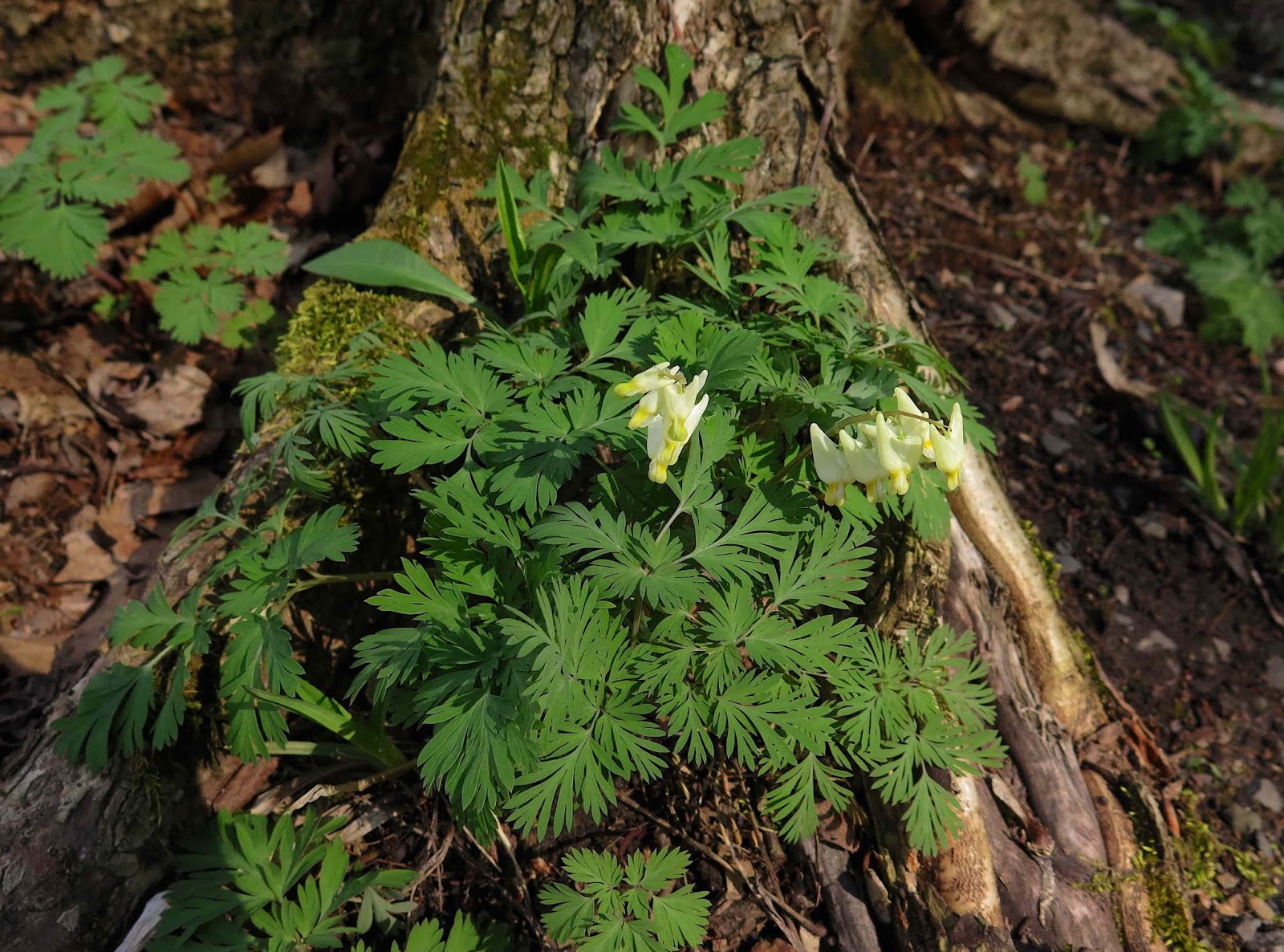
In uncountable numbers, Dutchman's Breeches (Dicentra cucullaria) decorated the creek's floodplain with clumps of lacy leaves and inflated-pantaloon blossoms.


I found one single Long-spurred Violet (Viola rostrata) here along the creek, and none others anywhere else I walked today.


I swear this ravine is the Enchanted Valley of the Early Bloomers.  Everywhere else I have looked this week, Red Trilliums (Trillium erectum) are barely out of the ground, let along sporting such remarkably red flowers.


Two days before, I had searched for just the slightest trace of Early Blue Cohosh (Caulophyllum giganteum) at another site, and here they were, already in full pollen-offering bloom and unfurling leaves.


I HAD found a few Trout Lilies (Erythronium americanum) earlier this week at other sites, but only solitary outliers, struggling to open a single blossom.  But here was a group of four, in full vigorous flower.


 And there were other flowers, too -- Wild Ginger, Toothwort, American Fly Honeysuckle, Early Meadow Rue, more -- that were just on the cusp of blooming. What IS it about this valley that the spring flowers seem to just love?  Is the soil enriched by minerals leeching from the shale? Is a cold-tempering mini-climate produced by a canyon-like depth to the ravine?  Do spring floods along the creek wash the snow away extra early?  Whatever it is that makes this valley so remarkable, I am enormously grateful that I and some other wildflower-enthusiast friends have come to know about it.

UPDATE:  Ding! Ding! Ding! We have a winner!   One of this blog's readers, Sara Rall, has named all these buds correctly.  Click on the "Comments" to read her answers. 

Wednesday, April 15, 2020

Good Buds at Mud Pond

I went looking for spring flowers today at Mud Pond.  Would Shadblow be blooming, in drifts of white that look like clouds have settled on the mountainsides?  Or maybe Trailing Arbutus, exuding a heavenly fragrance worth falling on your knees to enjoy? Or those tiny white violets that grow near the edge of the pond, also fragrant, but only at certain times of day?  But nope.  No flowers today  (unless you count the rosy floral puffs on the Red Maple trees).  But I did find some buds just as pretty as flowers.  And other buds of interest, as well.

First, the buds I long to see every spring, the elegantly symmetrical, finely flocked, ample leaf buds of the Striped Maple tree.


I just can't get over how gorgeous these leaf buds are, pale jade touched with rose and covered with a fine down. The terminal buds are held aloft like a scepter, and all are borne as erect as candle flames on braceleted twigs that can range from a deep mahogany red to a dark forest green to a deep gray. In the dim light beneath a towering overstory, the velvety buds cast a pearly glow as if they were lit from within.


Here were some other buds that caught my attention, not for their beauty but because I had never seen such a thing before.  Oh, I have seen the clusters of buds at the terminal tips of oak saplings before.  But never with twisting golden threads streaming from them like this.  I just cannot guess what might have caused these unusual growths.  Maybe one of this blog's readers will solve this mystery for me.


UPDATE:  My friend Bonnie Vicki believes she has solved the riddle of these mysterious thread-like remnants.  She had seen similar threads on oaks that still held some dried leaves.  The stems of some of the leaves were disintegrating, revealing a similar threadiness to the interior of the stems.  Recent strong winds had ripped many leaves from the twigs, leaving behind the remnants of the leaf stems.  Great detective work, Bonnie!


These tobacco-brown, scimitar-shaped buds hold the leaves of a Witch Hazel shrub.  I know of no other tree or shrub that bears leaf-buds of this distinctive curving shape, so that makes Witch Hazel easy to identify, even before its leaves unfurl.


There were hundreds of Toothwort plants sprouting up near a stream that was pouring into the pond today.  And it won't be long before we see clusters of white, four-petaled flowers emerging from those closed buds.


I already mentioned the rosy floral puffs of the Red Maple trees that surround Mud Pond. But most of those flowers were too high up in the trees for me to get a good photo.  So I was delighted to find a branch hanging low over the water.


And there in the water, another sign of spring: a congregation of Whirligig Beetles.  They were mostly clustered tightly together, as if to keep each other warm on this chilly day.  But now and then, one or another would be overcome with an urge to "do his thing," and away he would swirl, around and around, setting circles to dance on the surface of the water.


Monday, April 13, 2020

The Week in Wildflowers

Enough with the bad news! No more moaning about disease or deforestation.  Let's just look at the flowers now showing up in various local woods.  The weather has been very changeable, from balmy warm to windy cold to driving rain to even a brief snow shower, with every night consistently cold, the temps dropping into the 30s.  But "the force that through the green fuse drives the flower" has not let up, no matter the daily weather, so that every day I go out I find something new.

A week ago, I found  the Leatherwood flowers had broken through their furry buds to dangle small yellow trumpets in the Skidmore Woods.


The forest floor at Skidmore is green with sedges, including this narrow-leaved, early-blooming one, with its tousled head of yellow stamens and wispy little white threads of pistillate flowers lower down on the stem.


The hepatica festival is in full swing now in the Skidmore woods, where I found both round-lobed and sharp-lobed species, their flowers displaying most of the lovely colors this wildflower is known to bloom in. I thought this one was particularly remarkable because its whitish sepals were edged with deep pink.  The more common color scheme for hepatica blooms is for the colored sepals to be edged with whitish "haloes."


Here was one of the round-lobed hepaticas displaying blooms of a lovely rich purple.


This pristinely white hepatica was blooming a few days ago at Orra Phelps Nature Preserve in Wilton.


I found this next hepatica just yesterday, Easter Sunday, at the Ballston Creek Preserve. It looks as if it couldn't make up its mind whether to produce white flowers or purple ones, so it compromised by producing white ones brushed with purple.  Lovely!


I had gone to the Ballston Creek Preserve to see if the Carolina Spring Beauties were carpeting the forest floor there.  I certainly was not disappointed! Thousands of them, each new cluster of pink-striped blooms more lovely than the last.


There were also thousands of Trout Lily's mottled green leaves all over the woods at Ballston Creek, but of all those thousands of plants, only a single one was bearing a flower.  Just wait, though.  Soon there will be a sea of these lovely yellow blooms, I imagine. Although I know that most plants never seem to bloom.


As I left the woods at Ballston Creek and came out onto a sunlit verge, there I saw a splendid  profusion of Bloodroot in bloom right next to the road.  What an incredibly beautiful flower, with pristine white petals arrayed symmetrically around a sunburst of golden stamens. A perfect flower to chance upon at Easter, its radiant bloom like a glorious ALLELUIA!!! made visible.


This last flower, which I found at the Orra Phelps Nature Preserve in Wilton, made me want to shout "Alleluia!" myself.  For this is the first of our native violets to bloom.  And I dearly love violets.  This vividly lemon-yellow one is the Round-leaved Violet, and it opens wide its flowers before its leaves have even unfurled.  Note that this yellow violet has basal leaves only.


We have another native yellow violet called Downy Yellow Violet, but that one has flowers of a paler hue, and its leaves grow from the same stems as the flowers. It also blooms later in spring than this one does.  But all these early bloomers are sharing a single message -- that the wildflower season is  now upon us in earnest.  As I said before:  Alleluia!

Tuesday, April 7, 2020

Is It Legal to Denude a Riverside Hill?

Another lovely day of blue skies and warm sun.  Since every day now is like a weekend day, with kids and their parents home from school and work, I guessed that every park and nature trail would be kind of crowded.  So I chose to bushwhack down to the Hudson River through a trail-less woods at the end of Potter Road in Moreau. The river here runs back behind an island and in and around little bays and rocky promontories.  Very pretty! And very serene today.


After checking to see if a patch of Trailing Arbutus I knew of might be blooming now atop some boulders  (they weren't), I decided to walk downstream toward the Sherman Island Dam, sidestepping soggy spots and pushing through shrubby thickets.  I knew of a spot where Leatherwood grew and I wanted to see how close it was to blooming.  But I never got there.  My way was definitely impeded.


Gosh, look at all these fallen trees! Did a straight-line wind come barreling through here and topple all these trees in the same direction?  That was my first thought.


But then I saw that it wasn't a wind that toppled these trees. They had been toppled by human hands wielding a chainsaw.


The entire steep bank to within a few dozen yards to the river had been denuded of trees, many of them large mature trees.  Now, why would anybody do that?  Wouldn't deforesting a bank as steep as this and so close to the water contribute to destabilizing the bank and cause the erosion of soil and the polluting of the river?


The bank was so steep I had to crawl on hands and knees and pull myself up by grasping at saplings.  When I made it to the top of the bank and onto level ground, I saw that even more trees had been cut down up here.


When I turned, I saw I was close to a house.  I wondered if now I was trespassing in their back yard. Did these homeowners own this property all the way to the river?  I had thought the banks and adjoining forested lands were controlled and managed by National Grid, the power company that operates the two hydroelectric dams (Spier Falls and Sherman Island) at each end of this river catchment.


When I turned and looked back down the bank, I could see all the way to the river and the mountains beyond through the now-thinned forest. Was it possible these homeowners were clearing the woods from their house to the river so that they would have a better view?  Would this be legal? Did they need a permit to do so? Would such a project require an environmental impact review?


I am trying now to reach the power company and ask them about this deforestation project.  I hope they can answer my questions.

UPDATE: After many attempts, I finally reached a representative from the power company, who told me that the company had sold all the property they owned along the river in this catchment.  This person did not know who owned the land, suggesting I contact the Moreau town administration to find out.  But the town offices are now closed for the duration of this pandemic, so my queries will go unanswered for the time being. And why should I bother to pursue this issue? Nothing can be done about it now, even if the tree-cutting occurred on land that did not belong to the adjacent property owner. 

Considering the much greater problems we are all facing right now, I must just let this one go.   But I can't help grieving the loss of all these mature trees for no good reason, especially since mature trees are among our greatest defenses against climate change.  As I look around the housing development that has grown up along this part of the river, I see little evidence that these homeowners are particularly concerned about environmental issues, anyway. When I first started exploring this area over 20 years ago, I approached it along a dirt road where giant trees spread their canopy over the road from the forest that closed in on either side.  All those trees and the roadside forests were sacrificed when the road was paved and building lots were cleared.  Dozens of houses were built, and the people who came to live in those houses have cleared whatever remained of the forest to plant large lawns of turf grass, monocultures that require pesticides and weedkillers to maintain, plus the release of many hydrocarbons from all the power equipment used to mow the useless grass.  Makes me wonder why people move to the woods, only to destroy it.

Monday, April 6, 2020

All Is Not Well With (Some of) the Violets

Sadly, I found more evidence this week that all is not right with the world. For more than 20 years, I have been visiting a patch of white English Violets (Viola odorata var. alba) that grow along a woodland trail in the Skidmore woods in Saratoga Springs. These lovely pure-white, purple-spurred, exquisitely fragrant violets are very early bloomers, so I imagined they might be blooming already. And indeed they were. But most of their petals were shredded, having been eaten by some pest I could not see. Never in all the years I've been visiting these violets have I seen any insect damage to the flowers. It seems that some new threat is stalking the violets in these woods, just as this new and terrible virus is stalking the humans of this world. Alas! I did not need another omen of disease right now.

Here's an old photo of an English Violet when healthy and intact, with a pristine white face that shows no trace of dark veining, although it does have a purple spur.


And here's what these violets looked like today, with petals and leaves shredded by some creature feeding on them. I can only hope it was some desirable creature like a butterfly larva that's been feasting here, but I wonder why they never feasted here in years past. I know that Fritillary larvae feed on violets, but I do not recall ever seeing a Fritillary flying about these woods this early in spring.


After grieving this larval damage to the white variety of English Violets, I went over to the other side of the Skidmore campus, where I knew of a patch of the purple ones that grow along Daniels Road. How delighted I was to find them thriving undamaged and in full bloom!   I could find no sign of any larvae having fed on either flowers or leaves. What a gorgeous deep-purple these violets are! And as fragrant as they are beautiful.


Since these violets grow wild by the side of the road, where they are being encroached upon by masses of Garlic Mustard, I felt no guilt about picking a small nosegay to bring home to perfume my kitchen.  (I also weeded back a considerable swath of that Garlic Mustard.)  Considering how this wee little bouquet filled my car with their scent in just a few seconds, I can imagine that the Victorian ladies who once lived at this very site might have cultivated this violet species for the sole purpose of their fragrance.


Apparently, these violets are just as tasty as they are fragrant -- or at least they were to my cat, who promptly leapt on the table and began to chew on them.  To protect my little bouquet, I had to cover it with a glass. I lift the glass now and then to release that glorious perfume. 


Okay, this violet is not a native species.  And I am a native-wildflower snob. So shouldn't I regard it with disdain?  But oh, it's so lovely, and oh my gosh, that fragrance!  And while it's non-native, I've never really experienced it as invasive.  So who could resent its presence?


Friday, April 3, 2020

Rare Find in the Woods

Can't go to the movies, can't go out to eat, can't visit my friends or hug my grandkids or go to church, but I can still go for a walk in the woods, as long as I walk alone. And what a treat I found in the woods this week: the adorably tiny Snow Trillium (Trillium nivale). 


The native range of this miniature trillium species does not extend into New York State, but a naturalist planted some in her own woods many years ago, and they have continued to persist and even thrive. This very early bloomer lives up to its name by daring to bloom very early, sometimes while snow still lies deep in the shady hollows of the woods. 

Don't ask me to tell you where I go to visit this beautiful little flower. The site could be the only place it grows in all of New York State, although it is known to carpet the woodlands in states further south and west.  Many, many fewer specimens grow at this location.  Sadly, I have caught poachers illegally digging up other plants from this woods, so I am grateful the Snow Trillium population here has as yet remained intact.

Wednesday, April 1, 2020

Out and About. All Alone

I really can't complain.  I am safe at home and have everything I need:  a roof over my head, hot and cold running water, a clean warm bed, plenty of food in the pantry and freezer, a house-full of books,  computer and cable TV and Netflix, a cat for my lap, a husband by my side, and a telephone to connect with our kids and grandkids, every one of whom is still healthy.  I even have plenty of toilet paper!  What I don't have, though, are my nature buddies to join me out in the woods, since we're all "social distancing" from anyone not already in our households.  And until today, when the sun shone at last, a series of cold rainy days has not exactly urged me to get outdoors.  But I did go out.  Alone.

One place I went was the Ballston Creek Preserve, a many-acred woodland bordering a swamp a few miles south of Ballston Spa.  It's a good thing I wore my waterproof boots, since the trails were pretty soggy.  We've had a LOT of rain!


I was hoping to visit the colony of Great Blue Herons that have nested here for many years, building their giant nests in the many snags that stand in the swamp that is watered by Ballston Creek.  But no sign of them yet this year.  And most of their nests are gone or blown to tatters.  Oh dear!  Little by little this colony has diminished over the past few years.  I wonder if they will not return at all this year.  There used to be Ospreys here, too, as well as a Great Horned Owl. But not anymore.


Well, THAT hardly cheered me up!  Thankfully, there were a few other things to delight in as I made my muddy way back to my car.  This fallen log colonized by colorful fungi and lichens was a happy sight to see.


And here was a lovely green abundance of both moss (Anomodon minor) and liverwort (Porella sp.) sharing the living bark of a standing tree.


I also found a dead twig dotted with tiny Split Gill Fungi only about a quarter inch across.  This is a pretty fungus that is even prettier viewed from underneath.


Today the sun shone bright and warm all day, so the trails through the Skidmore woods here in Saratoga Springs were dry and passable.  And I found a SECOND hepatica in bloom, this one of the round-lobed species, Hepatica americana.


What an enchanting flower, with its explosion of stamens surrounding a green hedgehog of pistils, and such a beautiful shade of purple!


I found no more hepaticas blooming yet, nor any other wildflower.  But I did find the buds on the Leatherwood shrubs quite swollen and covered with fur.  So it won't be long before the scales part to release the small yellow trumpets packed within.


As I strolled along through the sunlit woods, that sunlight caused this moss-covered boulder to glow a beautiful green and picked out a generous patch of Walking Fern that spread across the top.


A closer view of that Walking Fern reveals how the tips of its long skinny fronds embed in the moss and cause new plants to sprout from the point of contact. This is how the fern "walks" across the face of the rock.


The warmth of the sun today inspired a number of early lepidoptera to flutter about the woods.  Having wintered-over as an adult, this Mourning Cloak Butterfly looked a little worse for wear.  I wonder if a foraging bird had nibbled its wings as it hid under bark or leaf litter during the winter. At least it still had enough left of its wings to take to the air today. I couldn't get any closer than this before the butterfly wafted away.


The  Eastern Comma is another butterfly that winters over as an adult and frequently can be seen fluttering about the woods on the first warm days of early spring.  I first spotted this one flashing its bright-orange wings some distance away, but it disappeared as I approached it, perfectly camouflaged where it landed among the dead leaves. My nearing footfalls caused it to take to the air once more, and lucky for me, it landed on this twig where I could see it perfectly, even after it closed its colorful wings to become nearly invisible.  I could certainly see it well enough to detect the diagnostic white "comma" on its underwing.  The almost-identical Question Mark Butterfly would have a white dot near the comma.


At first, I thought I was "seeing things."  I kept detecting some motion just above the leaf litter, but I could see nothing but leaves when I turned to look.  Must be the wind, I thought.  But there was no wind in the woods today.  I turned to go, but suddenly I sensed that motion again!  This time I bent near the ground and searched,  and this time I saw the moth! Oh ho, how well camouflaged you are, little Common Oak Moth!  And in such perfect condition.  That's because this moth has only recently emerged from its wintering-over pupa, just in time to lay eggs on oak trees so its larvae can start feeding on the leaves as they bud out.


I was glad to read later that the Common Oak Moth larvae don't cause much damage to the trees. Now I can be genuinely happy I saw this moth today, just one of the signs that life is once again re-emerging in the woods. I need to cling to that hopeful thought as we go through these stressful times.