Friday, July 19, 2019

Midsummer Flora of Sunlight and Shade

There's a good reason not many wildflower walks are offered this time of year -- at least, not walks that pass through the woods. With the tree canopy fully closed over now, only a few flowering plants can set bloom in the deep shade.  But a few still do, as I discovered on a walk yesterday in the woods surrounding Mud Pond at Moreau Lake State Park.  As this photo below reveals, the pond is so full this summer, there's no way to walk close to the water now, so I had to stay on trails that led through the deep woods.


I find it interesting that most of the woodland flowers that DO bloom in deep shade are those that have evergreen leaves.  Could it be because they've had all year to store up the energy to bloom, so perhaps they have no need to depend on direct sunlight to produce their mid-summer flowers? (This is just a ponder of mine, not based on any science I have read.)   One of those evergreen plants blooming now is the native orchid called Checkered Rattlesnake Plantain (Goodyera tesselata), and I hadn't gone far on the trail through the woods before I came upon this specimen.  Its small white florets were beautifully displayed against the dark wood of a fallen log.


I was sorry to see I had missed the bloom-time of another evergreen woodland plant called Pipsissewa.  But its closely related cousin, called Striped Wintergreen (Chimaphila maculata), was just coming into its glory, dangling multiple waxy-white blooms above its pale-striped dark evergreen leaves.


Here's a photo of the underside of the Striped Wintergreen flowers:


I soon found another evergreen plant now in bloom, the glossy-leaved, aptly named Wintergreen (Gaultheria procumbens), dangling its snowy-white bell-shaped flowers on red pedicels.  So pretty!


OK, here was a plant that tested my hypothesis about evergreen leaves and summer blooms.  Pointed-leaved Tick Trefoil (Hylodesmum glutinosum) does not have evergreen leaves.  But it does have nice broad ones, and lots of them, to capture whatever sunlight might penetrate the deep woods where I always find it. Its small bright-pink flowers on long slender stems certainly stand out in the gloomy shade.


And here's a flower with no leaves at all!  But Indian Pipe (Monotropa uniflora) doesn't need any leaves to obtain its nutrients, for it is a parasitic plant that gets its energy, not by photosynthesis, but rather by soil fungi that deliver nutrients to it from nearby photosynthesizing trees.  Often mistaken for a fungus itself, it is indeed a flower.  And its ghostly whiteness sure makes it stand out against the dark leaf litter of the deep woods.


What a contrast, then, to step out from the deeply shaded woods into the brilliant light beneath the powerline that runs just north of Mud Pond.  It's here we will find those midsummer flowers that thrive in full sun, like the abundant stands of Early Goldenrod (Solidago juncea) just now coming into bloom.


Another sun-lover found here is Butterfly Weed (Asclepias tuberosa).  This native milkweed species is distinguished by clusters of brilliant-orange blooms.


Here's proof of how attractive these flowers are to butterflies, in this case the little American Copper (Lycaena phlaeas), with wings as orange as the florets.


Not a flower, but rather a cluster of ripening American Hazelnuts (Corylus americana) with bracts as ruffly as any bloom.  The nuts seem extra-large this year, so I'm wondering if the size could be affected by the abundant rainfall we've experienced all spring and early summer.


The Northern Dewberry fruits are ripening now, offering a juicy tart treat as I walked beneath the hot sun.  Rubus flagellaris is this common low-growing plant's scientific name.


Much sweeter than the Dewberries were the abundant Lowbush Blueberries (Vaccinium angustifolium) that also populate this open clearcut. Hot and sweating beneath a relentless midday sun, I was delighted to find refreshment by popping quite a few of these into my mouth.


I had parked my car by the side of the road, and as I made my way there, I was amused by all the fluffy little flowerheads of Rabbit-foot Clover (Trifolium arvense) that were carpeting the roadside.  I can't think of a more appropriate common name for this plant, with its chubby oblong flowerheads covered with pink-gray silky hairs.  The tiny florets are nestled within all these hairs.


Like most other clovers, Rabbits-foot Clover is not a native species, having arrived in North America  from Europe with some of the earliest European settlers.  And like all other clovers, it enriches the soil it grows in.  Its roots form nodules that house certain bacteria that take in nitrogen out of the air.  This nitrogen becomes part of this annual plant, and when the plant dies and decomposes each year, the nitrogen enters the soil and enriches it. This ability to make its own nutrients, combined with its tolerance for drought, allows this pretty plant to grow where many other plants can't.  But even so, I doubt it could grow in the deep shade of the midsummer woods.  I've certainly never found it there, only along sunny roadsides where few of our native plants could thrive and become competition.

Thursday, July 18, 2019

Stalking the Rare Wild Plants


Great St. John's Wort is a gorgeous native wildflower, with bright-yellow flowers nearly two inches across and standing tall on stems approaching four feet or more.  But sadly, this species (known by the scientific name Hypericum ascyron ssp. pyramidatum) is almost as rare as it is beautiful.  The New York Flora Association lists it as an S3 species, meaning it is known to occur in only 21 to 100 places in all the state.  I remember how excited I was when I found a small population of them on one of the islands in the Hudson River.  That was some years ago, and this past year I found a much larger population in a beaver meadow not far from where I found the first ones. This abundant patch convinced me I should invite Rich Ring, a rare-plants monitor for the New York Natural Heritage Program, to visit these sites to document the size and security of these populations.

 Rich said he'd be quite happy to do so.  Although Rich travels around the state to assess many rare plant populations, he told me he'd never seen these flowers in the wild, so we were in luck that at least a few were in full glorious bloom when we paddled the Hudson together this past Tuesday.  He brought along Dani Yashinovitz, a summer intern with the Natural Heritage Program, to assist in the documenting of each site. My friend Sue Pierce, newly retired and able at last to enjoy a weekday outing on the river,  also joined us, helping to spot any plants that may have escaped our searching.


Here's Rich instructing Dani in the fine points of documenting a rare-plant population.  The plant in question was blooming where Rich is pointing, right at the water's edge.  We had found others just a short distance away, about 13 individual plants in all.  Not a huge population, but one that I am lucky enough to find and enjoy every year.


On our way back to land, we detoured to visit another beautiful flower that was growing along these riverbanks.  I asked Rich if he could help me identify this plant, which I recognized as one of the Evening Primrose species (Oenothera spp.) known by the common name of Sundrops. But which one? Because of the overall hairiness of the plant's stem and leaves, my guess was that it was O. pilosella, or Prairie Sundrops, a species distinguished by its hairiness.  Rich said he tended to agree, and gathered a specimen of it for further analysis.


I included my hand in this photo of these Sundrops, in order to provide perspective regarding how large this flower is.


For contrast, here is a photo of the Small Sundrops (O. perennis) that grow in abundant numbers along this same stretch of the Hudson River.  We found lots and lots of these plants, while finding only that one small patch of the larger-flowered Sundrops.


We had to bushwhack a bit through a forest to reach our next destination, an open meadow at the edge of a beaver pond.  This meadow was hip high with many different sedges and ferns and flowering plants, including the Swamp Milkweed that Sue is photographing here.


Happily, our trophy plants were towering over  most of the other vegetation, so we could easily see their swelling yellow buds and occasional big yellow flowers. I asked Dani, a tall young woman, to stand next to this one so we could convey some idea of the plant's height.  We counted 49 individual plants of Great St. John's Wort at this site.


Part of the process of assessing a rare-plant site is noting the presence of other plants in the same area.  We were happy to note the presence of many different native ferns and grasses and flowering plants, including this towering stalk of Blue Vervain (Verbena hastata).


All the while we were assessing this pond-side meadow, Meadowhawk dragonflies appeared to be assessing us, flitting around us and hovering near, as if they had never seen such creatures as we were.  Possibly, they never had, since there was no regular easy access to this site, with no trails leading to it, and the creek that runs by it obstructed by fallen logs and beaver dams.  The dragonflies were in such constant motion, I never attempted a photograph.  Except for this amorous couple, who took some time out from their flitting to tend to other matters.


Wednesday, July 17:  Another rare plant, another site to assess
Nobody could deny that the Great St. John's Wort is a big beautiful flower.  I doubt they would say the same, however, about our next rare plant, which Rich and Dani returned to assess the next day, at two sites in Moreau Lake State Park. Called Green Rock Cress (Borodinia missouriensis), this state-listed Threatened species (S2) did have some small white flowers a month or more ago, but by now the plants had gone to seed, displaying the arching slender seedpods this Mustard-family plant is distinguished by.


Another feature that distinguishes Green Rock Cress is the number of stem leaves, which Rich was examining in the photo above and is photographing in this photo below.  Fewer than 30 leaves on the stem would indicate the plant was probably NOT the rare species of Borodinia but rather another, more common one (or possibly a hybrid).  Happily, most of the more than 150 plants we found today displayed the appropriate number of leaves.


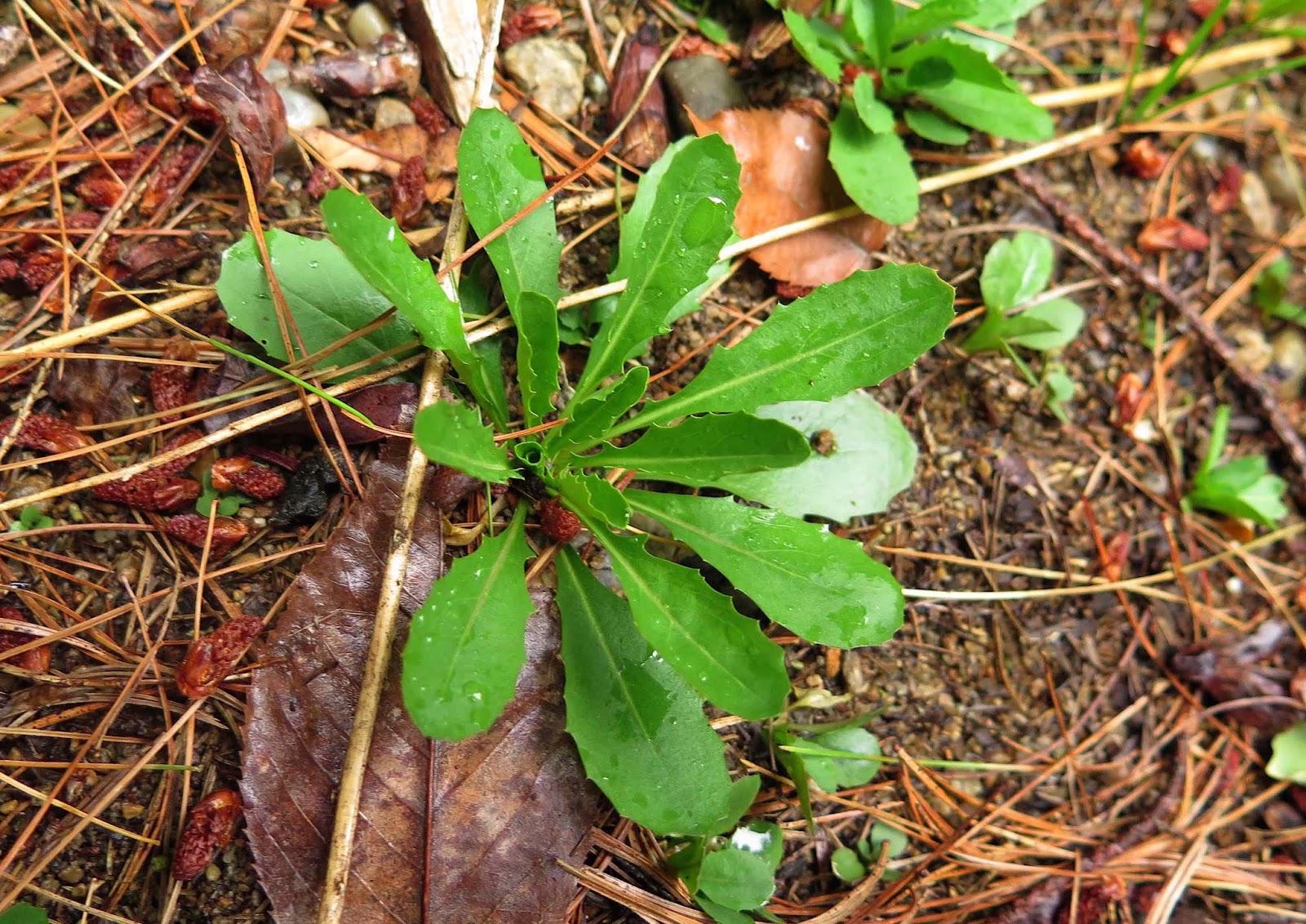
We also found many of the leafy rosettes, sprouted this year from last year's seeds, with the typical leaf-shape that distinguishes B. missouriensis from other, more common species.


Our search for Green Rock Cress at Moreau Lake was not an easy one, thanks to high water this year that has completely swamped the sandy shore, with the lake rising well into the shrubby thickets that line the east side of the lake.  Our progress along this shore offered a choice of pushing through rain-drenched shrubs and branchy blow-down, scrambling up the steep forested banks, or wading along in the water.  Obsessed botanizers as we are, we pushed on, hot in pursuit of this rare plant, and constantly surprised by finding more plants, just when we thought our population had petered out. We did, of course, come to a place where we spied no more plants, almost half way along that side of the lake. I guess it would be fair to say that Borodinia missouriensis is not a rare plant at this lake.


There is a second, even rarer plant that inhabits these same shores, a state-listed Endangered species (S1) called Whorled Mountain Mint (Pycnanthemum verticillatum var. verticillatum).  I'm sure that much of the large population of 273 plants Rich and I counted a few years ago is now under water. But happily, we found quite a few still present just where the water lapped the shore at the forest's edge.


And today, those plants were in bloom! (You have to look close to spy the tiny purple polka-dotted white florets.) As our legs brushed past the plants, we could detect the refreshing scent of mint on the air.


We were also granted a few moments' delight by the sight of this trio of Loons that swam close to shore.


UPDATE: An observant reader of this blog has pointed out the fishing lure dangling from the beak of the middle loon.  Let this be an admonishment to all anglers to please account for all their tackle and retrieve any barbed lures caught in tree branches or on fallen logs or in the mouths of fish tossed back after capture. I once had to free a frantic tiny Wood Duckling that was snagged in the bill by a lure that was dangling from an overhanging tree.  If you personally cannot retrieve such an object, please report it to someone who could.


After taking a break for lunch at a picnic area near the park's swimming beach (empty now, due to thunderstorm warnings), we next headed to the second site in Moreau Lake State Park where I'd found what I thought were Green Rock Cress. This site was along a powerline clearcut that lies just north of Mud Pond.  This site is far more sandy and sunlit than the forested site we explored in the morning. And when we got there, I sure  had a hard time detecting any remnants of them among the Sweet Fern and Scrub Oak that dominated the site.


Also, to dissuade my diligent searching, the rain that had been falling lightly began to come down in buckets.  But that didn't stop Rich, whose practiced eye quickly spotted plenty of the sought-after plants.  I forget exactly how many he found (30? 50?), but the smile on his rain-wet face indicates he had not been disappointed.


Sunday, July 14, 2019

A Week-ful of Wanderings

Just because I haven't posted a blog for a week, it doesn't mean I haven't been out wandering the woods and waterways.  On the contrary, I've been wandering so much and so far afield, I haven't had time to sit down and write, let alone edit the hundreds of photos of all the marvels I encountered.  If I posted all my photos, I  think I would use up all of my blogger allotment, so here are just a few of the highlights of my week-ful of wanderings.


Tuesday, July 9:  Whiteface Mountain


Yes, I know I was just up on the summit of Whiteface Mountain only about 10 days before.  But on that date (June 28), the wee little pyrola called Lesser Shinleaf (Pyrola minor) was still in tight bud, and darn it all, I just HAD to have a photo of it in bloom!  So up I went once more, again paying the $16 toll to drive to the summit, which is the only location in all of New York State that this Endangered species is currently known to grow.  Wildflower nut that I am, finding and photographing the flowers in bloom was worth the price of admission.


Granted, the lowest-growing globular florets don't look that much different from the globular buds still closed at the top of the stalk.  But that's what the florets of this particular species look like: short and round and with no protruding stamens.


Mission accomplished, I then looked around at some of the other changes since my visit in late June.  When I spotted this patch of Bearberry Willow (Salix uva-ursi), a low-growing dwarf willow of alpine habitats,  I had a quick delusion that snow had fallen on them (hey, snow falls on mountaintops late in the  year!).  But of course, it was only the willow catkins covered with the fluff that would carry the seeds on the wind.


On my previous visit, I'd found clumps of the grass-fine leaves of Mountain Sandwort (Mononeuria groenlandica) tucked in among the boulders.  They were studded with tight green buds at that time, but today they were starred with the small white flowers that inspired their common name.  This is another rare plant that thrives only in alpine habitats.


Wednesday, July 10: Valcour Island in Lake Champlain


Here are my boat-mates Ruth Brooks, Dan Spada, Gary Lee, and Nancy Slack, bouncing across the choppy waters of Lake Champlain as we head toward Valcour Island, a limestone underlaid paradise of rare plants that lies not far offshore.   Ruth is a fellow passionate plant enthusiast and a diligent student and documentarian of all the plants she finds; Dan is a retired resource analyst for the Adirondack Park Agency; Gary is a retired Forest Ranger from the Department of Environmental Conservation; and Nancy is a bryologist and former professor of ecology at the College of Russell Sage.

The folks on this foray, co-sponsored by the New York Flora Association and the Adirondack Botanical Society, represented a vast compendium of knowledge about New York flora.  That knowledge soon would be put to the test when we came upon the rather weedy-looking plant Steve Young, chief botanist with the New York Natural Heritage Program, is here keying out.  With modern technology, we can now carry all the information contained in the  comprehensive botanical tomes and manuals right at hand in our pockets!


As it turned out, this plant was certainly worth the pondering, since Steve was ultimately able to confidently assert that it was, indeed, the Endangered species Lactuca hirsuta (Tall Hairy Lettuce), an extremely rare plant that hadn't been reported from Valcour Island since 1965.  I wasn't in on the discussions about the plant's fine points, but I did learn that the brick-red opening flower petals were among its diagnostic features.


We found many other interesting plants on the island, but this False Indigo (Amorpha fruticosa) was among the few that were new to me.  I have toured this island twice before, but both times earlier in the year, so I would not then have seen these flower heads of a remarkable purple-blue color, beautifully in bloom on this day.


What a spot for a picnic, eh? And we couldn't have had a more beautiful day to enjoy the cooling breeze on the tree-lined shore of Valcour Island.


All around us there,  in the grassy verge that edged the rocky shore,  were  dozens of the small native orchid called Shining Ladies' Tresses (Spiranthes lucida), the lower petals of its tiny white florets streaked with golden yellow.


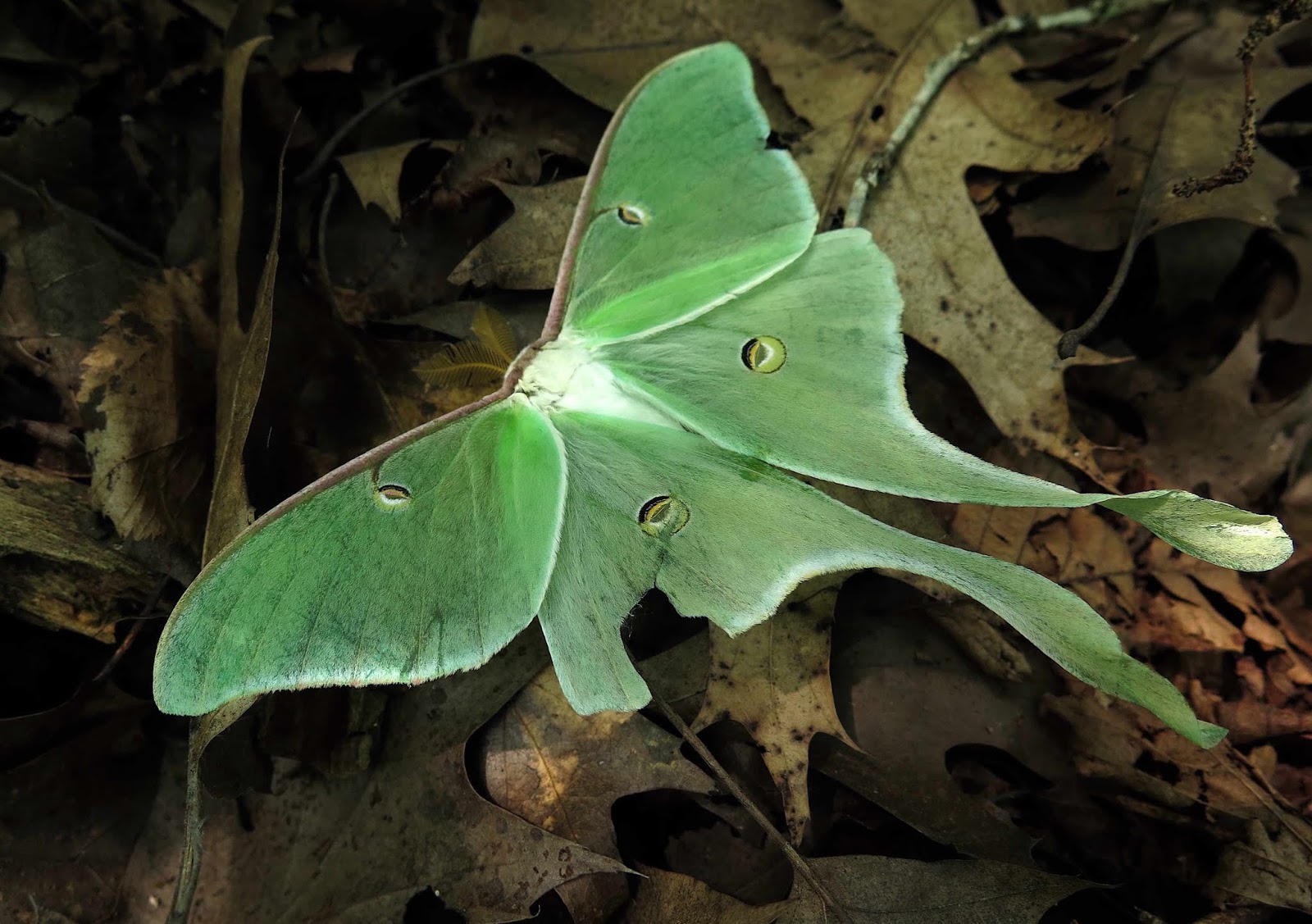
I did have a few distressing moments when I failed to notice my fellow botanizers leaving the trail to spread out to explore a swamp, and after I'd blithely continued on a bit, I found myself alone on the trail far from where I'd last seen my companions.  My momentary anxiety was relieved by the sight of this gorgeous Luna Moth resting on the leaf litter.  And of course, we all did find one another at last!


Thursday, July 11:  The Ice Meadows along the Hudson River in Warren County


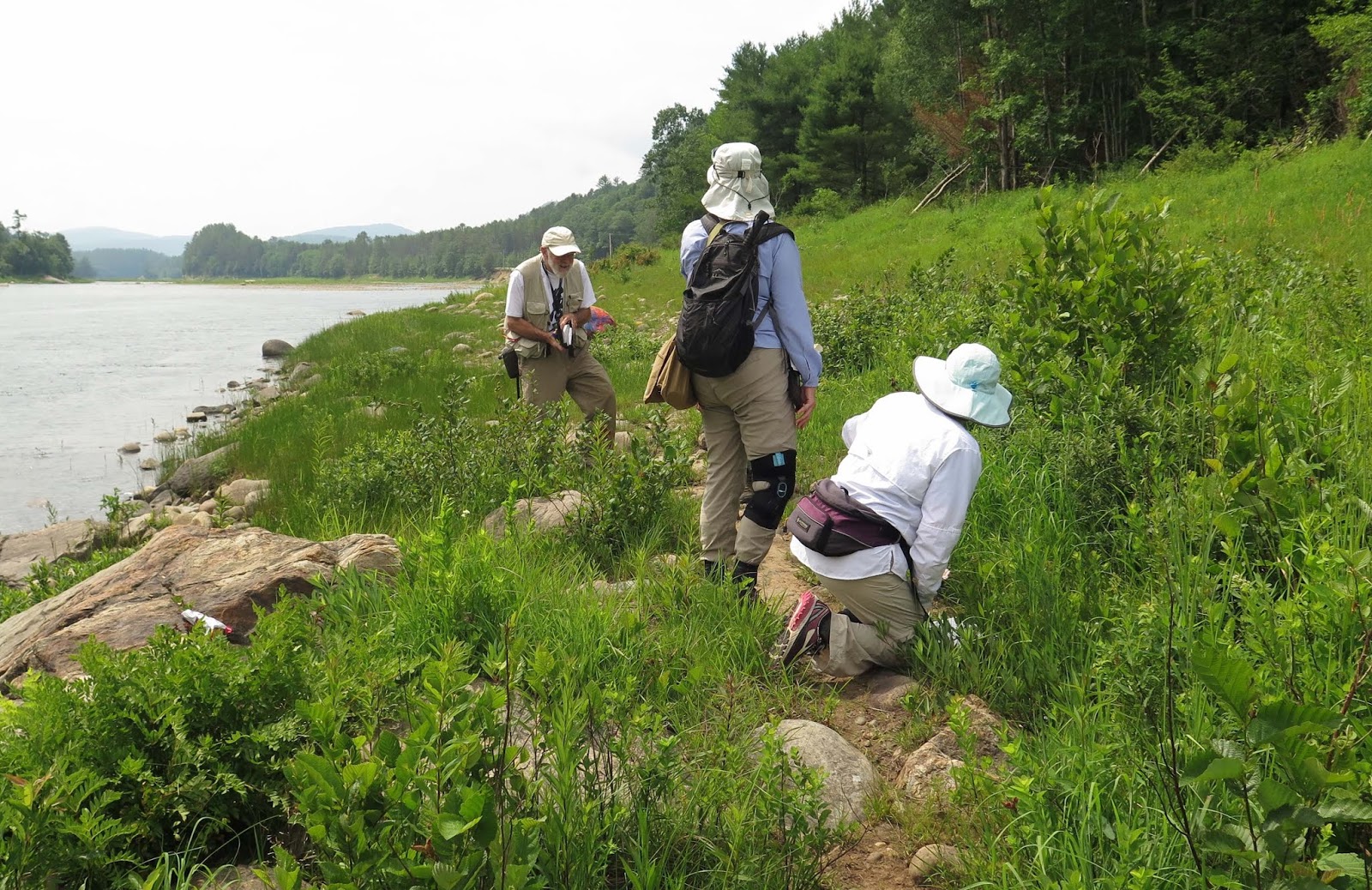
If there's any place in northeastern New York that could rival Valcour Island for the number and variety of rare plants that inhabit it, a stretch of Hudson River banks north of Warrensburg called the Ice Meadows would probably be it. During the winter, a special kind of ice called "frazil" piles up on these shores in impressive heaps, sometime to 12 or 15 feet or more.  Both the weight and the chilling effect of all that ice have created a habitat ideally suited for plants that have evolved to endure such harsh conditions.  Our group of plant enthusiasts called The Thursday Naturalists visits this site every year, and last Thursday was the day we did it.

We had barely cleared the forest and stepped out onto the sunny meadow when we saw masses of pretty pink orchids called Rose Pogonia (Pogonia ophioglossoides) starring the grass.  One of New York's prettiest orchids, it is also one of the commonest and easiest to find, since it can tolerate both acidic and basic conditions.  And this particular stretch of river bank, with its acidic rock that is watered by springs that deliver mineral-rich water to standing pools, offers both conditions.  So we find lots and lots of Rose Pogonia here.


Here's a closer look at the pretty pink Rose Pogonia.


Other orchids grow here too, including the Little Clubspur Orchid (Platanthera clavellata), which was almost ready to open its buds on the day we were here.  We did not find several other orchid species we've found here in the past (Tubercled Orchid, Smaller Purple-fringed Orchid, and Ragged Fringed Orchid).  Perhaps they had not yet come into bloom.


We did, however, find lots and lots of the wee little puffy-white blooms of Sticky Tofieldia (Triantha glutinosa), an Endangered species that has been reported from only 3 other counties in the state.


Many interesting grasses and sedges also grow happily here, with Buxbaum's Sedge (Carex buxbaumii), a Threatened species in New York,  probably being among the rarest of them.


We were just in time to find the carnivorous little sundews in bloom, both the Spatulate-leaved Sundew pictured here (Drosera intermedia), and the Round-leaved Sundew (D. rotundifolia), which had flowers a little bit smaller than these.  Both sundews attract insects to their sparkling leaves, which trap the insects with sticky fluid as the leaves curl over them and hold them in place for the plants to consume.


Masses of tiny white Large Cranberry flowers (Vaccinium macrocarpon) bloomed amid the boulders along the shore.


The lovely purple-flowered Harebell (Campanula rotundifolia) thrives here in this harsh habitat, despite its delicate appearance.


And if Harebells appear to be delicate, these tiny little Marsh Bellflowers (Campanula aparinoides) appear to be even more so, with their weak thread-like stems that allow the palest-blue flowers to collapse amid the surrounding vegetation.  The yellow flower here is Pale St. Johnswort (Hypericum ellipticum), a strange choice of a common name for a plant so vividly colored at many stages, bud, flower, and seedpod.


Here's another wee flower, Racemed Milkwort (Polygola polygama), one we probably never would notice if not for its vivid color.


And talk about vivid color! Our native Wood Lily (Lilium philadelphicum) is so showy, it's hard to believe it's a native wildflower and not some horticultural prize garden plant.  These flowers have already faded where I find them at Moreau, but here on the Ice Meadows they were still in their gorgeous glory.


Swamp Milkweed (Asclepias incarnata) was also in its glory this day along the Ice Meadows.  This is not a rare plant, but it's certainly a beautiful one, and looking even more lovely than ever, amid such a spectacular setting.


Here was a little treat for us as we wound up our visit to this amazing place.  Low nutrient soils caused by  seasonal flooding, plus suppression by heaps of winter ice, result in the dwarfing of most of the woody shrubs and trees out here, so the fruits of this Shadblow (Amelanchier sp.) were well within reach below our knees instead of dangling far over our heads. The colors of the berries were beautiful, and the flavor was delicious!


Friday and Saturday, July 12 & 13, the Hudson River at Moreau

I'm saving my photos from these two days, when I paddled the Hudson and bushwhacked a woods at Moreau, searching for Great St. John's Wort flowers (Hypericum ascyron ssp. pyramidatum).  I'm escorting a rare-plants monitor from the New York Natural Heritage Program to these sites next week, when he will assess two populations of this  flower that is classified as Rare in New York State.  Here's what it looks like, a great big beautiful flower:


While we're on the river, I hope this state botanist can confirm for me the name of this large showy Sundrops flower (possibly Oenothera pilosella) that I found while searching for the St. John's Wort. I've never seen it before in over 25 years of paddling this stretch of the Hudson.


I plan to be back next week with reports on these plants and others.