Wednesday, May 23, 2018

Overwhelming Botanical Bounty!

Frankly, I'm just overwhelmed by the floral bounty occurring now.  Each day of late I've been off to another marvelous botanical site, coming home with so many photos it takes me hours just to download them from my camera to my computer and file them appropriately.  Consequently, they haven't yet been posted on my blog.  And now, looking over the photos again, I notice that most are of green plants only, since we're in that transition period after the spring ephemerals have faded and the full flush of summer flowers has yet to bloom.  Sure, I could do a post comparing the distinctive leaves of each dogwood species, or explaining how to tell the difference between Solomon's Seal and Solomon's Plume, or distinguishing one fern or moss from another -- all subjects quite fascinating to me, but maybe not to others who aren't so botanically obsessed.  So instead, I've decided to cherry-pick from my photos those that are the prettiest or most interesting.  As well as just a few from each outing.

Joralemon Park, Thursday, May 17


I turned 76 years old this week.  I guess by anyone's definition, that makes me an old lady.  But whenever I'm wandering the woods with my friends in the Thursday Naturalists (some of whom are a good deal older than I am), I feel like a kid again.  And I believe my friends must feel that way too, for they sure seem to have a lot of fun, bringing an almost childlike wonder to what we find in nature.
They sure know of a lot of great places to botanize, too, and this past Thursday we visited a place that a state botanist once called the richest wildflower site in the entire state -- Joralemon Park, a limestone-rich area about 15 miles south of Albany.

I've been asked not to name some of the rarest plants in this preserve, for fear of attracting poachers, but I'm happy to share some of the unusual ones that are less rare, like these dangling clusters of American Bladdernut flowers (Staphylea trifolia).  These flowers will later produce the inflated three-lobed fruits that inspired the name of the shrub.


Walking Fern (Asplenium rhizophyllum), a single-leaved fern that travels by rooting new plants from its long narrow tips, is always a sign of a rich habitat.  Sure enough, we found masses of it growing on moss-covered limestone boulders.


Fragrant Sumac (Rhus aromatica) is one of the least commonly encountered members of its genus, but we found it growing on rocky cliffs overlooking a pond.  It's the leaves and stems, not the small yellow flowers, that inspired this low-growing sumac's specific name.  The leaves have a pleasant citrusy fragrance when crushed.


Rue Anemone (Thalictrum thalictroides) is not the most abundant flowering plant at Joralemon. That designation would have to go to the masses of Virginia Waterleaf that carpet the forest floor there but was not yet blooming at the time of our visit.  But Rue Anemone would have to be a close second. I found more of these snowy-white-flowered plants  here than I have ever seen anywhere else I've explored.


Rue Anemone may have been among the most abundant plants, but there was certainly no contest as to which was the most colorful:  the spectacularly scarlet Wild Columbine (Aquilegia canadensis) took that prize!  How lovely that Columbine appeared when mixed with carpets of Bluets (Houstonia caerulea) out on the rocky promontory where we sat to enjoy a picnic lunch overlooking a pond.


The Skidmore Woods, Saturday, May 19
Wild Columbine was also displaying its gorgeous red flowers when I led a small group on a walk through the woods at Skidmore College on Saturday. The day was chilly, and rain began before we ended our walk (which was sponsored by the local chapter of the Audubon Society), but the sight of these lovely flowers was our reward for braving the rain and the cold.


As I mentioned before, the early spring flowers had faded already, but the Sharp-leaved Hepaticas (Hepatica acutiloba) had replaced their flowers with bright-green new leaves and seed pods just as pretty as their flowers had been.


A few colorful new flowers had opened their blooms, such as this Wild Geranium (Geranium maculatum) that an airborne bee was arriving to investigate.


We missed the first full flush of Large-flowered White Trillium (Trillium grandiflorum) when masses of them were as white as their common name would indicate.  But we did find a few, including some whose once-snowy petals bore traces of pink as the flowers began to decline.


One flower just coming into bloom was the Wood Betony (Pedicularis  canadensis), whose fern-like leaves are nearly as ornamental as its flowers.


The Large-flowered and Sessile Bellworts that grow in the Skidmore woods had already gone to seed, but we found a small patch of Perfoliate Bellworts (Uvularia perfoliata) just opening their buds.  We even found one flower that had opened enough to reveal the dark-yellow interior granules that distinguish this species from the flowers of the other two bellworts.


Cole's Woods, Sunday, May 20

Cole's Woods is an extensive many-acred forest that lies right in the heart of the city of Glens Falls.  A network of trails, designed for competitive cross-country skiing in the winter, offers miles of nature walking when not covered with snow.  Right now, the snow is gone (at last!), and it's the snowy little orbs of Dwarf Ginseng flowers that line the trails in astonishing abundance.


Another lovely flower that abounds along these trails right now is Rose Twisted Stalk (Streptopus lanceolatus).  It would be easy to miss these pretty pink bell-shaped flowers, since they dangle on twisted pedicels below the leaves.  You have to lift the stalk to see them.


A spectacle not to be missed each May is the marvelous mix of snow-white Staflower (Lysimachia borealis) and vivid-purple Fringed Polygala (Polygala paucifolia) spangling the forest floor.


We found another lovely mix of flowers on a soggy log at the edge of a brook: The vivid purple Marsh Blue Violets (Viola cucullata) punctuated by a few bright-yellow blooms of Marsh Marigold (Caltha palustris).  Marsh Violets usually can be distinguished from a distance by the way the flowers are borne on long slender stems that hold the blooms well above the leaves.


We found several little American Toads hopping among the grasses beside the trail, but this one was kind enough to cling to some lichen-covered tree bark and sit quite still for the picture-taking.


This gorgeous Yellow Lady's Slipper (Cypripedium parviflorum) was not growing at Cole's Woods.  I found it growing along a road not far away from Glens Falls, in a spot where I've found numerous plants of this showy native orchid before.  I was much relieved to find them all still undisturbed this week, especially after discovering that the ones I used to find in the Skidmore woods appear to have been poached.  So sad, since the chances of any orchid surviving transplant to a garden are very slim.  I'm so grateful I know of a very few sites  in the wild where I can still enjoy the splendor of this beautiful flower.


Thursday, May 17, 2018

Here and There in Saratoga County

Oh my!  I've been hurrying around to so many places this week, and taking so many photos, I will never be able to write a full accounting of these forays nor post the photos of all the variety of plants and animals encountered on them.  So I'm just going to post some highlights here, in order to clear the deck for recounting further botanical adventures coming up.  I still have a hundred photos in my camera from a trip today to Joralemon Park, one of the richest wildflower sites in all the state, and on Saturday I'm scheduled to lead a wildflower walk in the Skidmore woods, a site that is almost as rich. So first, let's see just a sampling of the treasures I've already found so far this week.

On Tuesday I joined noted bryologist Nancy Slack and her bryophyte group on a trip to Stark's Knob near Schuylerville.  Stark's Knob is a huge heap of pillow basalt, a kind of volcanic rock that erupted up through what was once a seabed covering this region of North America over 400 million years ago.  The unique chemistry of this coal-black rock supports a number of interesting mosses and liverworts, and I'm still trying to learn the names of what we found there. At least I do know the name of this gorgeous wildflower, many dozens of which were growing right out of the basalt.  This is our native wildflower called Wild Columbine (Aquilegia canadensis), looking extra beautiful with the sun's rays causing the scarlet blooms to glow like Japanese lanterns.


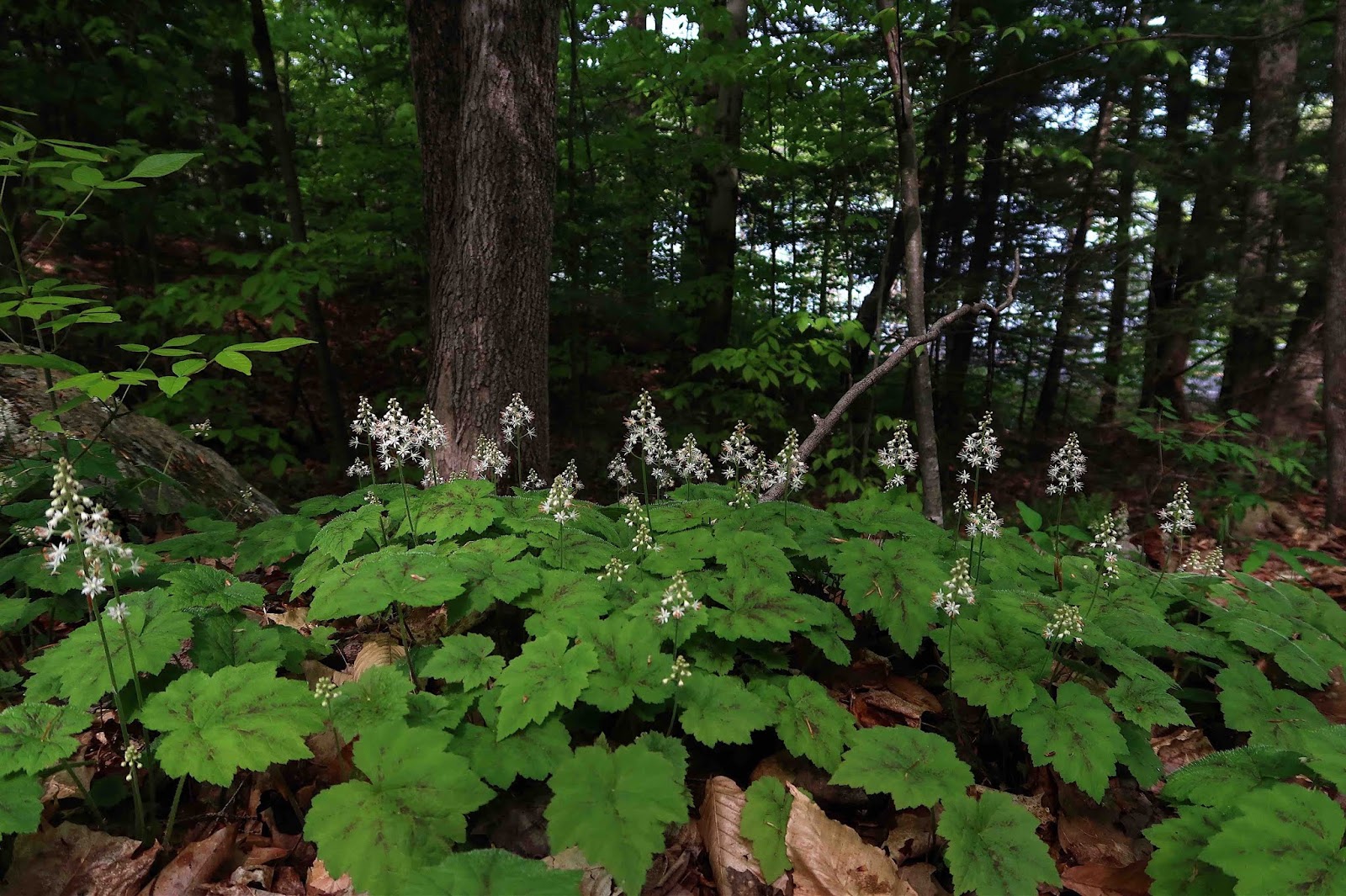
On Wednesday morning, the staff naturalist from Moreau Lake State Park, Gary Hill, asked if I would join his guided hike up to an overlook in the Palmertown Mountains, my purpose being to point out to his hiking group the wildflowers that grow along the trail.  Well, I know that Gary likes to hike faster than my arthritic knee could keep up with, so I volunteered to join his group for the first 50 yards of the trail, naming the amazing variety of flowers that grow along that short distance.  Luckily, some of those flowers -- like this beautiful mound of Foamflower (Tiarella cordifolia) -- were putting on a spectacular display.


The tiny little flowers called Bluets (Houstonia caerulea) were also looking their best, massed with their sky-blue faces turned skyward, echoing the sky's azure radiance in the grass.


Later on Wednesday, I joined fellow wildflower enthusiast Dan Wall to explore a small hidden swamp in the forest of Moreau Lake State Park.  A little more than a year ago, I had posted a photo on my blog of the seed pods of Early Coralroot (Corallorhiza trifida) in that swamp.  Dan, inspired by that post, determined to find this tiny native orchid there when it came into bloom. And oh boy, did he EVER!  He wrote to tell me he had found a dozen of them in this little swamp, where I had found only that single stem bearing seed pods. He graciously offered to show me his finds.  This is just one of the many we found blooming. Despite its diminutive size, there's no doubt that it's truly an orchid.


There were a few other flowers blooming on the sphagnum-covered fallen logs.  This dainty little violet -- Northern White Violet (Viola pallens) -- was one of them.  So pretty!  And also quite fragrant.


Look what else we found on those moss-covered fallen logs:  the vividly colored Red Eft.  So cute!  This is the juvenile terrestrial form of the aquatic Spotted Newt.  Efts will eventually head to the lakes, ponds, and pools and spend the rest of their lives as Newts in the water.  Even at this stage, they like a wet environment, and the cool damp mosses found in shady swamps like this are a favored habitat.


While waiting for Dan to join me at the swamp, I explored the sunnier, drier terrain at the swamp's edge and was delighted to find a number of Fringed Polygalas (Polygala paucifolia) scattered across the grass.  What a charming little wildflower!  Another name for it is Gaywings, a name that couldn't be more apt for a flower that looks like a wee little single-engine airplane, propellors awhirl.


Ooh, look what else I found!  The astoundingly furry Virginian Tiger Moth (Spilosoma virginica).


In case you were wondering how such a pure-white moth got the name "tiger," just lift a wing and you'll find the orange and black markings that might have inspired that name.  You also can see a bit of orange fur between the moth's front legs in the photo above.


Tuesday, May 15, 2018

Bog Meadow in Transition

I heard some news lately about Bog Meadow Brook Nature Trail that has me a little concerned. This two-mile wetland trail, which lies just east of the city of Saratoga Springs, is home to a number of wonderful flower species, some of which are considered to be vulnerable to exploitation or which appear to be disappearing from parts of their former range.  Because the trail is an old railroad bed, with the ties still embedded in the path, it's not the most comfortable trail to hike on, and bicycling is definitely unadvisable.  So the plan is to remove the railroad ties, widen and raise the trail, and give it a harder surface of crushed stone.  My concern is that these vulnerable plants do not get destroyed in the process.

I acknowledge there are problems with this trail. Surrounded by wetlands on both sides along its entire length, the trail is frequently flooded, or at least made quite muddy, especially when beavers block drainage with their dams.  The abundance of wetland plant species, like the Tussock Sedge  (Carex stricta) blooming in the photo below, surrounded by Skunk Cabbage, certainly testifies to the sogginess of the habitat through which Bog MeadowTrail runs.


And when beavers block the Bog Meadow Brook where it runs under this bridge (as this photo shows they have now), the waters can rise and sometime make the trail impassable.


Before the trail work begins, I wanted to check on the vulnerability of some of my favorite plants along the trail.  There are masses of Wood Anemone (Anemone quinquefolia) now blooming close to the edge of the trail, and they will probably be paved over by the proposed improvements, but this is a hardy species that will probably just move further under the woody shrubs that now line the trail.


I don't worry too much about the Wild Strawberries (Fragaria virginiana), either.  This is a plant that can certainly thrive in many otherwise inhospitable sites.


But I do worry about this single Rose Twisted Stalk (Streptopus lanceolatus), since I have found this lovely native species nowhere else in the county, at least to date.  At present, it is growing beneath the shrubby hedge that lines the trail, so I'm hoping it can persist there.  If the shrubby hedge is removed, however (and these shrubs are mostly invasive honeysuckle), it may not survive.  It's not an endangered or even rare species, but it tends to prefer cooler, more northerly regions of the state, and  I will miss its presence here if it has to go.  Until I reported this particular plant at Bog Meadow, there was no record of it growing in Saratoga County.


When I visited the Rose Twisted Stalk on Monday, the tiny pink bell-shaped flowers were just beginning to emerge from the buds that dangle beneath the leaves.


My special concern is for the population of Nodding Trillium (Trillium cernum) that abounds along isolated sections of the trail.  I was told by state botanists a few years ago that this species of trillium seems to be disappearing from much of its original range, so I have been vigilant to document its presence along Bog Meadow Trail.  Up to now, I was always pleased to find it thriving year after year, although not always in the same spot.  I was happy to find quite a few plants yesterday, but it does take some effort to discover them.  The whole plant tends to hide well under the shrubbery, and then it hides its nodding white flower beneath its large, wide leaves.  This cryptic behavior could be its protection from poachers, anyway. But if the trailside shrubs are removed when the trail is widened, I'm sure these trilliums will be destroyed in the process. I wonder what we could do to protect or preserve them.


Here's a peek at that nodding flower, showing the pinkish anthers suspended from the distinctive long filaments that distinguish this species from other white trilliums of our region.


There's one more species I'm concerned about, and that is Loesel's Twayblade (Liparis loeselii).  Again, this is not considered a rare plant in the state, but it is an orchid and thus is protected by law, as are all our native orchids.  Although it has been documented to exist elsewhere in Saratoga County, I have come across it only along Bog Meadow Brook Nature Trail.  The tiny greenish flowers are yet to bloom this year, but I know where to find it because of its pale-colored seed pods.  Here's a photo of it in bloom last summer, its flower stalk dwarfed by the larger stalk of seed pods.


At present, the Loesel's Twayblade is located just off the trail, close to the edge of a brook and hidden in summer among other taller green plants.  But will it still be safe in its hiding place when the trail is widened and minerals from the crushed-stone paving leach into its habitat, perhaps changing the soil chemistry?  I guess I can only hope so.  My worry is that most of the folks who enjoy Bog Meadow Brook Nature Trail do so for athletic exercise or birding or just generally enjoying a walk in the woods, without really caring about what native plants grow along the trail.  Chances are good that most have never seen such hidden flowers as Rose Twisted Stalk, Nodding Trillium, or Loesel's Twayblade anyway.  So why should they care about them?  Since I do, I guess I have to speak up and try to be their champion.

Saturday, May 12, 2018

A Roadside Rock Garden and Woodland Blooms


I was driving along Spier Falls Road this week, where the road runs close to the river, and mountains rise abruptly from the edge of the road.  What a beautiful sight I beheld!  Here, on these massive roadside boulders, where tiny springs constantly water the rocks, a veritable garden of lovely spring flowers has sprung from every ledge.

The predominant plant that populates these rocks is Early Saxifrage (Micranthes virginiensis), a beautiful little flower with a most appropriate name.  Saxifrage literally means "rock splitter."  But I wonder if the splits in the rocks came first, allowing the plants to find a home within the cracks and crannies.  Their crowded clusters of dainty white flowers almost look like drifts of mist among the dark rocks.


Or did the mosses come first?  I have to wonder, since wherever I see the clusters of Saxifrage, I also see cushions of moss.


A number of moss species grow on these rocks, but the one that predominates in the well-watered spots is the spiky bright-green moss called Fountain Moss (Philonotis fontana).


A few other flowers have found these rocks to their liking, too, including these sky-blue miniatures, appropriately called Bluets (Houstonia caerulea).


Here and there, branches of Round-leaved Gooseberry (Ribes rotundifolium) lean out from within the boulders and dangle clusters of long-anthered, pink-petaled flowers.


After admiring the beauty of this rock garden, I wandered off into the nearby woods and came upon several Hobblebush shrubs (Viburnum lantanoides), their enormous clusters of blooms a startling white in the dark of the forest.  The big white sterile flowers of the outer circle offer no reward to pollinators, but their very size and brightness attract those insects to come and feast on the tiny pollen-producing florets in the center.


Oh!  Yes!  Here is the treasure I always hope to find in these woods, and in many years I don't.  But this year I did!  A whole bunch of Painted Trillium (Trillium undulatum), blooming quite a bit earlier than I would expect to see them. 


Here was a final treat, and quite unexpected, at that:  another congregation of Early Saxifrage, growing out of a moss-covered rock along the banks of a forested stream.  I would have thought the shade in these woods was way too dense for their liking.  What a pretty surprise!


Friday, May 11, 2018

A Bounty of Blooms at Bog Meadow

As the warm weather continues, I've been running all over the county, trying to greet -- before they disappear -- the flowers that came into bloom during my absence.  It's not for nothing they're called spring ephemerals!  On yet another gorgeous shirt-sleeve warm day yesterday, I did a quick tour of parts of the Bog Meadow Brook Nature Trail, entering the trail through the Meadowbrook Estates spur.  This part of the trail leads down a steep slope from upland woods to a boardwalk that crosses a wetland full of Skunk Cabbage, native ferns,  and other plants that prefer a damp habitat.


Two species of Horsetail (Equisetum spp.) share this habitat with many other wetland-loving plants without dominating the vegetation the way some other species of Equisetum do.  I was lucky to catch both the fertile (brown) and sterile (green) early shoots of Field Horsetail (E. arvense) together in one easily photographed location.  The fertile stalks bear spores in those cone-like growths that top their segmented stems, and once the spores ripen and are shed, these stalks will wither away and disappear completely.  The small green sterile plants will continue to grow taller and spread their branches wide, photosynthesizing throughout the growing season.


Nearby was a second species of Horsetail, the Woodland Horsetail (E. sylvaticum), distinguished by the way its whorls of leaves are multi-branched.  Another distinctive feature of this species is that it bears its fertile cones (called strobili) atop green sterile stalks, rather than on separate stalks. These cones will fall off, once the spores have been dispersed, and the branching whorls will grow longer, presenting a very lacy appearance when the plant is mature.


The trail at this point leads directly toward an open swamp, which today was a field of gold, with thousands of clumps of Marsh Marigold (Caltha palustris) loaded with bright-yellow blooms.


Here's a closer look at those gorgeously colorful blooms:


Sharing the shallow standing water with those masses of Marsh Marigold were mats of tiny green leaves.  Seeing how thickly they covered the mud, it's easy to understand how this wetland plant called Golden Saxifrage (Chrysosplenium americanum) earned its other common name of Water Carpet.


What I don't understand is what inspired the "golden" part of its common name. (Or the chrysosplenium part of its scientific name.)  A close look at its miniature flowers reveals some red dots that I believe are its staminate parts.  A bit later, some tiny yellow dots -- the pistillate parts -- will also appear, but they will be virtually invisible to standing-height onlookers and not lend a golden color to the plant mass as a whole.  Hmmmm.


Back on the trail, an old railroad right-of-way still underlaid with railroad ties,  I walked along a tiny stream that closely follows the trail for much of its distance.  I was grateful for the watercourse behind these stems of Miterwort (Mitella diphylla),  which allowed the tiny fringe-petaled flowers to stand out against the dark water.


That same dark water provided a similar favor to the flowers of Toothwort (Cardamine diphylla) growing along its bank.


When I walked in the Skidmore woods earlier this week, all the Trout Lilies (Erythronium americanum) there were withered and gone, but here in the woods along Bog Meadow Trail, these beautiful yellow lilies were still in their glory.


I was grateful I hadn't missed the bloom-time of the lovely Goldthread (Coptis trifolia), which is usually among our earliest bloomers. There've been other years when I've missed its brief appearance entirely, but today there were multitudes spangling the edge of the trail like stars in the sky, backed by their glossy evergreen leaves.


Another plant that was offering a trailside bounty was Dog Violet (Viola labradorica [formerly conspersa]), blooming abundantly in colorful numbers.


Without a closer look, it would be easy to confuse this violet with the Common Blue Violet, but Dog Violet bears its leaves on its flower stems, while the Common Blue has basal leaves only.  Another distinguishing feature is the presence of sharply toothed stipules surrounding the leaf nodes on the Dog Violet.  This feature has proved a helpful mnemonic for me: sharp teeth suggest "canines," which in turn suggest "dog."   Hey, whatever works!  Violets are so confusing, we need all the help we can get to accurately identify and remember them.


Another abundant floral display:  the tiny white blooms of Northern White Violet  (Viola pallens) dotting a hummock of Tussock Sedge within a trailside pool.  We have another small white violet that is virtually indistinguishable by folks like me, except that I know this particular violet likes it wet, while the other one likes it dry. (And it blooms a bit later.  Usually.)


Here's a closer look at one of those violets, displaying the wide, nearly round shape of its leaves.  Another distinguishing feature, I've been told.


The most colorful violet of the day was saved for last.  As I made my way down a sunny, sandy bank toward my car, I was greeted by the deep-purple blooms of Ovate-leaved Violet (Viola sagittata var. ovata).   Despite its wooly leaves and stems that could protect it from cold, this is a violet that likes it hot and dry. Such a lovely flower, with blooms that are bigger than its leaves, at least when it first emerges.  I'm glad I didn't miss seeing it.