Monday, June 19, 2017

Plants Along the Powerline

 Again, not the nicest day for a walk, with thunder rumbling and big drops splashing against my windshield as I made my way to a powerline clearcut along Spier Falls Road at Moreau.  So I parked my car close to where I hoped to find Greenish-flowered Pyrola (Pyrola chlorantha) among the mosses and pine needles under the wires.  In other years, this is where I had found some, but always a little worse for wear, so this year I hoped to find it in its prime.  And I was not disappointed.


Greenish-flowered Pyrola is not a rare plant in New York, but I find it much less often than I do the white-flowered species of Pyrola called Shinleaf.  So I was glad to have found a reliable location where I can revisit this native wildflower every year.  And this year, it was looking better than I had seen it before.


The reproductive parts of Pyrolas are quite distinctive, with a long curving style that extends way below the corolla, surrounded by ten stamens that appear to split into two yellow anthers at the tip of each.


I'm glad I was able to photograph the Pyrolas before the clouds opened up to dump drenching buckets on me and my camera.  I did manage to sneak my camera out of my raincoat pocket to take a few more photos of other plants under the powerline.  Masses of Whorled Loosestrife plants (Lysimachia quadrifolia) held their wreaths of small red-centered yellow flowers on thread-fine stalks.


Patches of brilliant-pink Maiden Pinks (Dianthus deltoides) spangled the grass at the edge of the road.  Although this is not a wildflower native to North America, it's hard not to welcome its vivid blooms to these neglected areas of disturbed soil.


It won't be long before bright-orange Wood Lilies (Lilium philadelphicum) open their big gorgeous blooms under the powerlines.  I found just this one plant in bud today, but that doesn't mean there aren't many more hiding among the grasses.  I confess I was getting so soaked at this point, I didn't search very hard for more.


I did stop as I hurried to my car, though, to admire how each leaf of this Wild Lupine plant (Lupinus perennis) held a diamond drop at its center.


Friday, June 16, 2017

A Wet Walk to a Rare Wild Orchid

 No, it wasn't the nicest day for a hike: it was cold and it was WET!  It was raining steadily, in fact, when Lucy Marsac (tan rainsuit), Bonnie Vicki (green parka), and I set out through the Adirondack forest, and it only poured harder the further we went.  So what would induce three perfectly sane ladies-of-a-certain-age to challenge our already aching joints on a slippery, rugged trail in a drenching downpour?  Well, one of the rarest orchids in all New York State was probably blooming way back in those woods, and by gum, we were going to SEE it!

But it wasn't going to be a walk in the park.  Beavers had been mighty busy since the last time we passed this way, and the trail now lay well under water in spots.  Hmm, we wondered:  will that dam hold us if we try to teeter across it?


We were in luck!  It did!


And we also managed to keep from slipping on moss-covered stepping stones -- not so easy with clouds of mosquitoes swarming around our faces and biting our hands.


Ah, but all that effort and clammy discomfort was certainly worth it!  Here was the treasure we'd come to seek, and it was in perfect bloom:  the Hooker's Orchid (Platanthera hookeri), one of the rarest flowers in all of New York.  The last I heard, there were only 5 specimens of this orchid known to exist in the entire state, and 3 of them grew right here between our knees.  Just one was blooming this year, but its florets were wide open from bottom to top.  (We also found the leaves of a 4th Hooker's Orchid nearby.)


Bonnie moves in for a few more shots, and Bonnie deserves to take all she wants.  It was she, after all, along with our mutual pal Evelyn Greene, who first discovered these orchids along this trail some 22 years ago, although at the first encounter, the flowers were not in bloom.  Bonnie told me they couldn't identify it right away, but when Bonnie returned to find it in bloom and keyed the flowers out as being those of Platanthera hookeri, she and Evelyn could hardly believe it.  Here was one of the rarest flowers of New York, and they had just stumbled upon it.


Unfortunately, the spot where they found the Hooker's Orchids lay smack-dab in the middle of a  state snowmobile trail, a trail that was often illegally used by ground-ripping all-terrain vehicles as well as snowmobiles.  Thanks to Evelyn's pleas to the state conservation folks, the trail was eventually re-routed and the orchid's safety preserved.  Now, only a handful of people know how to find this original trail, and I happen to be lucky enough to be friends with some of them.  So I get to see these orchids, too.


The orchids are actually not that easy to see, being green in a world of green.  But as hard as they are for my eyes to pick out, my camera lens has an even harder time focusing on the flowers.  It always helps to put something dark behind them.  Thanks, Bonnie, for letting me use your rainpants as a backdrop.


My hand worked as a backdrop, too, for allowing my camera to show me the floret's interior, complete with its golden-colored pollen bundles (pollinia).  Those pollen bundles are strung on a thread strategically placed to catch on the legs of a pollinator, who will carry that pollen away to any neighboring Hooker's Orchid blooms.  Sadly, however, these Hooker's Orchids have no near neighbors to pollinate, so the tribe will be very, very slow to increase.  There's been no sign of any new plants nearby since these four were discovered more than 20 years ago.


Of course, we saw other flowers in bloom along the trail, including ample patches of the little dwarf dogwood called Bunchberry.  Bunchberry used to be called by the perfectly easy-to-remember scientific name, Cornus canadensis, but now some plant taxonomists have assigned it a new, unpronounceable one: Chamaepericlymenum canadense.  I was glad to see that our New York State Flora Association still lists Cornus as the accepted name.  At least for now.


We were very surprised to find Pink Lady's Slippers (Cypripedium acaule) still in beautiful bloom.  And we saw quite a number of them.


We also found many clumps of the pretty green three-parted leaves of White Wood Sorrel (Oxalis montana), but very few with open flowers or even buds.  But here was one, with just a few of the rose-striped white flowers struggling to open despite the chill and the rain.


Eventually, the rain stopped.  And it stopped just in time for us to visit this quintessential Adirondack pond. Here we sat, not only to enjoy the lovely view and our picnic lunches,  but also to delight in recalling our incredible good fortune at seeing that rare Hooker's Orchid.


Two Butterflies, But One Species

While walking a sun-warmed country road yesterday, I noticed two beautiful butterflies wafting by, and they danced and weaved in the air as if they were courting each other.  But how could that be, I wondered, since they seemed to be two different species:  one was iridescent purple with pronounced red spots, and the other appeared from afar to be all black with broad white bands on all four wings. Then, bless their hearts, they both came to rest not far from my feet, spread their lovely wings, and stayed right there for their portraits.  Now I could get a good long look at them and search on-line to identify their species.  And guess what?  They ARE the same species!  The same polytypic species, that is: Limenitis arthemis.

They do have different common names, however.  The purple one with red spots is called the Red-spotted Purple (L. arthemis astyanax).


And the dark one with broad white bands is called the White Admiral (L. arthemis arthemis).  A closer look at this one reveals some iridescence as well as bright-blue and faint-red spots that correspond to those on the Red-spotted Purple.


So maybe they WERE doing a courting dance along that country road.  They certainly were well-matched for beauty.  I wonder:  if they DO get together, what will their children look like?

Thursday, June 15, 2017

To the Ice Meadows, Once Again!

My friends and I in the Thursday Naturalists could not have had a more beautiful day than today to return to the Ice Meadows for our annual plant pilgrimage.  This stretch of Hudson River bank north of Warrensburg is known far and wide as a place for rare and unusual plants, a habitat maintained by heaps of ice that pile up on these banks to prodigious heights each winter. That's how this area gets the name Ice Meadows.   It takes nearly to June for all of that ice to finally melt, after which the gravelly shores explode with flowering plants that are particularly suited to these harsh conditions. So as we came down through the woods to the sunny shore, we were prepared to be delighted.

The first flowers to greet us were tall stalks of what looked to be wild strawberry flowers on steroids: Tall Cinquefoil (Drymocallis arguta).  Although this is not a rare plant in New York, I hardly ever see it anywhere other than the Ice Meadows, and I understand that it is rare in many surrounding states.


The sunny shore was brightened even more by the bright-yellow flowers of Frostweed (Crocanthemum canadense).


I'm always surprised to find such a delicate-appearing flower as Harebell (Campanula rotundifolia) thriving out here among the rocks in this barren soil.


I recognize Tall Thimbleweed (Anemone virginiana) by its long stems (not evident in this photo, I realize), but also by the points on its petals and the profusion of green fluffy anthers at its center.


This little cinquefoil was sprawling all over the sand among the rocks, and a close examination revealed that its leaves were serrated from the middle only, leading me to identify this as a Dwarf Cinquefoil (Potentilla canadensis).


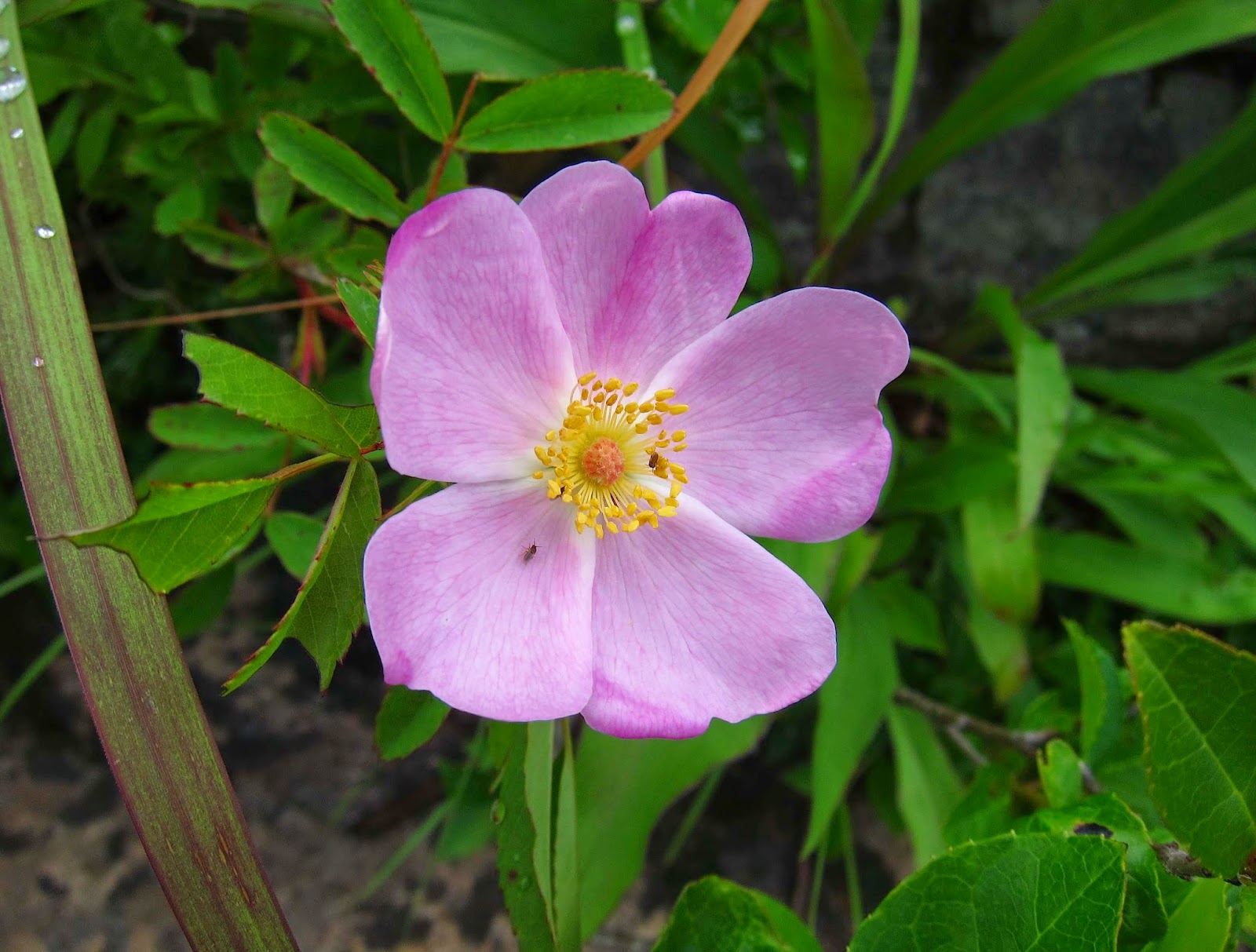
No one would mistake this sweetly fragrant flower for any thing but a wild rose, but more knowledgable folks than I have told me that this is a Carolina Rose (Rosa carolina), to be exact. I personally did not examine it to see if its thorns were slender and straight, or if its stipules were narrow, two of the Carolina Rose's diagnostic characteristics.


There were lots and lots of these two flowers scattered across the shore and nestling among the shoreline rocks:  the bright-yellow Small Sundrops (Oenothera perennis) and the dainty blue Bluets (Houstonia caerulea)
.


After thoroughly exploring the flat, dry, sandy and gravelly shoreline, we headed upstream to where running springs gather in little pools among shrub-lined boulders, expecting to find a different kind of flora inhabiting this more well-watered habitat.


We found many tufts of Spatulate Sundew (Drosera intermedia) clinging to boulders at the edge of little pools.  Sundews trap insects with those sticky hairs, then fold them into their leaves to digest them.  I can see the remains of one unfortunate insect's wings still stuck to the leaves.


We also found the Round-leaved Sundew (Drosera rotundifolia), although less frequently.  This plant uses the same strategy to trap and consume insect prey.


Many of the flowering shrubs surrounding the spring-fed pools were bearing blossoms today.  These small yellow trumpets belong to our native Bush Honeysuckle (Diervilla lonicera).


Most of the woody shrubs that grow out on the Ice Meadows are considerably dwarfed by the enormous weight of winter's ice.  This Winterberry shrub (Ilex verticillata) is obviously mature enough to bloom, and yet it barely reached my shin in height.


We found both the male and the female flowers of Carrion Flower (Smilax herbacea) growing among the rocks.  Here are the tiny anthers of the male flower cluster, releasing the stench this flower is famous for.  We may not like the smell, but it sure does attract the pollinating flies!


The pistillate flowers of the female Carrion Flower also reek, and also draw pollinators to their smell, ideally those that are dusted with pollen from having visited the male flowers not far away.


There are numerous species of grasses, sedges, and rushes that thrive on the Ice Meadows, some of them found in few other places in the state.  The Alpine Bulrush (Tricophorum alpinum) that flourishes in the damp soils around the pools may not be rare, but it certainly is remarkable looking, with those wild white "hairdos" appearing to blow in the wind!


We found a number of other plants today that I did not take photos of, but I had to go back into my photo files to find images of some of the rare beauties we did NOT find today, much to our disappointment.  I guess those weeks of rainy cold have delayed some of our favorite flowers, such as Sticky Tofieldia (Triantha glutinosa), a threatened species in New York that we have formerly found growing here so profusely, we had to watch where we stepped.  We did find some leaves and tiny buds, but nothing that looked like this:


Nor did we find any sign of this gorgeous little orchid, Rose Pogonia (Pogonia ophioglossoides), that usually thrives by the dozens on the Ice Meadows by mid-June.


Not a trace, either, did we find of the yellow-lipped Shining Ladies' Tresses (Spiranthes lucida), another of the several native orchids that we normally find on our early-summer pilgrimages to this special place.  I guess if we want to see them here this year, we're going to have to return in a couple of weeks.


Same goes for the Tubercled Orchids (Platanthera flava var. herbiola) we found no trace of as yet.


Was I disappointed to miss these flowers?  Well, sure, a little, but I can come back. Or wait until next year.   I felt most of my disappointment for my dear friend Ed Miller, who so looks forward to sharing these rare beauties with our group when we visit here, arranging to time our visits for maximum flowering plants.  He's having some issues with his eyes right now that will limit his driving for a while, and heck, now that Ed is 92 years old, I expect he likes to make the most of each day remaining to him.  Which he did today.  I hope that if I ever make it to 92-plus, I'll still be able to scramble over boulders the way Ed does, full of eager excitement over what treasures may be found.


Wednesday, June 14, 2017

What Is So Rare . . . ?

Ahh!  This is more like it! Today was that kind of June day the poet wrote about as being so rare:  neither cold and rainy nor hot and humid,  but simply perfect!  The air was light and dry, cool in the shade and warm in the sun, with just enough breeze to set the surface of the lake to sparkling.   What a lovely day, too, for ascending Mount McGregor in Wilton and gazing for miles and miles away from atop the mountain's overlook.


I had come up here today to meet with the folks at the Ulysses S. Grant Cottage, the New York State historic site where President Grant spent his last days, struggling to complete his memoirs before he died, so his family would have some income after his death. (No pensions for U. S. Presidents back then!)  This is a moving and fascinating site, offering informative tours of the cottage during the warm months, as well as a series of programs on a variety of topics, mostly to do with American history.  But this coming July 1, I will be offering a photo presentation on the wildflowers of the surrounding mountains, followed by a wildflower walk around the grounds.  So today, I thought I'd come up here to see what wildflowers might be blooming.


As it happened, most of the wildflowers blooming near the cottage today were not native plants, but rather the kind of introduced species we would expect to find at long-disturbed sites: hawkweeds and speedwells and daisies and clovers, and so forth.  But at least one of those clovers was one I had never seen before, and in fact was one I needed to collect for the Saratoga County plant atlas:  the Small Hop Clover (Trifolium dubium).  It was the smallest yellow clover I had ever seen, but very visible, because generous carpets of it covered the sloping open areas where we stood to enjoy the beautiful view from the Mt. McGregor overlook.


My scouting mission at Mt. McGregor completed, I continued on up U.S. 9 to Moreau Lake State Park, where I set off to enjoy a walk around the back bay of the lake.  The lake lay calm under that clear blue sky, its shoreline decorated with stands of our perfectly beautiful native Wild Blue Flag (Iris versicolor).


Just as blue as that radiant sky were the tiny flowers of our native Smaller Forget-me-nots (Myosotis laxa), spread in vast numbers across the damp sand near the water.


Such a wee wonderful flower, barely an eighth of an inch across!  Wouldn't it make a sweet bouquet for a dollhouse?


The north end of Moreau Lake's back bay has a sunny, sandy beach that my friend Sue calls "The Odonota Shore" for the crowds of dragonflies and damselflies that always dart and dash through the tall grasses and shoreline reeds along this part of the lake.  And they were certainly darting and dashing today!  A constant flash and flutter and thrumming whirr of glittering wings!


But all those darting and dashing dragons and damsels do come to rest from time to time.  In this case, they came to rest en masse:  a whole log full of Chalk-fronted Corporals!


Not many of the dragonflies, though, would come to rest long enough for me to grab their photos.  But here's one that did:  a handsome male Twelve-spotted Skimmer.


And here's another:  the brilliant-green female Eastern Pondhawk, resting momentarily on the sand.  Her powder-blue mate was dashing about, refusing to sit for his portrait.


I almost stepped on these pretty little Racemed Milkworts (Polygala polygama), so small I could barely see them sprawling across the sand.


What they lack in size, they certainly do make up for in brilliant color!  Here's a closer look.


I had to wade out into the water to take a photo of this one:  Water Smartweed (Persicaria amphibia).
That little bunch of tiny pink florets will enlarge as the summer goes on, and although these were floating out in a foot or so of water, sometimes I find them growing on wet land as well (true to their specific epithet!).  But on this gorgeous day of sweet warmth, I was quite happy to wade on out to say hello to one of our prettiest flowers of summer.