Oh my gosh! I had no idea when I went to bed last night that I'd wake up this morning to a snowy world outside. And quite a bit of snow, too, enough to cling to every branch and twig of this crabapple tree in Congress Park in downtown Saratoga Springs.
It was such a gorgeous sunny day yesterday, it sure didn't feel as if snow would move in overnight. Here was the serene sunlit view of Lake Bonita in Moreau Lake State Park, where I went for a walk yesterday afternoon.
I hadn't visited this recently acquired park property in over a month, and I was surprised to discover a new trail had been marked and groomed, the trail leading away from the dam at the northwest end of the lake and following a stream into the woods.
I followed this new trail while it kept to the stream, delighting in the little waterfalls that tumbled down the rocky watercourse. But soon the trail angled off to go deeper into the woods. I will have to ask the park staff where this new trail leads to, doubtless to connect with the network of trails that offer miles of hiking throughout the park's magnificent wooded and mountainous terrain. But I wanted to walk around the lake today, so I turned back to return to the shore.
Crews of volunteers and park staff have cleared and marked trails that completely surround the lake, passing through dense woods as well as moving close to the shore for lakeside views.
Although boating is not permitted on Lake Bonita, I was fortunate to have been granted permission to paddle out to these little boggy islands this past summer, charged by Moreau Lake State Park to document the plants that grow on them. They are covered with numerous plants that are usually found only in bogs, such as Pitcher Plants, Sundew, Small Cranberry, and Rose Pogonia orchids. The Low Blueberry, Leatherleaf, Sweet Gale, and Sheep Laurel shrubs that grow there add some ruddy color from their leaves and branches even this late in the year.
These Winterberry shrubs added bright spots of color to the sunlit shore.
As I approached the east end of the lake, I made my way out onto some boulders that line the shore here, and I sat to contemplate this scene of quiet beauty. The little stone building at the far end of the lake is the only man-made structure along the shore. It houses the pump that once provided water to the state prison that occupied these lands until just a few years ago.
While perched on the lakeside boulders, I noticed numerous tufts of Pale Corydalis plants nestled into the rocks, along with the red-budded twigs of Low Blueberry.
The lake appeared simply exquisite as the blue of the sky intensified and the lowering sun touched the tops of the trees with gold, all perfectly reflected in the mirroring water. I could have sat there for quite a bit longer, just breathing the cold sweet air and resting in the utter silence. But I knew I'd better get moving toward home, since darkness falls early these afternoons so close to Winter Solstice. The sun was already resting on the ground as I made my way back to my car along the old service road.
How amazing to wake up today to an entirely different kind of beauty!
For more than thirty years I've been wandering the woods and waterways of Saratoga County, New York, and regions nearby, looking closely, listening carefully, and recording what I experience. We are blessed in this region with an amazing amount of wilderness right at hand. With this blog I share my year-round adventures here, seeking out what wonders await in my own Madagascar close to home.
Monday, December 5, 2016
Saturday, December 3, 2016
The Thursday Naturalists Visit Victory Wood
Ever since I fell and shattered my kneecap a year and a half ago, I find myself seeking excuses to not get out for hikes or climbs, because, yeah, my knee still hurts. But then I think of my pals in the Thursday Naturalists, who get out there week after week, despite advancing age and various ailments. For instance, how could I let my friend Ed Miller, now 92, be more active than I, at the relatively young age of 74? So here I am following him onto the trail called Victory Wood in Schuylerville this past Thursday.
Actually, I had previewed this trail the week before, on a much sunnier day, when I took this photo of the Saratoga Battle Monument, honoring the victory of American troops against the British at the Battle of Saratoga in 1777, a turning point in the Revolutionary War. This monument marks the entry point for the Victory Wood Trail, and both the monument and the trail are part of the Saratoga National Historical Park, which includes the Saratoga Battlefield some eight miles to the south of this location.
Access to the Victory Wood Trail begins in the Prospect Hill Cemetery, which is adjacent to the monument. A large sign here reminds us of the history of this special place.
Here, on a cloudy wind-chilled day this past week, our friends in the Thursday Naturalists gathered in the cemetery before entering the woods.
Of course, being naturalists, we had to halt in our progress toward the woods to examine the lichens thriving on this gravestone.
We also paused at this grave, hoping its inhabitant had found happier times in the afterlife. (And also hoping no one would ever mark our graves like this!)
The trail through the woods is remarkably accessible to people of all abilities, with long stretches of boardwalk and stone paths hard enough for rolling a wheelchair. There is even a separate handicapped-designated parking lot offering direct wheelchair access to the trail, as well as several benches situated along the way. Also situated along the trail are a number of large signs explaining the historical importance of this location, the first of which our friends are examining here.
The trail proceeds through a mixed hardwood forest and past a small pond, its water afloat with bright-green duckweed and its shoreline thick with the red-fruited shrubs of Winterberry.
Another sign describes the importance of this location to native peoples long before the Europeans arrived on this continent.
A procession of signs describes the sufferings of the defeated British soldiers and their Loyalist supporters, who retreated to this location following their defeat in the Battle of Saratoga.
This series of signs certainly helped us understand and honor the history that had happened here. But naturalists being naturalists, we were often lured from the trail to examine some natural phenomena. Ed was particularly interested in the fungus growing on this Hop Hornbeam tree, an accumulation of small pinkish disks that he told us will usually be found only on Hop Hornbeam trees (Ostrya virginiana), although it can sometimes occur on oak or elm as well.
Almost the entire trunk was peppered with the fungus called Hophornbeam Disc (Aleurodiscus oakesii), a more massive accumulation, Ed told us, than he had ever seen before.
Ed also found more fungi thriving on this enormous stump, the size of which indicates it could well have stood here at the very time this location served as a camp for the defeated British forces.
The colorful caps of Turkey Tail fungus (Trametes versicolor) decorated many of the fallen logs throughout the woods.
Another fascinating fungus we found was the Split-gill Fungus (Schizophyllum commune), a fungus with several amazing attributes. One remarkable thing about it is that it can dry up and shrivel again and again, then spring back into fully reproductive life as soon as a rainfall revives it again. Another astounding property is that it has not just two, but at least 28,000 different sexes. (I'm not exactly clear how that works, but you can click HERE to read how mushroom expert Tom Volk describes this complex process.)
Here's a closer photo, revealing the split gills that give this fungus its name.
Another amazement was finding some Witch Hazel shrubs still in bloom, their yellow ribbons of petals unfurled despite the damp chill of the day and the past occurrence of several hard frosts.
Here was one more surprise find: the evergreen leaves of a little Botrychium fern.
Actually, I had previewed this trail the week before, on a much sunnier day, when I took this photo of the Saratoga Battle Monument, honoring the victory of American troops against the British at the Battle of Saratoga in 1777, a turning point in the Revolutionary War. This monument marks the entry point for the Victory Wood Trail, and both the monument and the trail are part of the Saratoga National Historical Park, which includes the Saratoga Battlefield some eight miles to the south of this location.
Access to the Victory Wood Trail begins in the Prospect Hill Cemetery, which is adjacent to the monument. A large sign here reminds us of the history of this special place.
Here, on a cloudy wind-chilled day this past week, our friends in the Thursday Naturalists gathered in the cemetery before entering the woods.
Of course, being naturalists, we had to halt in our progress toward the woods to examine the lichens thriving on this gravestone.
We also paused at this grave, hoping its inhabitant had found happier times in the afterlife. (And also hoping no one would ever mark our graves like this!)
The trail through the woods is remarkably accessible to people of all abilities, with long stretches of boardwalk and stone paths hard enough for rolling a wheelchair. There is even a separate handicapped-designated parking lot offering direct wheelchair access to the trail, as well as several benches situated along the way. Also situated along the trail are a number of large signs explaining the historical importance of this location, the first of which our friends are examining here.
The trail proceeds through a mixed hardwood forest and past a small pond, its water afloat with bright-green duckweed and its shoreline thick with the red-fruited shrubs of Winterberry.
Another sign describes the importance of this location to native peoples long before the Europeans arrived on this continent.
A procession of signs describes the sufferings of the defeated British soldiers and their Loyalist supporters, who retreated to this location following their defeat in the Battle of Saratoga.
This series of signs certainly helped us understand and honor the history that had happened here. But naturalists being naturalists, we were often lured from the trail to examine some natural phenomena. Ed was particularly interested in the fungus growing on this Hop Hornbeam tree, an accumulation of small pinkish disks that he told us will usually be found only on Hop Hornbeam trees (Ostrya virginiana), although it can sometimes occur on oak or elm as well.
Almost the entire trunk was peppered with the fungus called Hophornbeam Disc (Aleurodiscus oakesii), a more massive accumulation, Ed told us, than he had ever seen before.
Ed also found more fungi thriving on this enormous stump, the size of which indicates it could well have stood here at the very time this location served as a camp for the defeated British forces.
The colorful caps of Turkey Tail fungus (Trametes versicolor) decorated many of the fallen logs throughout the woods.
Another fascinating fungus we found was the Split-gill Fungus (Schizophyllum commune), a fungus with several amazing attributes. One remarkable thing about it is that it can dry up and shrivel again and again, then spring back into fully reproductive life as soon as a rainfall revives it again. Another astounding property is that it has not just two, but at least 28,000 different sexes. (I'm not exactly clear how that works, but you can click HERE to read how mushroom expert Tom Volk describes this complex process.)
Here's a closer photo, revealing the split gills that give this fungus its name.
Another amazement was finding some Witch Hazel shrubs still in bloom, their yellow ribbons of petals unfurled despite the damp chill of the day and the past occurrence of several hard frosts.
Here was one more surprise find: the evergreen leaves of a little Botrychium fern.
Monday, November 28, 2016
It's Getting Frosty Out There!
After holiday hosting duties had kept me indoors most of last week, I was really eager to get outdoors today, especially since the weather was clear and sunny. It seemed a great day to walk along the gracefully curving Spier Falls Road, with the nearby Hudson River reflecting that beautiful blue sky.
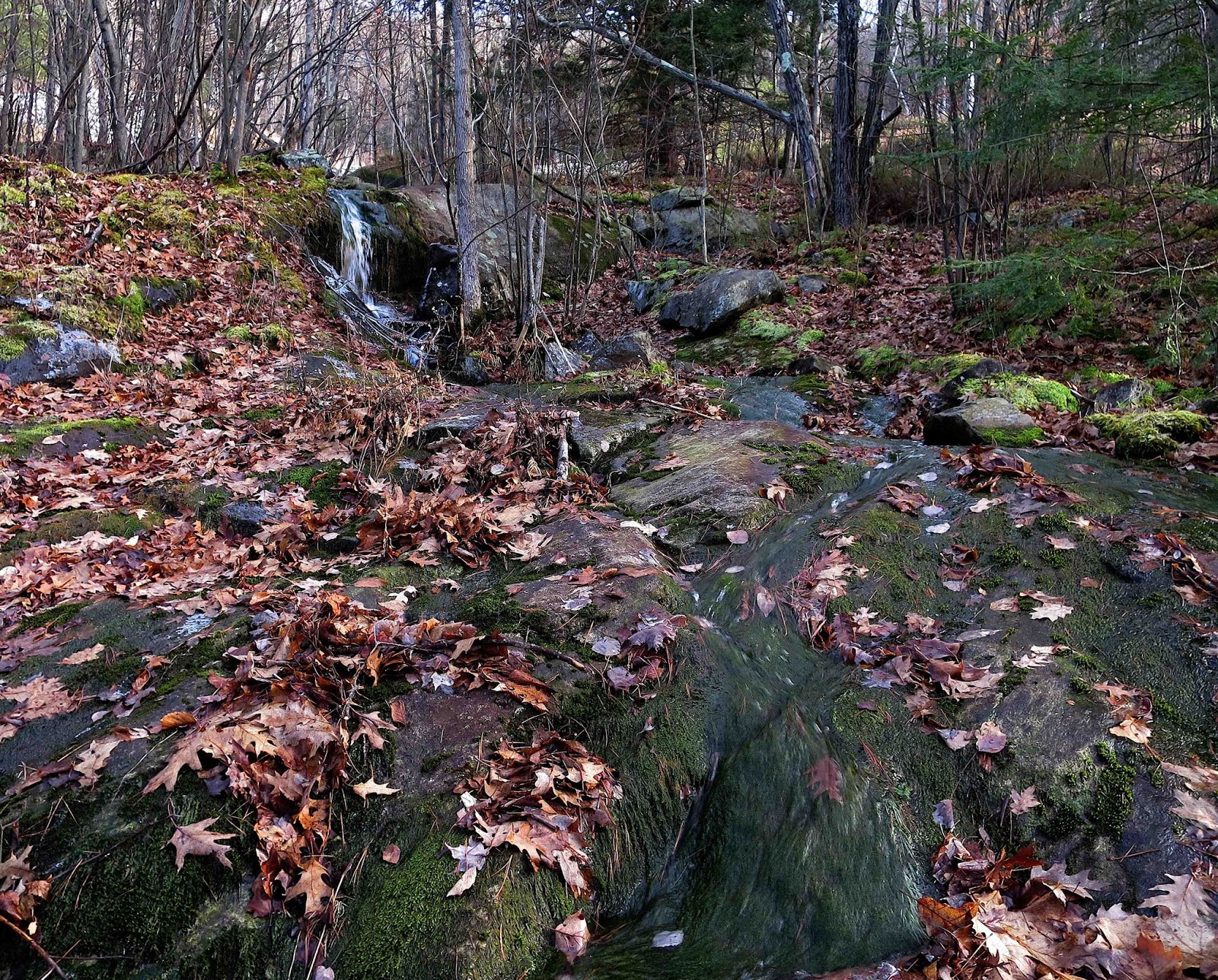
At one point I left the road to climb up the course of a waterfall that tumbles down the mountains that rise along the road.
With our lack of rainfall this year, I expected the course of the waterfall to be merely a trickle, but no, there was still enough water in the stream to tumble and splash among the mossy boulders.
I was surprised to find the forest floor here thick with frost on the north-facing slopes, and the frost's starry crystals outlined all the leafy vegetation. The bright-green of this Marginal Wood Fern's frond looked so pretty rimmed with white.
This mound of Delicate Fern Moss was also spangled with frost.
As were these gold-and-brown fans of Stereum fungus.
One branch of a native Yew shrub hung over the splashing water, and it was completely encased in crystalline ice.
With all this frost and ice persisting well into the afternoon, I wondered if I might find some Frostweed curls in the open areas under a powerline that runs along the top of Mud Pond. This area is not far away along Spier Falls Road, so I set off in that direction, stopping for just a moment to take in the serene beauty of late-afternoon light on the quiet river.
Since the curls of frozen sap that form at the base of Frostweed stems are so delicate and fine, I hardly dared hope I would find them today. It was already past three in the afternoon, and the day had been sunny. Wouldn't they have melted away by now? But lo and behold, I found many Frostweed plants with these frothy curls still intact! This action of sap escaping from splits in the stems to form curls of frozen vapor is the very feature that gives this native plant (Crocanthemum canadense) its common name. As far as I know, it is the only plant we have in this part of the country that can do this.
Much of the area under the powerline was still spangled with frost, adding interest and beauty to all the variety of mosses and lichens that flourish there. I was especially enchanted by this frosted pale violet-gray mushroom rising from amid a patch of Haircap moss.
The bright-red tops of Cladonia lichens are always a delight to find, and today they were made even prettier by the presence of frosty crystals.
I know that it's hard to say good-bye to this late-autumn's lingering warmth. But finding all these sparkling treasures today reminded me once more that every season has its delights. Even if you have to search a little harder to find them.
At one point I left the road to climb up the course of a waterfall that tumbles down the mountains that rise along the road.
With our lack of rainfall this year, I expected the course of the waterfall to be merely a trickle, but no, there was still enough water in the stream to tumble and splash among the mossy boulders.
I was surprised to find the forest floor here thick with frost on the north-facing slopes, and the frost's starry crystals outlined all the leafy vegetation. The bright-green of this Marginal Wood Fern's frond looked so pretty rimmed with white.
This mound of Delicate Fern Moss was also spangled with frost.
As were these gold-and-brown fans of Stereum fungus.
One branch of a native Yew shrub hung over the splashing water, and it was completely encased in crystalline ice.
With all this frost and ice persisting well into the afternoon, I wondered if I might find some Frostweed curls in the open areas under a powerline that runs along the top of Mud Pond. This area is not far away along Spier Falls Road, so I set off in that direction, stopping for just a moment to take in the serene beauty of late-afternoon light on the quiet river.
Since the curls of frozen sap that form at the base of Frostweed stems are so delicate and fine, I hardly dared hope I would find them today. It was already past three in the afternoon, and the day had been sunny. Wouldn't they have melted away by now? But lo and behold, I found many Frostweed plants with these frothy curls still intact! This action of sap escaping from splits in the stems to form curls of frozen vapor is the very feature that gives this native plant (Crocanthemum canadense) its common name. As far as I know, it is the only plant we have in this part of the country that can do this.
Much of the area under the powerline was still spangled with frost, adding interest and beauty to all the variety of mosses and lichens that flourish there. I was especially enchanted by this frosted pale violet-gray mushroom rising from amid a patch of Haircap moss.
The bright-red tops of Cladonia lichens are always a delight to find, and today they were made even prettier by the presence of frosty crystals.
I know that it's hard to say good-bye to this late-autumn's lingering warmth. But finding all these sparkling treasures today reminded me once more that every season has its delights. Even if you have to search a little harder to find them.
Friday, November 25, 2016
Turkey Tail Tales
I was way too busy cooking yesterday (and too pooped at night), to post a Happy Thanksgiving blog. But I hope all my readers had a wonderful day of feasting and family love, without too much friction among folks either happy or mad about our recent election. (Lucky for me and my dear family, our extended members who might want to fight are as far apart geographically as along the political spectrum.) I was hoping to get outdoors today, but the rainy grayness out there is not beckoning me, so I took a walk through my photo files instead. Since we're finishing off the tail-end of our turkey leftovers today, how about we look at a few variations of that beautiful fungus called Turkey Tail (Trametes versicolor)? This is the ruffly fungus shown in the photo above, sharing its fallen log with the vivid orange mushroom called Mycena leailana. I always thought this particular combination of fungi would make a beautiful centerpiece for the Thanksgiving table.
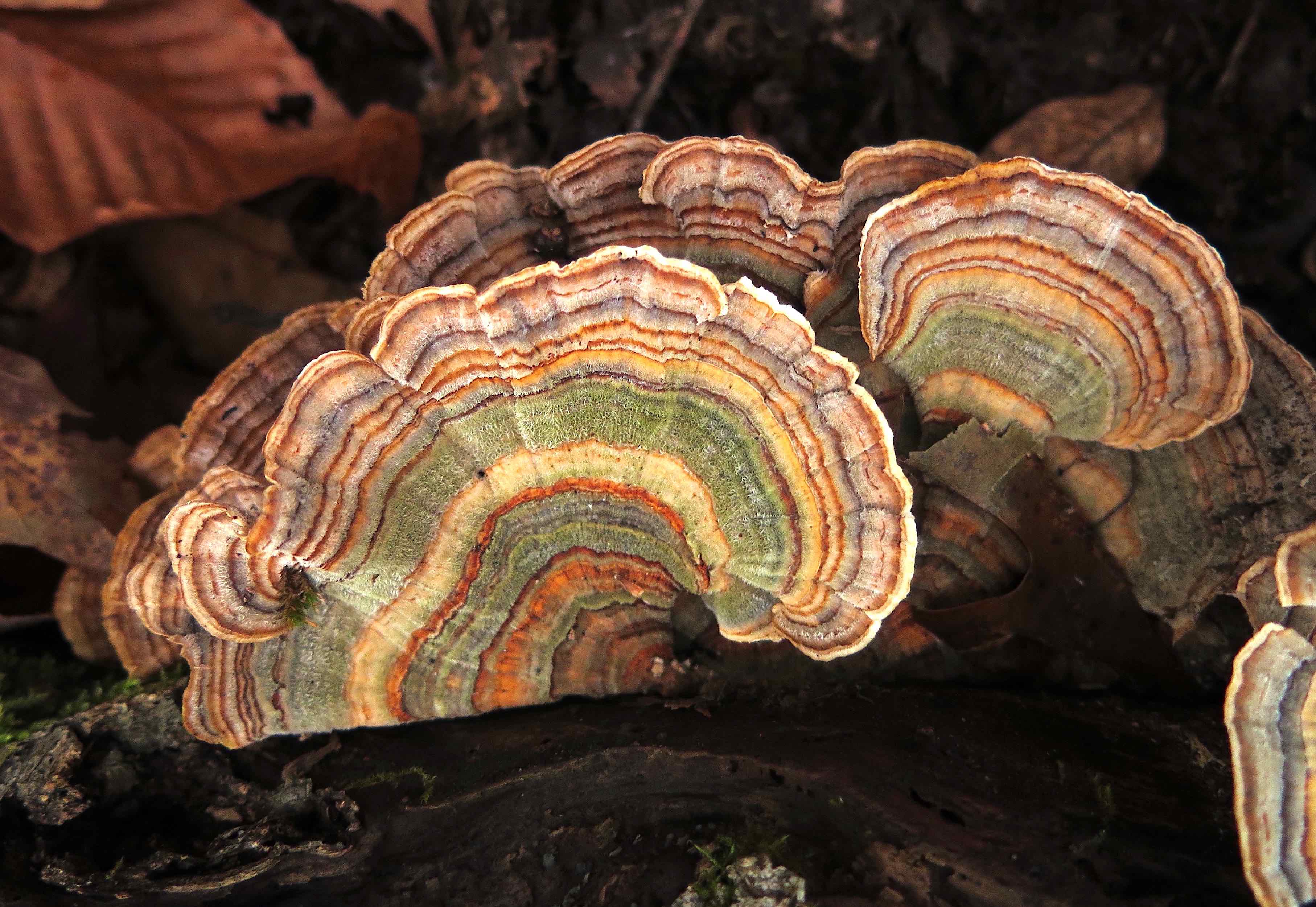
As the following sequence of photos shows, this is a very aptly named fungus, whether we call it by its common name or its scientific one. With its fan-shaped fruiting bodies displaying bands of alternating colors, it does rather resemble the spread-out tail of a courting or challenging tom turkey. And as its specific name, versicolor, suggests, it comes in a whole variety of colors.
Probably the most common colors we find are varying shades of tan and brown, from the softest ecrus and ivories and cafe-au-laits to the deepest chocolates.
Then once in a while, we come upon a mass of Turkey Tails with bands of vivid blue and vibrant orange.
Here's one I found with bands of bright orange set off by a wash of avocado green, thanks to a green-algae coating.
Somehow, the green bands in this vividly colorful example, do not look as if they were caused by algae, because that green tint is confined to its distinctly separate bands, rather than spreading across all bands. One gorgeous combination of colors!

Just recently, I stopped in amazement before this gorgeous mass of Turkey Tails with bands of school-bus yellow alternating with bands of blue. This is a combination I had never seen before.

All of these examples display the strikingly zonate bands of contrasting colors that are typical for this fungus, and a closer look would reveal that these zones are often different in texture as well as color, with fuzzy zones alternating with smoother ones. This fuzzy or velvety texture of the cap, as well as the starkly contrasting color zones are among the features that distinguish this species of Trametes from other similar members of its genus. Another distinguishing feature of Turkey Tail is that the fresh caps are thin and flexible, not rigid and hard.
The Turkey Tail is one of the polypore fungi, meaning that its fertile surface consists of many pores instead of gills. We have many other species of polypores, but in the case of Turkey Tail, these pores, while visible, are very tiny, presenting as many as 8 pores per millimeter.
This fungus grows on the deadwood of hardwoods and only rarely on conifer logs. And to the delight of hikers in every season, it can be found year-round. I'm hoping the weather clears a bit soon and my flagging energies revive so that I can get back out to the woods. Perhaps I will come upon a beautiful arrangement like this: vividly striped Turkey Tails sharing a mossy log with gray-green lichens.
As the following sequence of photos shows, this is a very aptly named fungus, whether we call it by its common name or its scientific one. With its fan-shaped fruiting bodies displaying bands of alternating colors, it does rather resemble the spread-out tail of a courting or challenging tom turkey. And as its specific name, versicolor, suggests, it comes in a whole variety of colors.
Probably the most common colors we find are varying shades of tan and brown, from the softest ecrus and ivories and cafe-au-laits to the deepest chocolates.
Then once in a while, we come upon a mass of Turkey Tails with bands of vivid blue and vibrant orange.
Here's one I found with bands of bright orange set off by a wash of avocado green, thanks to a green-algae coating.
Somehow, the green bands in this vividly colorful example, do not look as if they were caused by algae, because that green tint is confined to its distinctly separate bands, rather than spreading across all bands. One gorgeous combination of colors!

Just recently, I stopped in amazement before this gorgeous mass of Turkey Tails with bands of school-bus yellow alternating with bands of blue. This is a combination I had never seen before.
Here's that schoolbus yellow again, only this time alternating with dove gray.

All of these examples display the strikingly zonate bands of contrasting colors that are typical for this fungus, and a closer look would reveal that these zones are often different in texture as well as color, with fuzzy zones alternating with smoother ones. This fuzzy or velvety texture of the cap, as well as the starkly contrasting color zones are among the features that distinguish this species of Trametes from other similar members of its genus. Another distinguishing feature of Turkey Tail is that the fresh caps are thin and flexible, not rigid and hard.
The Turkey Tail is one of the polypore fungi, meaning that its fertile surface consists of many pores instead of gills. We have many other species of polypores, but in the case of Turkey Tail, these pores, while visible, are very tiny, presenting as many as 8 pores per millimeter.
This fungus grows on the deadwood of hardwoods and only rarely on conifer logs. And to the delight of hikers in every season, it can be found year-round. I'm hoping the weather clears a bit soon and my flagging energies revive so that I can get back out to the woods. Perhaps I will come upon a beautiful arrangement like this: vividly striped Turkey Tails sharing a mossy log with gray-green lichens.
Subscribe to:
Posts (Atom)