Oof! What a week of awful weather! It if wasn't pouring rain and blasting lightning, it was so steamy hot and muggy my glasses would float off my nose with the sweat running down my face. So mostly, I just stayed indoors. But today it seemed a bit fresher, so I did venture out.
My first stop today was the in-town Spring Run Trail, which starts just a few blocks from my house in Saratoga Springs.
Although this is a pleasant paved path through woods and wetlands, I don't walk here very often, native-wildflower snob that I am, because most of the wayside plants that proliferate here are invasive species, such as Japanese Knotweed and Purple Loosestrife. It does my heart good, though, to see that some of our native wildflowers still hold their own against the aggressive invaders. Here, the creamy-white frothy flowers of Boneset and the Rose-pink ones of Spotted Joe-Pye Weed refuse to be overwhelmed by the masses of Purple Loosestrife that surround them.
I remembered a particularly beautiful stand of Great Lobelia, where many plants of these stunning royal-blue flowers massed along a creek bank, their very numbers amplifying their beauty. Well, it turned out that those fierce thunderstorms with driving rain and blasting winds that kept me indoors this week caused some significant damage to this patch of Great Lobelia. Branches had fallen across the patch, toppling the tall flower stalks and pinning their blooms beneath the detritus of the storm.
But here and there a plant or two had escaped utter destruction, their flower stalks reaching up toward the sun and their radiant flowers still beckoning pollinators.
Content to have found those gorgeous Great Lobelias and starting to wilt from the noonday sun now beating down on the Spring Run Trail, I decided to head for shadier trails and next made my way to the wooded stream banks at Orra Phelps Nature Preserve in nearby Wilton. Just the look of all that deep-green forest and the sound of that splashing water had a cooling effect, even if the thermometer read the same at either location.
I did not expect to find many flowers blooming now under all this dark shade, but I did hope to find many colorful mushrooms sprouting up from the forest floor, following several days of drenching rain. And I was not disappointed. The first ones I spied were these little lemon-yellow Waxcaps (Hygrocybe flavescens), with their fragile pixie-hat caps atop hollow flattened stalks.
Close by were a number of these very smooth and creamy-tan Boletes, the species of which I have not been able to determine.
Their pores were the softest lemon-sherbet color, which stained a deep blue when I pressed them. That should have been a distinguishing clue, but the only Boletes of this color I find in my guides are described as non-staining. Maybe somebody can tell us what these are?
I do know what these flat leathery ones are, but only because I have found them in other years when their dark color suggested their common name of Black Tooth Fungus (Phellodon niger). They always have a ring of creamy-white around the edges, but this time the white has covered most of the surface. The toothed undersides still looked the same as I remembered. I wonder if a second, white-colored fungus has colonized the ordinarily dark surface of this fungus. Or maybe it's an entirely different one. Mushrooms are hard to ID!
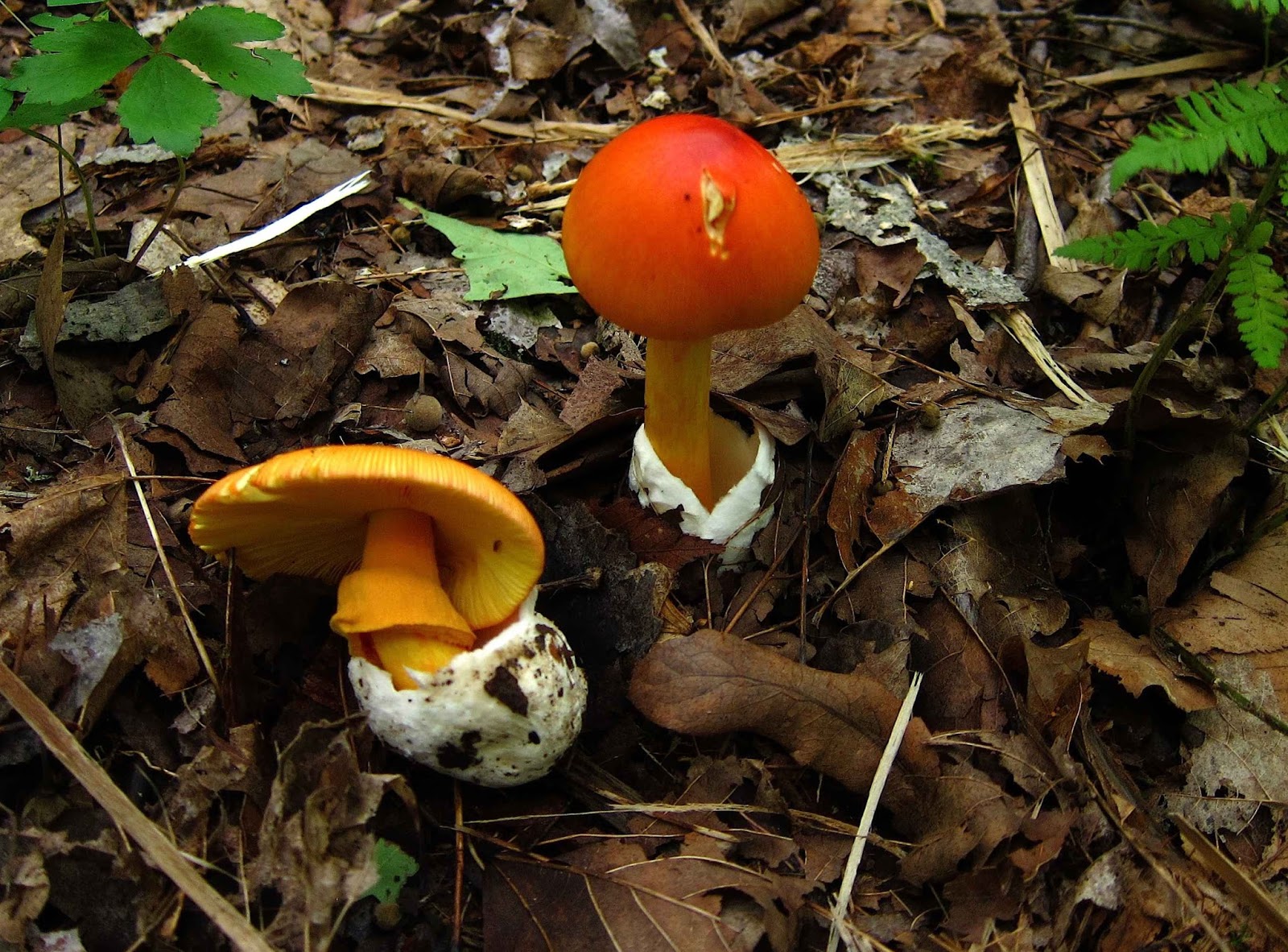
This mushroom isn't hard to ID, however. No other fungus but American Caesar Amanita (Amanita jacksonii) has this brilliant red cap on a bright-orange stalk rising out of a pure-white cup. And today I found TWO of them!
This is an easy one, too. That brilliant orange crust coating a depressed-cap mushroom couldn't be anything else but a Lobster Mushroom (Hypomyces lactiflorum). This is a bit of a misnomer, however, because H. lactiflorum actually refers to the orange fungal coating that has completely covered another mushroom, most likely one of the Lactaria, this fungus's usual host.
I found abundant numbers of Smooth Chanterelles (Cantherellus lutescens) just where I expected to find them, in an area of very wet soil, their preferred habitat.
There were dozens and dozens of these frilly Chanterelles in varying sizes, some almost as small as a pin.
I'm not going to try to name the coral fungi I found. There are many different ones and I have difficulty telling them apart. But I believe it is safe to say that this is an Orange Coral Fungus.
And this is a White Coral Fungus.
And this is not a fungus at all, but rather the slime mold Ceratiomyxa fruticulosa var. fruticulosa. That's not a name I can reel off on demand, but one I have to look up every time I find it. And since this is one of our commonest slime molds, I do look it up quite often. If we have periods of rain.
I did not remove this lovely purple mushroom from its niche at the base of a pine tree to examine it closely. But I think it may be the Viscid Violet Cort (Cortinarius iodes). It's almost always necessary to destroy a mushroom in order to accurately identify it -- pulling the cap off to note how the gills are attached, breaking the stem to note its color or if it is hollow, etc., etc.) -- and I thought it looked so pretty right where it was, complimented by the green Canada Mayflower leaves. I left it for others to admire.
Oh wait a minute! I DID find a flower at Orra Phelps! How could I miss this bright purple cluster blooming at the edge of the stream? It certainly catches the eye!
Looks like a Phlox, but not quite like the Phloxes that grow in my neighbor's garden. I thought it might be Wild Sweet William (Phlox maculata), but I didn't see a spotted stem and the leaves seem too broad to be that species. I have some queries out to folks who might know, but whatever species it is, it certainly was a pleasant surprise to see this lovely flower blooming so brilliantly, all alone in the woods.
For more than thirty years I've been wandering the woods and waterways of Saratoga County, New York, and regions nearby, looking closely, listening carefully, and recording what I experience. We are blessed in this region with an amazing amount of wilderness right at hand. With this blog I share my year-round adventures here, seeking out what wonders await in my own Madagascar close to home.
Tuesday, August 16, 2016
Thursday, August 11, 2016
Binge-botanizing With the Best Kind of Buddies
Not everyone likes to go for a walk or a paddle with me, wildflower-obsessed nature nut that I am. I'm always dropping to my knees every few feet to peer at a plant, or inching along the river banks to spy on some riparian wonder while my fellow paddlers are charging along a hundred yards ahead. So just imagine my incredible joy at having a whole HOUSEFUL of similarly inclined flower nerds to go out to play with! That was my great fortune last weekend when Andrew, John, Taylor, Linda, and Mark bunked down at my house and joined my pal Sue and me for two solid days of nature adventures.
Andrew and John had just spent most of a week camping in the Adirondack wilderness, where they taught a plant-identification course at the Shingle Shanty Preserve and Research Station, and Taylor, Linda, and Mark had been three of their students. Apparently, they had not yet had their fill of north- woods botanizing, for most of them enthusiastically set out with Sue and me for more, starting on Saturday morning with a visit to the east bank of the Ice Meadows, a remarkable stretch of Hudson River banks north of Warrensburg, where heaps of ice in winter create a distinctive habitat that encourages the growth of rare plants.
Saturday, August 6: The Ice Meadows and The Pack Forest
I chose this site specifically so that Andrew (in the pale-blue T-shirt above and below) could once again lay his eyes on a low-growing plant called Selaginella rupestris, a spike-moss that prefers to sprawl along dry rocky banks like the ones along this site. Andrew monitors rare-plant species for the state of Ohio, where this particular fern-ally (not really a moss, despite its name) is very rare. The other friends in this photo are Mark (focussing his camera), Sue (in blue shirt), and Taylor (bent over the Selaginella). Linda got cropped from this photo to spare Taylor the embarrassment of having his fanny foremost, and John stayed back in Saratoga, having visited this site many times before. (Perhaps he was just a little bit weary, from roughing it in the north woods without running water for the previous week.)
Here's a closer photo of that Selaginella in question. It would be easy to dismiss this unusual plant as a common moss, if one did not have a bunch of botanical experts along to wax amazed at the sight of it.
Andrew was also excited to find this pretty Toothed Flatsedge (Cyperus dentatus) growing down by the water. I think he said it might be rare in Ohio.
I know it's hard for most folks (including myself, at times) to get excited at finding rare grasses and sedges and rushes and reeds, but this stretch of Hudson River bank is known by graminoid-experts as being home to some of the rarest we have in the state. Here's one of those rare ones, called Whip Nut-sedge (Scleria triglomerata), which thrives in great numbers along this site, although it is listed as an Endangered species in New York.
This site also offers some pretty spectacular wildflowers that would amaze even those with no botanical leanings, such as this mass of the brilliant-red Cardinal Flower (Lobelia cardinalis).
Everyone, including Linda and Taylor, wanted to take some photos of this stunning array.
Except for Ohio-based Andrew, all of our guests this weekend were from states in the deep south: Alabama, Florida, and Louisiana. Although the range of Canadian Burnet (Sanguisorba canadensis) does extend into some southern states, it is not as common down south as it is up here, where it thrives in great numbers along these particular banks.
Our next excursion on Saturday was the nearby Charles Lathrop Pack Demonstration Forest, named after an Adirondack lumberman who donated the 2,500-acre tract to the State University of New York's College of Environmental Science and Forestry. As the day heated up, we were very glad to walk within the cool shade of this forest along pine-needle-cushioned trails.
I had brought my friends here to experience an old-growth forest containing some of the tallest White Pines in all of New York. Here, Sue is gazing up the 150-foot-high trunk of the biggest of them all, a giant almost 350 years old called Grandmother's Tree.
From the biggest trees to some of the smallest orchids: growing out of the mossy soil of the forest were many plants of Dwarf Rattlesnake Plantain (Goodyera repens), the smallest species of Goodyera that grows in this part of the state.
Aside from the dozens of Dwarf Rattlesnake Plantains we found, the most common forest-floor flower blooming this day was the dazzling-white Dalibarda repens. Three of the common names for this pretty Rose-family flower are Robin Runaway, Dewdrop, and Star Violet.
While blooming flowers may be scarce in the deep woods at this time of the year, the fruits of some plants can be just as dazzling as flowers, such as the bright-red fruit of this Painted Trillium (Trillium undulatum).
We also found a bright-red fruit on a native American Yew (Taxus canadensis) that carpeted the forest floor in some areas. I have often found these sprawling shrubs in the woods, but I have never seen one bear any fruit. This was our lucky day!
Another lucky find was a single plant of American Ginseng (Panax quinquefolia), a species so sought-after by poaching herbalists that it has been extirpated from much of its original range.
Blooming flowers may have been scarce in the Pack Forest, but the fungi were quite abundant following several days of rain. This Scaly Vase Chanterelle (Gomphus floccosus) was one of the showiest of them.
But this American Caesar (Amanita jacksonii) took the prize for the most spectacular fungus of all.
Sunday, August 7: The Hudson River at South Glens Falls
Canoes strapped to a convoy of cars, we made our way on Sunday morning to paddle the Hudson River at South Glens Falls. Here, we launched into the quiet backwaters once carved out of the riverbanks as sorting pools for logs floated down from the Adirondack Mountains. These shallow, still-water pools, home to many emergent and riparian plants, are also alive with birds of many species, including this regal Great Blue Heron perched on a fallen log.
Although the banks here are crowded with far too many invasive Buckthorn and Honeysuckle shrubs, we do still find abundant numbers of some of our most interesting native shrub species, including quite a few specimens of Wild Senna (Senna hebecarpa) with its bright-yellow flowers.
One of the floating flowers we found here was Water Marigold (Bidens beckii), a Rare species in New York but abundant here in the quiet backwaters, where it floats along trailing whorls of brown underwater leaves below its emergent yellow flowers and green stem leaves.
An even rarer flower we saw here is the Small Floating Bladderwort (Utricularia radiata), classified as "Threatened" in New York but found by the hundreds here in these quiet backwaters.
Our journey upstream took us past many examples of plants that thrive in damp soils along the banks. This beautiful patch of Mad-dog Skullcap (Scutellaria lateriflora) was striking with its radiant blue flowers.
I was particularly struck by a gorgeous patch of some kind of Smartweed (Persicaria sp.) I did not recognize. It was the same pretty pink as Lady's Thumb (P. maculosa) or Pennsylvania Smartweed (P. pensylvanica), but the open flowers looked much larger than I'm used to seeing on either of those similar species. Our state lists many species of Smartweeds, many of which are not included in the common wildflower guides. Perhaps this is one of them. Or maybe this rich riverside soil has encouraged the flowers to grow large.
One of the showiest flowers along the banks was this gorgeous bunch of Showy Tick Trefoil (Desmodium canadense), a native wildflower that would not be out of place in anyone's cultivated garden.
The same could be said for the brilliant-yellow Sneezeweed (Helenium autumnale) with its large flowers with ruffled petals.
As we approached the Feeder Dam upstream from our launch site, we moved under steep cliffs of the blackest shale that are constantly watered by mineral-rich springs, creating a rich habitat for many calciphile plants. In this photo, Taylor and John are pulling close to the cliffs to examine the many plants thriving there.
Two of the lime-loving species that were growing directly out of the shale were large bushy plants of Spikenard (Aralia racemosa) and the curving fronds of Bulblet Fern (Cystopteris bulbifera).
The beautiful little Kalm's Lobelia (Lobelia kalmii) truly thrives on the damp, mossy surface of these cliffs.
We were disappointed that the masses of Grass-of-Parnassus (Parnassia glauca) that cling to these steep cliffs were only in bud, but we could still enjoy the sight of their glossy green heart-shaped leaves. And also marvel up close at the beautiful blue flowers of the Kalm's Lobelia that shared the same space.
Monday, August 8: The Gardens at Yaddo
Most of my friends had left to return to their homes by Monday morning, but I still had a full day to enjoy the company of John and Taylor before they caught their flights home that evening.
Both of these men are professional gardeners: John (left) is curator of the native-plant collection at the Birmingham (Alabama) Botanical Garden, and Taylor has his own horticultural and garden-design business in New Orleans. So what better place to take them in Saratoga Springs than the beautiful gardens at Yaddo, the famous artists' retreat at the edge of town? There is a formal rose garden there, as well as a beautiful shade garden that shares its space with many native wildflowers, both gardens adorned with pools and fountains and statuary. Here are some scenes of the gardens, taken from my photo files:
As we bid good-by, with fond hopes to re-connect in the future, one of the garden's statues appeared to be raising his hand in farewell.
Yes, fare well, my dear friends, and look for the time we may botanize with such pleasure once more!
Andrew and John had just spent most of a week camping in the Adirondack wilderness, where they taught a plant-identification course at the Shingle Shanty Preserve and Research Station, and Taylor, Linda, and Mark had been three of their students. Apparently, they had not yet had their fill of north- woods botanizing, for most of them enthusiastically set out with Sue and me for more, starting on Saturday morning with a visit to the east bank of the Ice Meadows, a remarkable stretch of Hudson River banks north of Warrensburg, where heaps of ice in winter create a distinctive habitat that encourages the growth of rare plants.
Saturday, August 6: The Ice Meadows and The Pack Forest
I chose this site specifically so that Andrew (in the pale-blue T-shirt above and below) could once again lay his eyes on a low-growing plant called Selaginella rupestris, a spike-moss that prefers to sprawl along dry rocky banks like the ones along this site. Andrew monitors rare-plant species for the state of Ohio, where this particular fern-ally (not really a moss, despite its name) is very rare. The other friends in this photo are Mark (focussing his camera), Sue (in blue shirt), and Taylor (bent over the Selaginella). Linda got cropped from this photo to spare Taylor the embarrassment of having his fanny foremost, and John stayed back in Saratoga, having visited this site many times before. (Perhaps he was just a little bit weary, from roughing it in the north woods without running water for the previous week.)
Here's a closer photo of that Selaginella in question. It would be easy to dismiss this unusual plant as a common moss, if one did not have a bunch of botanical experts along to wax amazed at the sight of it.
Andrew was also excited to find this pretty Toothed Flatsedge (Cyperus dentatus) growing down by the water. I think he said it might be rare in Ohio.
I know it's hard for most folks (including myself, at times) to get excited at finding rare grasses and sedges and rushes and reeds, but this stretch of Hudson River bank is known by graminoid-experts as being home to some of the rarest we have in the state. Here's one of those rare ones, called Whip Nut-sedge (Scleria triglomerata), which thrives in great numbers along this site, although it is listed as an Endangered species in New York.
This site also offers some pretty spectacular wildflowers that would amaze even those with no botanical leanings, such as this mass of the brilliant-red Cardinal Flower (Lobelia cardinalis).
Everyone, including Linda and Taylor, wanted to take some photos of this stunning array.
Except for Ohio-based Andrew, all of our guests this weekend were from states in the deep south: Alabama, Florida, and Louisiana. Although the range of Canadian Burnet (Sanguisorba canadensis) does extend into some southern states, it is not as common down south as it is up here, where it thrives in great numbers along these particular banks.
Our next excursion on Saturday was the nearby Charles Lathrop Pack Demonstration Forest, named after an Adirondack lumberman who donated the 2,500-acre tract to the State University of New York's College of Environmental Science and Forestry. As the day heated up, we were very glad to walk within the cool shade of this forest along pine-needle-cushioned trails.
I had brought my friends here to experience an old-growth forest containing some of the tallest White Pines in all of New York. Here, Sue is gazing up the 150-foot-high trunk of the biggest of them all, a giant almost 350 years old called Grandmother's Tree.
From the biggest trees to some of the smallest orchids: growing out of the mossy soil of the forest were many plants of Dwarf Rattlesnake Plantain (Goodyera repens), the smallest species of Goodyera that grows in this part of the state.
Aside from the dozens of Dwarf Rattlesnake Plantains we found, the most common forest-floor flower blooming this day was the dazzling-white Dalibarda repens. Three of the common names for this pretty Rose-family flower are Robin Runaway, Dewdrop, and Star Violet.
While blooming flowers may be scarce in the deep woods at this time of the year, the fruits of some plants can be just as dazzling as flowers, such as the bright-red fruit of this Painted Trillium (Trillium undulatum).
We also found a bright-red fruit on a native American Yew (Taxus canadensis) that carpeted the forest floor in some areas. I have often found these sprawling shrubs in the woods, but I have never seen one bear any fruit. This was our lucky day!
Another lucky find was a single plant of American Ginseng (Panax quinquefolia), a species so sought-after by poaching herbalists that it has been extirpated from much of its original range.
Blooming flowers may have been scarce in the Pack Forest, but the fungi were quite abundant following several days of rain. This Scaly Vase Chanterelle (Gomphus floccosus) was one of the showiest of them.
But this American Caesar (Amanita jacksonii) took the prize for the most spectacular fungus of all.
Sunday, August 7: The Hudson River at South Glens Falls
Canoes strapped to a convoy of cars, we made our way on Sunday morning to paddle the Hudson River at South Glens Falls. Here, we launched into the quiet backwaters once carved out of the riverbanks as sorting pools for logs floated down from the Adirondack Mountains. These shallow, still-water pools, home to many emergent and riparian plants, are also alive with birds of many species, including this regal Great Blue Heron perched on a fallen log.
Although the banks here are crowded with far too many invasive Buckthorn and Honeysuckle shrubs, we do still find abundant numbers of some of our most interesting native shrub species, including quite a few specimens of Wild Senna (Senna hebecarpa) with its bright-yellow flowers.
One of the floating flowers we found here was Water Marigold (Bidens beckii), a Rare species in New York but abundant here in the quiet backwaters, where it floats along trailing whorls of brown underwater leaves below its emergent yellow flowers and green stem leaves.
An even rarer flower we saw here is the Small Floating Bladderwort (Utricularia radiata), classified as "Threatened" in New York but found by the hundreds here in these quiet backwaters.
Our journey upstream took us past many examples of plants that thrive in damp soils along the banks. This beautiful patch of Mad-dog Skullcap (Scutellaria lateriflora) was striking with its radiant blue flowers.
I was particularly struck by a gorgeous patch of some kind of Smartweed (Persicaria sp.) I did not recognize. It was the same pretty pink as Lady's Thumb (P. maculosa) or Pennsylvania Smartweed (P. pensylvanica), but the open flowers looked much larger than I'm used to seeing on either of those similar species. Our state lists many species of Smartweeds, many of which are not included in the common wildflower guides. Perhaps this is one of them. Or maybe this rich riverside soil has encouraged the flowers to grow large.
One of the showiest flowers along the banks was this gorgeous bunch of Showy Tick Trefoil (Desmodium canadense), a native wildflower that would not be out of place in anyone's cultivated garden.
The same could be said for the brilliant-yellow Sneezeweed (Helenium autumnale) with its large flowers with ruffled petals.
As we approached the Feeder Dam upstream from our launch site, we moved under steep cliffs of the blackest shale that are constantly watered by mineral-rich springs, creating a rich habitat for many calciphile plants. In this photo, Taylor and John are pulling close to the cliffs to examine the many plants thriving there.
Two of the lime-loving species that were growing directly out of the shale were large bushy plants of Spikenard (Aralia racemosa) and the curving fronds of Bulblet Fern (Cystopteris bulbifera).
The beautiful little Kalm's Lobelia (Lobelia kalmii) truly thrives on the damp, mossy surface of these cliffs.
We were disappointed that the masses of Grass-of-Parnassus (Parnassia glauca) that cling to these steep cliffs were only in bud, but we could still enjoy the sight of their glossy green heart-shaped leaves. And also marvel up close at the beautiful blue flowers of the Kalm's Lobelia that shared the same space.
Monday, August 8: The Gardens at Yaddo
Most of my friends had left to return to their homes by Monday morning, but I still had a full day to enjoy the company of John and Taylor before they caught their flights home that evening.
Both of these men are professional gardeners: John (left) is curator of the native-plant collection at the Birmingham (Alabama) Botanical Garden, and Taylor has his own horticultural and garden-design business in New Orleans. So what better place to take them in Saratoga Springs than the beautiful gardens at Yaddo, the famous artists' retreat at the edge of town? There is a formal rose garden there, as well as a beautiful shade garden that shares its space with many native wildflowers, both gardens adorned with pools and fountains and statuary. Here are some scenes of the gardens, taken from my photo files:
As we bid good-by, with fond hopes to re-connect in the future, one of the garden's statues appeared to be raising his hand in farewell.
Yes, fare well, my dear friends, and look for the time we may botanize with such pleasure once more!
Subscribe to:
Posts (Atom)


