Another gorgeous day, a good friend to spend it with, and a terrific place to walk amid midsummer's burgeoning wildflowers and the fascinating creatures that live among them: that was my lucky day today. Knowing the limitations my injured leg places on me, my good friend Sue suggested a morning stroll along the paved paths of the Warren County Bikeway, and I was delighted to take her up on that.
The day was warm and sunny, with a sweet cool edge to the breeze that made walking in the sun a great pleasure, especially where our path was lined with a splendid mix of summer flowers. Here, Joe-Pye Weed, Goldenrod, Spotted Jewelweed, and Virgin's Bower form a thicket along the way.
The aster explosion has just begun, and the Flat-topped Aster is among the earliest of them to bloom.
Under the shade of trailside shrubs, this sprawling Bedstraw looked like tiny stars scattered among the ferns.
Tall stalks of Wild Blue Lettuce towered above the underbrush, and their flowers are so tiny we might have passed them by without a second glance. But the sunlight picked out this little cluster of wee little blooms that begged for a closer look at their translucent beauty.
The Panicled Dogwood had long ago shed its white flowers, but its clusters of green berries atop vivid pink pedicels were as lovely as any flowers had been.
While examining milkweed leaves in the hope of finding Monarch Butterfly eggs or larvae, we discovered some other interesting creatures. We later determined that these fat green caterpillar-like things were actually Syrphid Fly larvae chowing down on the aphids assembled there.
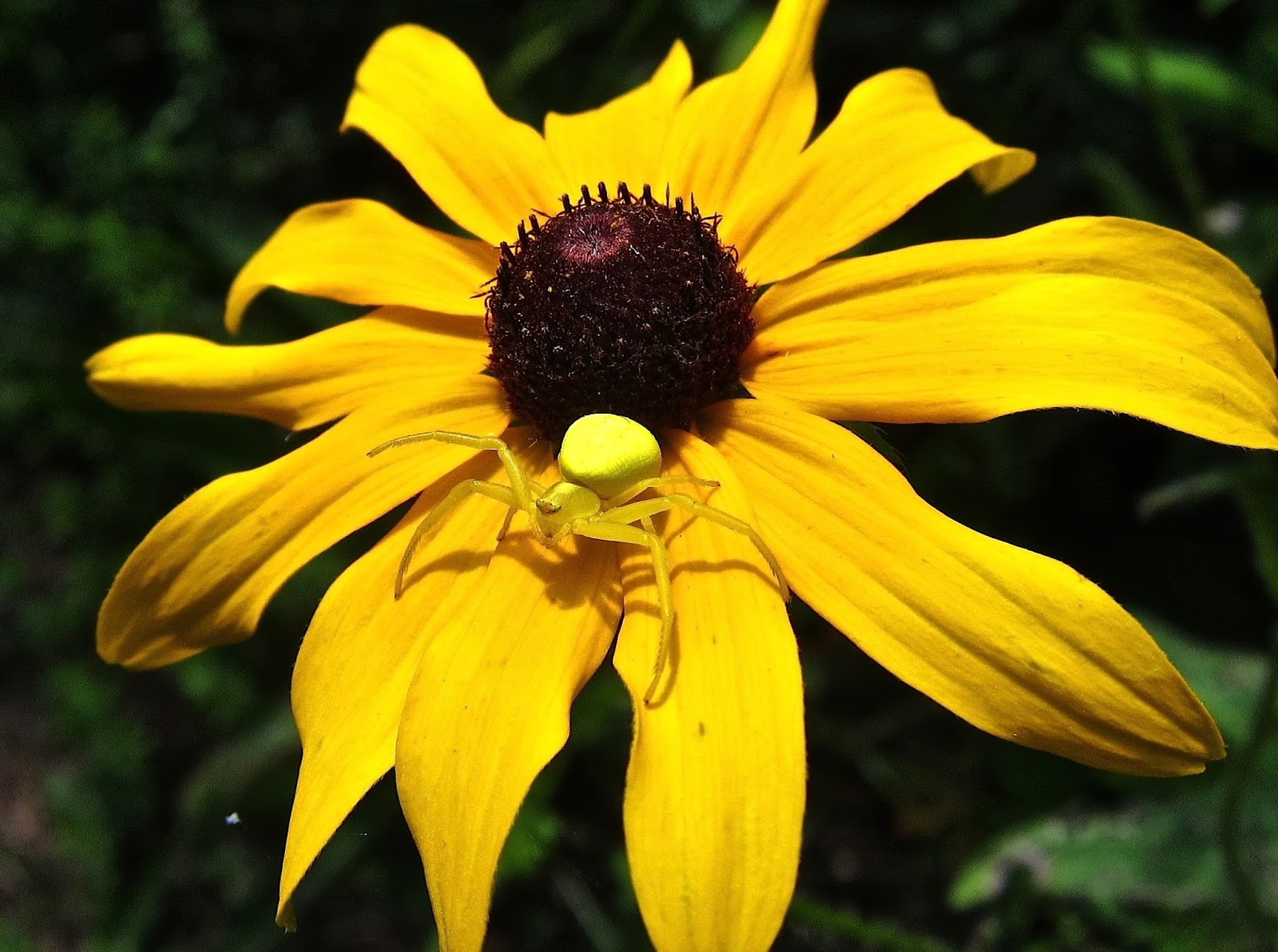
Yes, finding critters is even more fun than finding flowers, especially when we encounter such vivid critters as this bright-yellow Crab Spider perched on a Black-eyed Susan. It stood its ground as we got in close, never retreating but rearing up and raising its front barbed legs as if to grab us the same way it grabs all of its prey.
But the critter find of the day was this little Gray Tree Frog huddling atop a milkweed leaf, its normal gray coloration turned green to attempt some camouflage among the greenery. That stratagem (along with my poor eyesight) worked with me, since I passed it by, assuming that pale green blob was just a milkweed pod. I never would have seen it, if not for my eagle-eyed friend Sue. We wondered what might have brought it down to earth from its normal tree-top residence. Perhaps one of our recent storms blew it down.
After an hour or so of exploring this mid-summer naturalist's paradise, I was ready to rest my knee, so we headed north to Lake George and a wonderful lunch on a restaurant deck that offered this beautiful view. Life doesn't get much better than this! Even the food was good, and the parking was free!
For more than thirty years I've been wandering the woods and waterways of Saratoga County, New York, and regions nearby, looking closely, listening carefully, and recording what I experience. We are blessed in this region with an amazing amount of wilderness right at hand. With this blog I share my year-round adventures here, seeking out what wonders await in my own Madagascar close to home.
Saturday, August 8, 2015
I Was Strollin' Along on Moreau's Back Bay
What a gorgeous day for a stroll around the back bay of Moreau Lake: puffy white clouds in a radiant blue sky, just a light breeze to dry the sweat of my brow but not ruffle the mirror-like surface, and a healing knee that was pain-free enough to put up with a bit of a scramble over a few fallen logs. Keeping mostly to the sandy shore, I actually made it all the way around!
At first glance I could hardly detect any flowers blooming in the dry sand, but a closer inspection revealed the tiny yellow curling blooms and blood-red buds of the almost invisible Canada St. Johnswort.
Higher up toward the edge of the woods were patches of puffy white Boneset, a true magnet for all kinds of pollinators, including this small Bumblebee and an amorous pair of Long-horned Flower Beetles.
I remembered a patch of Pearly Everlasting that grows about half way around the bay, and today I found they were in full bloom, with their globular white flowers, sharp-pointed petals as crisp as straw.
The air was deliciously scented from thick stands of Wild Mint, which released its sharp fragrance every time my leg brushed against its leaves.
Here and there among the Wild Mint's pale lavender blooms I spied a huge ebony-black wasp, its wings a stunning cobalt blue. I had no fear of leaning in close to take a photo, for this is one of our digger wasps, the Great Black Wasp (Sphex pensylvanicus), a non-aggressive ground-dwelling wasp that feeds on flower pollen.
There were dragonflies everywhere, but only one, this male Widow Skimmer, sat still long enough for me to take its picture as it rested near a patch of False Nettle.
The most exciting moment of my amble today was coming upon this Garter Snake having just a moment before started swallowing what looks to be a good-sized frog. Although much of the frog is well within the snake's swelling body, its legs were still protruding from the snake's mouth.
The snake sped away when I leaned in to take a picture, and I was amazed by how quickly that frog was disappearing down the snake's gullet. This photo was taken only a few seconds after I snapped the one above.
And only a few seconds after that, the frog was just a mere swelling a good deal further down the length of the snake. Amazing!
Wednesday, August 5, 2015
Revisiting Wilton
The Wilton Wildlife Preserve and Park is one of the places in Saratoga County I frequently visit to look for wildflowers, as longtime readers of this blog may recall, since I have featured this preserve's fascinating flora many times over the years. Perhaps that's why WWPP's executive director Margo Olson has invited me to present a wildflower slideshow to the preserve's volunteers next month. I have so many photos in my files I could probably prepare my presentation without leaving my house, but oh, such a lovely day for a wildflower walk it was today! Why not head out to the Wilton Wildlife Preserve and Park for a little inspiration?
My favorite portion of this extensive preserve is the Gick Farm Parcel along Rte. 50 north of Saratoga Springs, for it's here I can find many of the sand-plain plants that favor this kind of oak/pine habitat. In fact, this parcel is the ONLY place in all of Saratoga County I will find the giant stalks of Tall Ironweed (pictured above) waving their bright-pinky-purple blooms right by the parcel's parking area. Although this species of Ironweed thrives in more central areas of New York, it is not native to Saratoga County and possibly found its inadvertent way to Wilton with the grass seed used to restore this old farmland acreage to its pre-agriculture state.
The Wilton Wildlife Preserve and Park is perhaps best known locally for its efforts to restore the habitat for the federally-endangered Karner Blue Butterfly. In spring these open meadows punctuated by oaks and pines will be a sea of blue, thanks to the acres of Wild Blue Lupine that have been planted here, the only flower that can support the Karner Blue caterpillars. But today the meadows are a sea of green, with the wind passing in waves through the native grasses that also thrive here.
In certain areas, that sea of green was interrupted by masses of Horsemint, a native wildflower that's another favorite of various butterflies and other pollinators.
Although the Horsemint's flowers are pale yellow spotted with red, the most noticeable part of the plant, especially from a distance, are the wreaths of pale pink or white bracts that circle the stems.
In a few weeks, these meadows will be a sea of gold as many native species of Goldenrod open their blooms. And by then, the pretty pink puffs of Meadowsweet will probably have faded. In fact, I was surprised to find it still in bloom today.
Other butterflies beside the Karner Blue find a happy home here, including this Great Spangled Fritillary. I posted a photo of its gorgeous orange wings on my previous post, but this photo shows its distinctly spotted, paler-colored underwings.
When I was here in May, the Karner Blue Butterflies could be seen by the hundreds, flitting among the Wild Blue Lupine and other blooming plants. Today, this was the only Karner Blue I saw, and it must have mistaken my blue sneaker for its favorite blue flower, since it landed on my foot and clung there even as I continued to walk. I later examined my shoe, but did not find any trace of butterfly eggs.
It wasn't just the sights, but also the smells that gave me great pleasure today. Passing by this patch of sun-warmed Sweet Fern, I breathed extra deep to draw in the exquisite scent its leaves were giving off.
More sweet scents awaited me when I moved from the open sunlit meadow into the shady pine woods, and the equally delicious fragrance of pine needles filled the air.
I saw many still-green basal leaves of the Pink Lady's Slippers that burgeoned here in the pine woods last May, and I kept searching the needle-strewn forest floor in hopes I might find other orchids here, perhaps one of the species of Goodyera. Well, no Goodyera did I find, but I did find a pretty orchid. This is Helleborine, and although it is not one of our native orchids, it's still an orchid.
And looked at closely, a rather pretty little orchid, at that.
My favorite portion of this extensive preserve is the Gick Farm Parcel along Rte. 50 north of Saratoga Springs, for it's here I can find many of the sand-plain plants that favor this kind of oak/pine habitat. In fact, this parcel is the ONLY place in all of Saratoga County I will find the giant stalks of Tall Ironweed (pictured above) waving their bright-pinky-purple blooms right by the parcel's parking area. Although this species of Ironweed thrives in more central areas of New York, it is not native to Saratoga County and possibly found its inadvertent way to Wilton with the grass seed used to restore this old farmland acreage to its pre-agriculture state.
The Wilton Wildlife Preserve and Park is perhaps best known locally for its efforts to restore the habitat for the federally-endangered Karner Blue Butterfly. In spring these open meadows punctuated by oaks and pines will be a sea of blue, thanks to the acres of Wild Blue Lupine that have been planted here, the only flower that can support the Karner Blue caterpillars. But today the meadows are a sea of green, with the wind passing in waves through the native grasses that also thrive here.
In certain areas, that sea of green was interrupted by masses of Horsemint, a native wildflower that's another favorite of various butterflies and other pollinators.
Although the Horsemint's flowers are pale yellow spotted with red, the most noticeable part of the plant, especially from a distance, are the wreaths of pale pink or white bracts that circle the stems.
In a few weeks, these meadows will be a sea of gold as many native species of Goldenrod open their blooms. And by then, the pretty pink puffs of Meadowsweet will probably have faded. In fact, I was surprised to find it still in bloom today.
Other butterflies beside the Karner Blue find a happy home here, including this Great Spangled Fritillary. I posted a photo of its gorgeous orange wings on my previous post, but this photo shows its distinctly spotted, paler-colored underwings.
When I was here in May, the Karner Blue Butterflies could be seen by the hundreds, flitting among the Wild Blue Lupine and other blooming plants. Today, this was the only Karner Blue I saw, and it must have mistaken my blue sneaker for its favorite blue flower, since it landed on my foot and clung there even as I continued to walk. I later examined my shoe, but did not find any trace of butterfly eggs.
It wasn't just the sights, but also the smells that gave me great pleasure today. Passing by this patch of sun-warmed Sweet Fern, I breathed extra deep to draw in the exquisite scent its leaves were giving off.
More sweet scents awaited me when I moved from the open sunlit meadow into the shady pine woods, and the equally delicious fragrance of pine needles filled the air.
I saw many still-green basal leaves of the Pink Lady's Slippers that burgeoned here in the pine woods last May, and I kept searching the needle-strewn forest floor in hopes I might find other orchids here, perhaps one of the species of Goodyera. Well, no Goodyera did I find, but I did find a pretty orchid. This is Helleborine, and although it is not one of our native orchids, it's still an orchid.
And looked at closely, a rather pretty little orchid, at that.
Tuesday, August 4, 2015
Hello Again
So sorry, my dear blog friends, to have neglected my blog for so long. I've had some set-backs in recovery from my knee injury that have caused me too much pain to sit at my computer for the hours it usually takes to edit photos and compose copy. But I HAVE managed to get outdoors from time to time for brief walks, knowing how instrumental to recovery exposure to nature can be. And lucky for me, I have many beautiful natural places with level ground to visit -- as well as dear friends who are willing to walk very slowly along the trails with me. Here's a brief digest of some of the places I've been and wonders I've seen over the last week or so.
Thursday, July 23, Moreau Lake State Park
I stopped in the Nature Center at Moreau Lake State Park a week ago last Thursday to visit with the naturalists there and observe their amazing display of Monarch Butterflies emerging from chrysalises. The Monarchs were contained within a net cage (to be released eventually), but I was told that a Common Milkweed patch by the swimming beach was loaded with caterpillars. Of course I had to investigate, and yes, indeed, I did find lots of tiny caterpillars. Not Monarchs, though, but early instars of the Milkweed Tiger Moth, chewing away on the milkweed leaves whose toxins will be absorbed by the caterpillars to deter any predators. As yet, they have not produced the brilliant coloring that will also warn predators to seek their meals elsewhere. But they do look kind of tiger-like, don't they, all yellow and black and fuzzy?
Saturday, July 25: Powerlines and Woods at Moreau
I could walk these powerline easements alone, but it's much more fun (and safer for me) to explore them with my dear fellow nature nut Sue Pierce. We met last Saturday on Spier Falls Road at the top of Mud Pond. Our goal this day was to search for the elusive Checkered Rattlesnake Plantain that we've found before in the woods around Mud Pond, but of course we had to check what was growing in the open areas under the powerlines. Most notable, even at a glance, were the gorgeous yellow blooms of Early Goldenrod.
On every side, we saw Great Spangled Fritillaries wafting among the goldenrods, but only one sat still long enough for me to take its picture.
As we walked through the piney woods adjacent to the powerline, we searched for the little white orchid called Checkered Rattlesnake Plantain. As is true for many orchids, it was not blooming where we expected to find it.
But we did find lots more plants than ever before, although in places we'd never seen them before.
Sharing the same mossy pine-needled forest floor were many unfolding stalks of ghostly-pale Pinesap.
We were surprised to find several Blunt-leaved Milkweeds still blooming here in the woods, still tempting pollinators to risk partaking of its pollen. All milkweed flowers are capable of snagging the legs of visiting insects, and I often find dead ones dangling from the florets. This was one lucky fly that managed to safely graze.
Sue then drove us to another section of powerline with an easy-walking sandy trail lined with Hazelnut shrubs.
Never had we seen Hazelnut shrubs so laden with nut clusters that the boughs nearly touched the ground. And this has been true for every place we have found Hazelnut growing. The squirrels and chipmunks and other nut-eaters will be feasting this fall!
Although Round-headed Bush Clover has a homely, weedy appearance from a distance, a close look reveals many tiny pink-striped blooms that are really very pretty.
We should be sure to revisit this powerline stretch when the abundant Blackberries have ripened.
How lucky that a sunbeam struck this American Copper butterfly at the very same moment it rested and opened its beautiful copper-colored wings! Without that illumination, its wings appeared just dull gray.
This Net-winged Beetle didn't need any extra light to show off its striking orange and black bands.
Friday, July 31: Woods Hollow Nature Preserve, Milton
The Woods Hollow Nature Preserve just north of Ballston Spa offers a variety of habitats from forested wetland to oak-pine savannah. It was the open sandy oak-pine savannah I visited on Friday.
Across a sunlit stretch of sandy meadow populated mostly by Sweet Fern, I could see stalks of light-colored plants growing under a stand of Black Locust trees. On closer inspection, these proved to be Horse Mint, whose wreaths of red-speckled yellow flowers bloom beneath rings of pinky-green or whitish pointed bracts.
At the shady edge of the woods, I found several clusters of the vivid-pink Centaury, a really tiny flower that would be easy to overlook if not for its vibrant color.
My favorite finds this day were the dozens of Sand Tiger Beetles I saw scurrying across the hot sand. They would shoot across the ground at amazing speed, then stop abruptly, only to resume their hell-bent pursuit of prey, until once again they halted then sped off again, sometimes in a different direction, never taking to the air. I looked this bug up on line, where I read that these beetles can run so fast, they outrun their eyes' ability to perceive their prey, which is why they have to stop in order for their eyesight to catch up. One of the fastest creatures on earth, relative to its size, is what I read at one site.
Saturday, August 1: Betar Byway, South Glens Falls
When Sue asked me where I would like to walk with her this past weekend, I immediately asked to visit some place near water. The Betar Byway, which runs along the Hudson River just upstream from Glens Falls, proved to be just the ticket. And what a gorgeous blue-sky, blue-water day it was to amble there!
Sue has paddled these waters recently, so she was able to report that the rare Water Marigold was blooming in one backwater. I was able to detect through binoculars its vivid yellow blooms protruding above the water, unfortunately too far away for me to take a photo. This photo is one I took on a previous visit to this same site.
We also spotted the even-rarer Small Floating Bladderwort drifting along in the current offshore, and again it was too distant for me to photograph. But I have seen it many times in this stretch of the river, where I took this photo last year.
Lucky for me, the vivid purple Pickerelweed was blooming abundantly nearer shore than those other elusive flowers.
And in the deep shade along the banks, the first Cardinal Flowers were blazing away, red as fire.
The air was filled with the musky fragrance of Groundnut flowers, which we had to search to find, their vines hidden among other green foliage and the flower clusters drooping downward, hiding their vivid rosy interiors.
A beautiful summer day it was, perfect for wandering the banks of this gorgeous river. There were even benches to allow us to rest awhile, which my throbbing knee was begging me to do. But hey, how's this for a lovely spot to rest?
Thursday, July 23, Moreau Lake State Park
I stopped in the Nature Center at Moreau Lake State Park a week ago last Thursday to visit with the naturalists there and observe their amazing display of Monarch Butterflies emerging from chrysalises. The Monarchs were contained within a net cage (to be released eventually), but I was told that a Common Milkweed patch by the swimming beach was loaded with caterpillars. Of course I had to investigate, and yes, indeed, I did find lots of tiny caterpillars. Not Monarchs, though, but early instars of the Milkweed Tiger Moth, chewing away on the milkweed leaves whose toxins will be absorbed by the caterpillars to deter any predators. As yet, they have not produced the brilliant coloring that will also warn predators to seek their meals elsewhere. But they do look kind of tiger-like, don't they, all yellow and black and fuzzy?
Saturday, July 25: Powerlines and Woods at Moreau
I could walk these powerline easements alone, but it's much more fun (and safer for me) to explore them with my dear fellow nature nut Sue Pierce. We met last Saturday on Spier Falls Road at the top of Mud Pond. Our goal this day was to search for the elusive Checkered Rattlesnake Plantain that we've found before in the woods around Mud Pond, but of course we had to check what was growing in the open areas under the powerlines. Most notable, even at a glance, were the gorgeous yellow blooms of Early Goldenrod.
On every side, we saw Great Spangled Fritillaries wafting among the goldenrods, but only one sat still long enough for me to take its picture.
As we walked through the piney woods adjacent to the powerline, we searched for the little white orchid called Checkered Rattlesnake Plantain. As is true for many orchids, it was not blooming where we expected to find it.
But we did find lots more plants than ever before, although in places we'd never seen them before.
Sharing the same mossy pine-needled forest floor were many unfolding stalks of ghostly-pale Pinesap.
We were surprised to find several Blunt-leaved Milkweeds still blooming here in the woods, still tempting pollinators to risk partaking of its pollen. All milkweed flowers are capable of snagging the legs of visiting insects, and I often find dead ones dangling from the florets. This was one lucky fly that managed to safely graze.
Sue then drove us to another section of powerline with an easy-walking sandy trail lined with Hazelnut shrubs.
Never had we seen Hazelnut shrubs so laden with nut clusters that the boughs nearly touched the ground. And this has been true for every place we have found Hazelnut growing. The squirrels and chipmunks and other nut-eaters will be feasting this fall!
Although Round-headed Bush Clover has a homely, weedy appearance from a distance, a close look reveals many tiny pink-striped blooms that are really very pretty.
We should be sure to revisit this powerline stretch when the abundant Blackberries have ripened.
How lucky that a sunbeam struck this American Copper butterfly at the very same moment it rested and opened its beautiful copper-colored wings! Without that illumination, its wings appeared just dull gray.
This Net-winged Beetle didn't need any extra light to show off its striking orange and black bands.
Friday, July 31: Woods Hollow Nature Preserve, Milton
The Woods Hollow Nature Preserve just north of Ballston Spa offers a variety of habitats from forested wetland to oak-pine savannah. It was the open sandy oak-pine savannah I visited on Friday.
Across a sunlit stretch of sandy meadow populated mostly by Sweet Fern, I could see stalks of light-colored plants growing under a stand of Black Locust trees. On closer inspection, these proved to be Horse Mint, whose wreaths of red-speckled yellow flowers bloom beneath rings of pinky-green or whitish pointed bracts.
At the shady edge of the woods, I found several clusters of the vivid-pink Centaury, a really tiny flower that would be easy to overlook if not for its vibrant color.
My favorite finds this day were the dozens of Sand Tiger Beetles I saw scurrying across the hot sand. They would shoot across the ground at amazing speed, then stop abruptly, only to resume their hell-bent pursuit of prey, until once again they halted then sped off again, sometimes in a different direction, never taking to the air. I looked this bug up on line, where I read that these beetles can run so fast, they outrun their eyes' ability to perceive their prey, which is why they have to stop in order for their eyesight to catch up. One of the fastest creatures on earth, relative to its size, is what I read at one site.
Saturday, August 1: Betar Byway, South Glens Falls
When Sue asked me where I would like to walk with her this past weekend, I immediately asked to visit some place near water. The Betar Byway, which runs along the Hudson River just upstream from Glens Falls, proved to be just the ticket. And what a gorgeous blue-sky, blue-water day it was to amble there!
Sue has paddled these waters recently, so she was able to report that the rare Water Marigold was blooming in one backwater. I was able to detect through binoculars its vivid yellow blooms protruding above the water, unfortunately too far away for me to take a photo. This photo is one I took on a previous visit to this same site.
We also spotted the even-rarer Small Floating Bladderwort drifting along in the current offshore, and again it was too distant for me to photograph. But I have seen it many times in this stretch of the river, where I took this photo last year.
Lucky for me, the vivid purple Pickerelweed was blooming abundantly nearer shore than those other elusive flowers.
And in the deep shade along the banks, the first Cardinal Flowers were blazing away, red as fire.
The air was filled with the musky fragrance of Groundnut flowers, which we had to search to find, their vines hidden among other green foliage and the flower clusters drooping downward, hiding their vivid rosy interiors.
A beautiful summer day it was, perfect for wandering the banks of this gorgeous river. There were even benches to allow us to rest awhile, which my throbbing knee was begging me to do. But hey, how's this for a lovely spot to rest?
Subscribe to:
Posts (Atom)