Sunday, June 7, 2015

Counting My Blessings

I was supposed to wake up today on the shores of Lake Huron, up in the Bruce Peninsula of Ontario, sharing a spacious lakeside home with five amazing botanical buddies.  My friends have sent me photos, and boy, is it gorgeous there!  I can't wait to see more photos of all the rare plants they'll be finding there on the limestone shores,  and hear of all the fun the guys are having without me.  So, do I feel a bit sorry for myself that I'm laid up with a broken kneecap?  Well, sure.  But as they say, those are the breaks (pun intended!). At least I have a comfy couch, with kitties for cuddly companions, a dear attentive husband who caters to my every need, adequate Oxycodone to deal with the pain, and a view out the window on this sparkling morning of Mountain Laurel in full bloom and a pair of Cardinals in a lilac shrub.  And even more, I have years of botanical adventures closer to home to look back on, all recorded here in my blog.  So I think every day in the long recovery weeks ahead I will look back in my archives and see what I was doing about this time of year on other years.

It was just about a year ago I found myself teetering from log to log in a cedar swamp up near Johnsburgh, searching for the almost -invisible Naked Miterwort (Mitella nuda).  And thanks to the better eyesight of my companions Evelyn, Bob, and Sue, I was actually able to find it.  Isn't it adorable?


With its hair-fine stems, delicate yellow-green flowers, and leaves no bigger than pennies,  this is a flower that easily hides from view -- even when it's in plain sight.

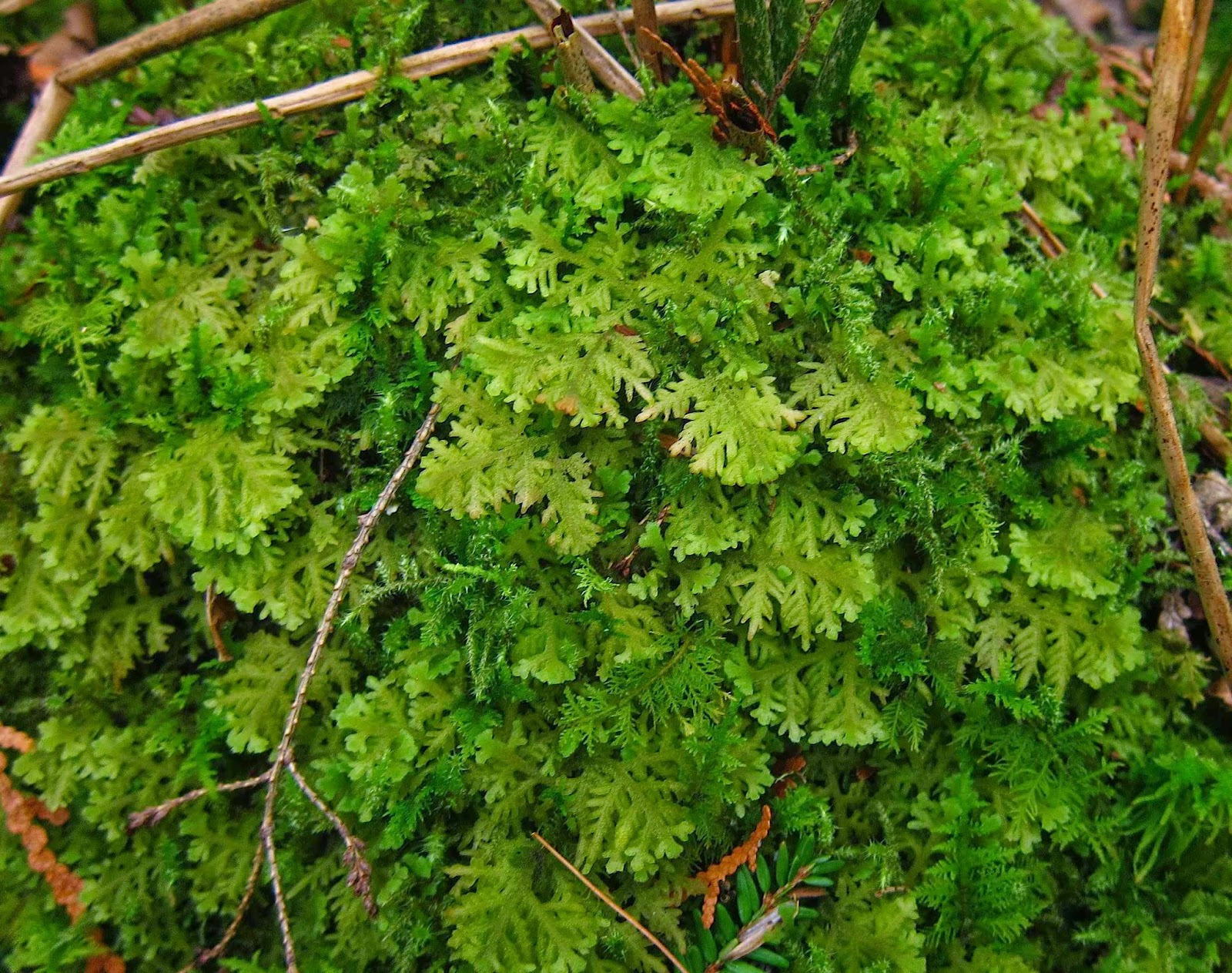
Here was another lifetime find for me that day:  a liverwort I mistook for a moss.  (It's a good thing we had at least two folks along who were well-schooled in liverworts.)  As this photos reveals,  the liverwort Trichocolea tomentella sure would be easy to mistake for a moss:


If it hadn't been quite so wet as it was in that cedar swamp, this liverwort's leaves would have been more fluffed up, revealing how it came to have its common name of Handsome Woolywort.  I love that name!


Friday, June 5, 2015

A Dainty Favorite Milkweed


My friends in the Thursday Naturalists stopped by my house yesterday, to bring me reports from their walk in the Skidmore woods, and also to cheer me as I await the surgery that will start my broken kneecap on the road to recovery.  These friends are such amazing good company, they would have lifted my spirits even if they had not found my favorite flower that I'd hoped would be blooming this week.  But happy to report, the Four-leaved Milkweed (Asclepias quadrifolia) was found!

This is such a dainty little milkweed, only about a foot high, and on slender stems that hold clusters of pink-tinged white blooms in drooping clusters.  It grows in the shade, too, unlike most other milkweeds that demand full sun, so it would make a lovely shade-garden flower, especially in a garden with limey soil.  If only I could find a few plants with mature seeds!  Although this milkweed used to line the trails in the Skidmore woods abundantly, in later years now it has grown much less abundant, probably as nearby plants have towered over it.  It doesn't mind light shade, but it does not like to be crowded by taller plants.  As a result, I fear that the few remaining plants are not sharing pollen, and thus not setting seed.

I wonder what we could do to ensure the continuation of this lovely flower in the Skidmore woods.  Perhaps some Skidmore students could undertake its protection and propagation as one of their scholarly projects. I think I will propose this very project to a professor.


Monday, June 1, 2015

Last Hike of the Summer

Even though I was really busy this weekend, getting ready to go down to Vassar College on Sunday to attend our granddaughter's graduation, I'm glad I made the time Saturday to go walking at Moreau Lake State Park with my friend Sue.  Turns out, this will be the last hike I take for quite some time, since I fell on slippery pavement at Vassar and broke my kneecap.  I'm scheduled for surgery to repair my knee next week, followed by a long recovery time that will certainly curtail my hiking and paddling for most of the rest of the summer.  Yep.  A real bummer!  But at least the rain that made that pavement slick has started to fill some of our ponds, like Mud Pond pictured above.  Sue and I had never seen the water fallen so low.

Low water meant broad beaches around Moreau Lake, where we found evidence of many turtle nests. Unfortunately, many turtle predators also had found those nests and had made a meal of the eggs.  As Sue explained to me (Sue knows quite a bit about turtles), only about one out of every hundred baby turtles survives into adulthood.  As we well know, all critters gotta eat!


Because of sustained drought conditions through most of May, there were very few wildflowers along the shore.  We did find some Indian Hemp starting to bloom, but not much else.


I take that back.  There were LOTS of Small Forget-me-nots, our native species of this pretty blue flower, scattered across the damp sand.  But you had to look close to see them, they are so very tiny.


It was a fine day for finding critters, though, including this gorgeously colored Garter Snake stretched out across the top of a beaver lodge.


Usually, a walk around the lake starts hundreds of frogs to leaping away from our footfalls, but we saw nary a one on Saturday.  We did see one little American Toad, though, and a really cute one, at that.


Dragonflies were zooming everywhere, and occasionally coming to rest.  This fallen log provided a very attractive spot for masses of Chalk-fronted Corporals to take a break.


Ah, but the prize of our lakeside walk was this gorgeous butterfly that landed right beneath our feet to sip on something it craved within the damp sand.  Although it is called a White Admiral, this is really one of two color phases of the Red-spotted Purple Butterfly (Limenitis arthemis).


The underside of this butterfly's wings reveal the red spots that are typical of both color phases of Limenitis arthemis.  I was not able to take a clear photo of the underwings, but my friend Sue sure did.  You can see her fine photos of this butterfly (and more!) on her wonderful nature blog called Water-lily (watrlily.blogspot.com).


Not so pretty as that butterfly, but here's my red-spotted purple knee.  One of these days it will be back to normal, and I will return to the woods and waterways again.  For the next couple of months, however, I doubt I will be able to do much but hobble about stiff-legged while the kneecap knits back together.   No hiking or paddling in my near future, which means I will have to think of some other ways to post my blog.  In the meantime, though, I encourage my loyal readers to revisit old posts, where they can discover what's in bloom where and approximately on what dates.  There's more than six years' worth of archives here, so happy hunting, dear friends!


Saturday, May 30, 2015

Up the Marble Mountain for Moonworts and Many More Marvels

For the third time in as many years, this past Friday I followed my friends up a trail to old marble quarries on the top of a mountain in Vermont.  And it sure never gets old, finding the botanical rarities this lime-rich habitat supports, as well as gasping in wonder at the beauty of these old long-abandoned quarries, now taken over by ferns and mosses and all the wonderful plants that thrive in just such a site.


When I say "rareties," I'm really not kidding, either.  According to some botanists who study these things, this particular mountain is the only known site in the United States, east of the Mississippi, to support the tiny moonwort, Botrychium ascendens.  Here in this photo, my friends Kathy and Nancy are gazing, not just in wonder at this amazing rarity, but also in astonishment that ANYone could have found this itsy bitsy fern in all this grown-over woods.


Yeah, I doubt very much you can see the moonwort in the photo above, so I took another shot with my hand behind it, to give it scale.


We had orchids as well as moonworts to delight in up here, and this Showy Orchis was in the best shape I have ever seen it, each pretty flower fresh and rosy and unblemished.


Here's a closer look at those exquisite little orchids:


Other orchids we always expect to find up here are the Yellow Lady's Slippers, both the large-flowered variety and the small-flowered ones, as well as some that appear to be in-between, when the larger and smaller ones share the same site.  Note that the largeYellow Lady's Slipper has side petals that are yellow-green, while those of the smaller ones are deep purple.


The Small Yellow Lady's Slipper is so abundant up here, it was hard to walk through the woods without stepping on them.  What a sight!


Another rarity, easily overlooked because it is just about the opposite of showiness compared to those lady's slippers, is the tiny Mustard-Family plant called Rock Draba (Draba arabisans).  True to its name, it was growing among the boulders that were scattered throughout the woods, as well as in cracks in marble cliffs that lined the trail.


This photo better displays the twisted seed pod that is distinctive to Rock Draba.


Of course, we also found many of the more common inhabitants of rich woods, such as Sweet Cicely, Virginia Waterleaf, Wood Betony, Canada Violet, and Large-flowered Bellworts, among others.  In addition, we halted at every moss-covered cliffside to explore the varieties of mosses and ferns that grew there, including this dainty Slender Cliff Brake.   We were lucky to find both the fertile fronds (the long slender ones) and the infertile ones (the chubbier fronds) in the same location.


Wednesday, May 27, 2015

Butterfly Paradise

 I know a place where the Wild Lupine grows -- and boy, does it EVER!  That place is the Gick Farm parcel of the Wilton Wildlife Preserve and Park, where park managers have been sowing Wild Lupine for years, as a project intended to support the federally endangered Karner Blue Butterfly, whose larvae feed on lupine leaves and nothing else.  Well, it sure appears that their efforts have paid off!  Have you ever seen so much Wild Lupine in one place?


I even found some that were white!


I stood around in the middle of these Lupine fields, hoping to get a clear photo of the beautiful Karner Blue Butterfly, a wee little thing, barely an inch across, and as blue as a clear summer sky.  Here's one that landed, just briefly, and kept his wings open just long enough for me to snap his picture, before he flitted off.  They are such teases, so blue on the wing but gray as dust when they land on a flower to feed.


Most of the time, when these butterflies land, they snap their wings together and disappear, as if they had become the color of air.  Here's one whose image I managed to capture, because the sun lit up its gray underwings with their spots of orange and black.


You will notice these butterflies are not feeding on Wild Lupine, but rather on the flowers of Common Blackberry.  While it's true that this butterfly's larvae can only feed on the leaves of Wild Lupine, the adults are happy to take their meals wherever nectar is offered.  Blackberries must have nectar in abundance, to judge by the traffic jam of butterflies and others feeding on this patch today.


Oh look, a little brown butterfly has joined the party!  Chances are, it's a female Karner Blue, which is described in the butterfly guides as having wings of dusky brown, bordered with orange crescents.


As this photo shows, there is a slight blue cast to this brown butterfly's wings, especially near the body.  And when she closed her wings, her underwings were as silvery gray as her mate's.


There WAS another brown butterfly enjoying the feast of these fields, and that was this little Silver-spot Skipper, sipping some Wild Lupine nectar.


Here's another nectar-sipper, a cute little Bee Fly feasting on blackberry flowers with its needle-thin proboscis, its rapidly beating wings a-blur.


Yes, those butterflies looked so pretty, feeding on lovely flowers.  And hey, they STILL looked pretty, happily feeding on clumps of horse poo.  I have heard that mud and manure hold minerals that many butterflies crave, but it's always a little startling to see these ethereal creatures feasting away on feces.


Monday, May 25, 2015

Floral Finds in the Piney Woods, and On the Marble Shore

What fun to have my friend Sue on holiday today, so we could explore together a wonderful piney woods a few miles north of Warrensburg.  We had visited this woods together a couple of years ago, and we remembered nearly swooning from the sweet heady fragrance of thousands and thousands of Canada Mayflowers in bloom beneath the tall pines.  And yes, we found them here again this year -- and in full glorious bloom and bounteous aroma!  How to describe their fragrance?  Sweet and fruity, a little bit like grape lollipops.  But better.  Heavenly!  And they're also really pretty.


Just as pretty, if not quite so abundant, were the dozens and dozens of Pink Lady's Slippers in beautiful bloom on Monday, sharing that same woods as the Canada Mayflower and lots and lots of wee tiny pines.


I don't believe I have ever before seen a Pink Lady's Slipper so deeply pink.  What a rich wonderful color -- the visual equivalent of the rich wonderful fragrance we breathed as we gazed at the Lady's Slippers' beauty.


In the same vicinity under the pines, the Yellow Clintonia was also coming into its glory.


After sating our senses with the beauty and fragrance of all that grew in the woods, we next moved out to the shore of the Hudson River, which here at this spot possesses banks of the most amazing marble.


So many different shapes and colors and swirls of what once was molten rock!  It almost looks as if it were flowing still.


Tucked in among these swirling and crystalline rocks were a number of beautiful flowering plants, including the rare Dwarf Sand Cherry, its sprawling branches loaded with white, fragrant blooms.


Another pretty plant that thrives here is Star-flowered Solomon's Seal, each stem of blue-green leaves topped with a cluster of star-shaped white flowers.


We weren't the only ones enjoying these pretty flowers today, although I believe this female Scorpion Fly was more interested in the food it provided her than she was in its beauty.  Sue was the one who first spotted this interesting insect, and when I asked her how it came to be called a Scorpion Fly, she told me that if I were to see the male of this species,  I would know why.  If you Google "Male Scorpion Fly," you can see photos of its enlarged sexual organ, which does indeed look like the business end of a scorpion.


The flowers that grew among these rocks presented quite a colorful display, with these Golden Alexanders glowing a vivid yellow.


Clusters of dainty Bluets added their radiant blue hues.


Hedges of some species of Low Blueberry shrubs provided a charming multi-color display, the pink-blushed yellow blooms held in bracts of the loveliest turquoise-blue.


Bastard Toadflax held buds and blooms of purest white.


Wild Columbine brought the most smashing colors of all, their glowing scarlet outer parts enclosing intricate structures of bright-yellow.


After exploring the marble outcroppings that line the shore here, we next ventured downstream to a flatter area along the river, a stretch of sandy, gravely beach.


The flowers of New Jersey Tea or of Frostweed or of Tubercled Orchids were as yet nowhere to be found, nor were the tall stalks of flowing white Canadian Burnet that we knew to grow here.  But the baby leaves of Canadian Burnet, deeply scalloped and rimmed in red, were every bit as pretty as their flowers will ever be when they bloom late in summer.


We also found some interesting sedges, including the rare Buxbaum's Sedge, with its rather attractive seed heads colored a translucent lime green striped with black.


I don't know the name (as yet) of this attractive sedge, with its long male inflorescences colored a deep mustard yellow.  Many clumps of it were growing right next to the water in damp sand, so we can surmise it prefers a wet habitat.


These Lance-leaved Violets were our last surprise of our visit, since we did not remember finding them here before.  I wonder how we could have missed them, since they were growing in abundant numbers, and again, very close to the river's edge, in damp sand.