
Wednesday, October 19, 2011


Saturday, October 15, 2011
Today I Stayed Home
Wild and crazy weather today, so I just stayed home. First sun, then rain, then sun, then rain -- and all day long a roaring wind, with a brief burst of gale-force gusts in late afternoon. My hopes for having my Monkshood stand up straight were blown away with that wind. Every year I mean to stake them, but then I forget. And then I regret it. I do love the blast of radiant blue they add to the garden, long after every other flower has faded. This is IT, folks: the last of this year's flowers to bloom.

I'm not sure which species of Monkshood I obtained from a wildflower nursery years ago. It could be New York Monkshood (Aconitum noveboracense), since, floppy though they may be, the stems are stouter than the sprawling, weak stems of Wild Monkshood (A. uncinatum). Or perhaps it could be a cultivated species I've never heard of. Whatever the species, they're all extremely poisonous, I've read, and should never be planted where children or pets could get at them. The same goes for cut flowers in vases. On one alarmist website I read today, I was warned that I could be gravely poisoned if I just touched the plant with a cut on my hand. Uh oh, my cuticles are always ragged and bleeding, and I did grasp this flower stalk to hold it up for its photo. So far so good, though. It's been hours, and I'm still alive.

I did wash my hands carefully, though, when I came inside. I sure would not want to poison my darling kitties, and I can't keep my hands off them, they are so snuggly and soft. They're getting very big now, nearly quadruple what they weighed when I stole them away from their feral mom almost two months ago.


I realize I seem to only post photos of the kittens sleeping. That's because, when they're awake, they're never still, flying around the house like cattail fluff in the wind, always zooming out of focal length.
Searching for Autumn Coralroot


We would have gone on our hike today even if it had been raining, since our goal was to find Autumn Coralroot (Corallorhiza odontorhiza), a little orchid becoming increasingly rare in the northeast, before a hard freeze could destroy any evidence of its existence along this trail. We had seen it growing here in September, although at the time we didn't have any idea what it was. Then I saw a photo of it on a Facebook post by A.L. Gibson (who also writes a wonderful nature blog called "The Natural Treasures of Ohio"), and there was the answer to our mystery plant. We next discovered that there was no record of it growing in Saratoga County, so we were determined to collect a specimen (or at least to mark the site so we could collect it next year when it bloomed). But how to find it again, that was the challenge. Not only is it quite small, but its spent flower stalk is also exactly the color of the leaves and twigs littering the forest floor by the brook where we remembered it growing.

Our Autumn Coralroot was well past blooming, but we marked its site so we can return to collect an herbarium specimen when it blooms next year.
So just guess who saw it first. That's right, our eagle-eyed Sue. And she found it growing in a spot we hadn't found it before, as well as in its original location. That woman has the most amazing eyesight! I never, ever would have seen it without her pointing it out.
Sue also spotted this little golden-eyed Wood Frog hiding among the fallen leaves.

Again, it was Sue who discovered and pointed out to me the lovely chrysanthemum pattern on the inside of these acorn caps.

But even I, with my compromised eyes, could pick out the dozens of little Red Efts wriggling across the rain-damp path today. This tiny one was the smallest I've ever seen.

Descending the path toward a small rock-lined stream, we were struck by the lacy loveliness of the understory trees, the golden-leaved Striped Maple and Witch Hazel.

How odd, that, when all the other leaves are turning bright colors, these little scalloped disks (I think they are Water Pennywort) have turned a ghostly white, very striking against the dark green moss.

Ooh, doesn't this look gory! It's a clump of Wood Ear fungus I plucked to take home to add to a stir-fry, and it oozed blood-red liquid all over my hand. (Sue took this photo for me.) What's funny is that, in addition to being an edible fungus quite commonly found in Chinese food, the Wood Ear is also believed to have blood-thinning properties. Could this belief have been suggested by the fungus's own bloody-looking fluid?

Update: Well, I sure was wrong about this one. It's not Wood Ear (Auricularia auricula) at all, but rather another fungus called Jelly Leaf or Leafy Jelly (Tremella foliacea). I didn't eat it, after all, but I wouldn't have poisoned myself either way, since this one is edible, too. Sort of. Kind of rubbery. As I've said before, never eat a fungus you're not absolutely sure of, and I wasn't sure about this one.
More mushrooms, these ones very small (the tallest one maybe two inches) and the most wonderful shade of lime green.

These next mushrooms turned out to be quite a find. I sure wish I had picked a whole bunch (there were lots of them growing nearby), because when I got home and looked up what they are, I learned they are called Sweet Tooth (Hydnum umbilicatum), one of the choicest edibles. And so they were, with a fragrance and flavor similar to Chanterelles when I fried my two samples in butter.

There's a similarly choice and related toothed mushroom called Hedgehog Mushroom (H. repandum), but that one has its teeth descending the stalk and often has a small knob on top. My mushroom has a deep depression like a belly-button on top (hence the specific name, umbilicatum). Maybe with all the rain we are having again, I will find many more of this delicious fungus. I sure hope so.
Wednesday, October 12, 2011
Autumn Splendor Arrives at Last!
Let it be a lesson to me, never to lose faith in Mother Nature. I was afraid that autumn's glory would miss us this year. The weather stayed so warm and so wet for so long, our trees just kept pumping out the chlorophyll, and our woods stayed green well into the first week of October. What little color there was looked muted and dull. Well, I don't know what happened to trigger the sudden change, but almost overnight, it seems, our forests have burst into flaming colors. I went to Moreau Lake State Park today to walk the trail I've volunteered to steward, and I was just struck dumb with delight to see such spectacular foliage.
Happily, my trail soon took me down to the shore along the back bay of the lake, where the trees' beauty was doubled by their reflections in the still water.

Even such homely weeds as Spreading Dogbane were dressed in their season's finest.

Little seedling shrubs of Red Oak had leaves that lived up to their name.

The White Oaks rivaled the Red Oaks for intense color.

After following a muddy section of trail around marshy wetlands, where Phragmites towered over my head and obscured my view of the lake, it was such a pleasure to step out onto a sandy beach and gaze out at all that serene expanse of water.

Red Maples and golden Beeches intermingled in a riot of color.

This little Red Maple shrub resembled a blazing fire.

Sassafras leaves turn a hue that is like no other.

Shadblow, too, can be promptly identified by its coppery orange leaves this time of year.

And then there's Maple-leaved Viburnum, which adds its unmistakeable pinky-purple to the forest mosaic.

My trail circuit nearly completed, I sat for a while to take in the view from this prospect. I had half-filled a trash bag with beer cans and candy wrappers and styrofoam cups, and felt astounded that folks could be so blind to the beauty around them that they would sully it so. I guess some people just spread squalor wherever they go.

Witch Hazel was the only flower I found blooming today, aside from a single blossom of Small-flowered Gerardia that my camera refused to focus on. Those long ribbony petals will curl up into balls when cold weather comes, unfurling whenever the sun comes back to warm them. I have found Witch Hazel blooms as late as December, if the weather is mild.

No flower has seeds as spectacular as Common Milkweed. How I love to watch their silky tufts waft on the breeze. There was no breeze today to waft them away, but a single ray of sunlight broke through the general overcast to light up every filament like a prism. If you click on this photo, you might see the rainbow of colors among the silk -- a nice finishing touch to a day already filled with glorious color.

Monday, October 10, 2011
Sunday Afternoon on Pyramid Lake

Most Columbus Day Weekends find me up in Essex County at Pyramid Lake, where I volunteer at a retreat center, helping ready the center for the winter. A perfect gem of a wilderness lake, surrounded by mountains and incomparably beautiful in every season, Pyramid is never lovelier than on a perfect October day, exactly the kind of sun-warmed, blue-sky day we had on Sunday. My chores completed, I was free by late afternoon to slip my canoe into these pristine waters and paddle around the lake. The sun was easing down the western sky, shedding a golden light on the flaming foliage, and an absolute silence settled over the water as the day's brisk breeze died down.

The only sound I could hear was the drip, drip, drip from the ends of my paddle as I moved along close to shore, breathing in the delicious scent of pine-needled forest, feasting my eyes on a sapphire sky and the radiant trees, their gorgeous colors intensified in their rippling reflections.

As I rounded the end of a pine-studded island, I looked back to see the sheer cliffs of Bear Mountain gleaming in the late afternoon sun.

I nudged my canoe into a cedar swamp at the eastern end of the lake, wondering if I would once again find the millions of tiny pale-green jelly-like balls, called Nostoc Balls, that thrive in the shallow waters here. I did not see them at first, for they were not floating near the surface as I remembered them from earlier seasons, but were instead lying very close to the bottom of the autumn-chilled water. I reached down into the water and brought some swirling closer to the surface where I could see them better.

This tiny white feather (a loon's?) was floating on those same waters. I was struck by how it was beaded with sparkling dewdrops.

I was also struck by the vivid magic-lantern glow of this tiny Red Maple seedling growing on a moss-covered log, lit from behind by a lowering sun that also intensified the green of the moss.

Back on shore, I admired the beautiful fruits of Partridgeberry. Notice the two little "eyes" on each berry, which are the blossom scars. This is the only berry I can think of that requires two flowers to make one fruit.

After beaching my canoe, I walked down a trail that led to a thundering waterfall, its roaring waters amplified by this summer's abundant rainfall. It's really rare to see more than a trickle flowing over these rocks this late in autumn.

It's hard to think of this season as autumn, though, as the summer continues to hold sway over our weather, with temperatures still reaching into the 70s, and even 80s. No killing frosts as yet, even as far north as Pyramid Lake, where a garden planted with Zinnias attracted this lovely yellow sulpher butterfly.

Saturday, October 8, 2011
Perfect Day for a Paddle

Perfect! That's the only way to describe the Hudson River this exquisite morning, when I joined Ed Miller and some of his friends for a leisurely paddle.
We put in at the boat launch below Spier Falls, then crossed the river to glide along under sun-warmed banks. About a mile downstream, we crossed the river again to follow where the waters flowed around rocky promontories and tree-studded islands.

Because of high water levels due to excessive rainfall this summer and fall, we were able to paddle well back into a swamp that was bordered by an abundance of Black Tupelo trees. Unfortunately, most of these trees have had their trunks girdled by gnawing beavers and so are slowly dying, if not already dead. I've often pondered why the beavers left the trees standing, since their usual habit is to topple trees to access the tender bark and twigs at the top. My guess is that the beavers found the tough wood of the tupelos as difficult to penetrate as did early human settlers whose axes would simply bounce off the interwoven and cross-braided fibers of the timber.

Those tupelos added just about the only vivid color to the forest today, what with our autumn foliage so long delayed this year. Thankfully, the Winterberry shrubs are right on schedule with their brilliant berries.


Thursday, October 6, 2011
Great Day for a Trail. Or Two!

We met at a parking area off Hermes Road in what once was a tract of land called the Luther Forest but which now is home to a huge electronics manufacturing plant. Many hundreds of acres of wooded land still surround this complex, and a number of walking trails have been established here. The first part of the trail we chose today was level and paved with stone dust, leading to a spacious gazebo provided with a ramp for wheelchair access.

This particular trail was chosen to better accommodate the needs of one of the group's members, who, well into her 90s, still enjoys a walk in the woods and whose keen interest in things botanical adds much to the outing's enjoyment for everyone.
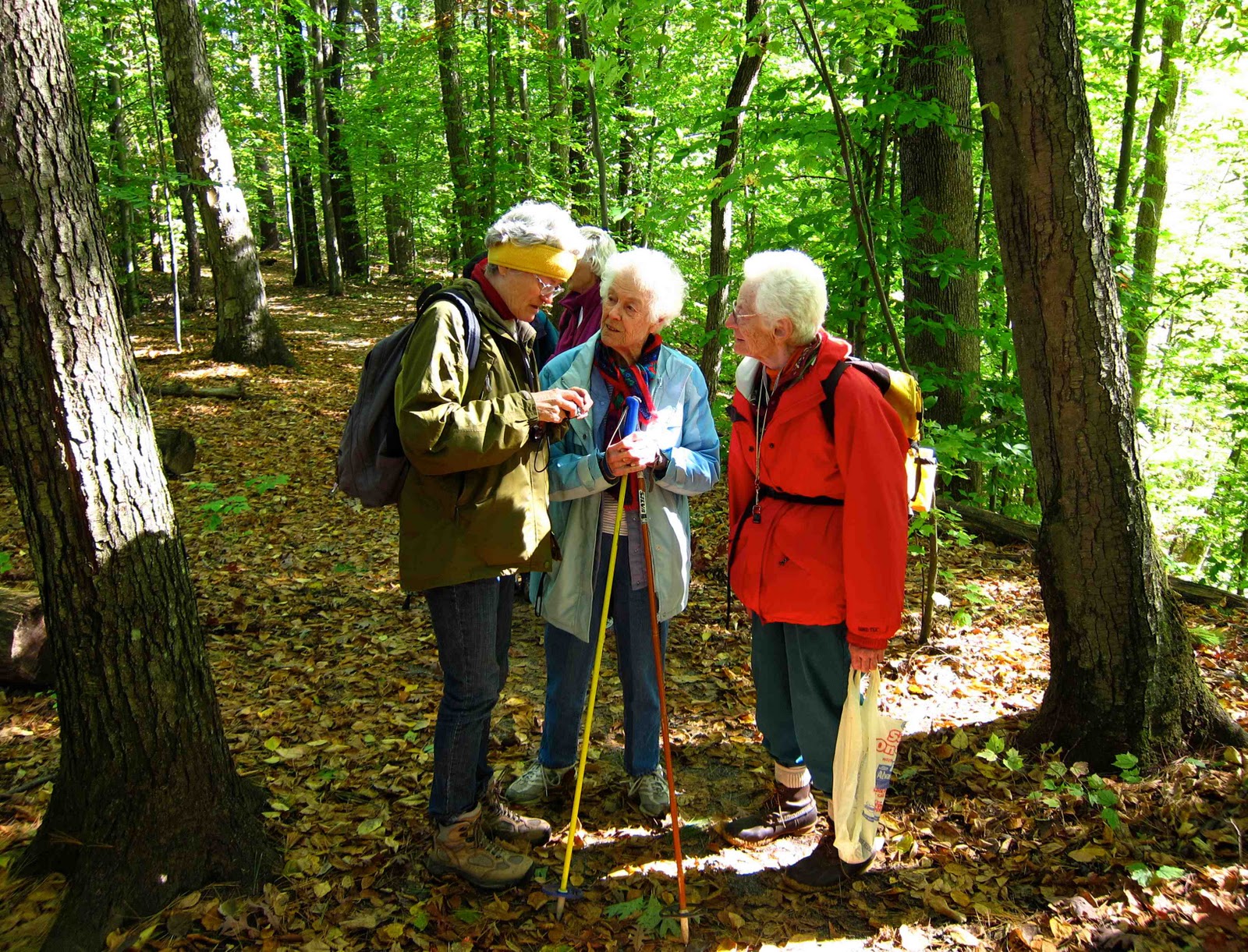
There were very few flowers along the trail today, but we still found much to delight and intrigue us. Here, Ed uses his magnifier to peer at a tiny insect nestled inside the gills of a Russula mushroom.

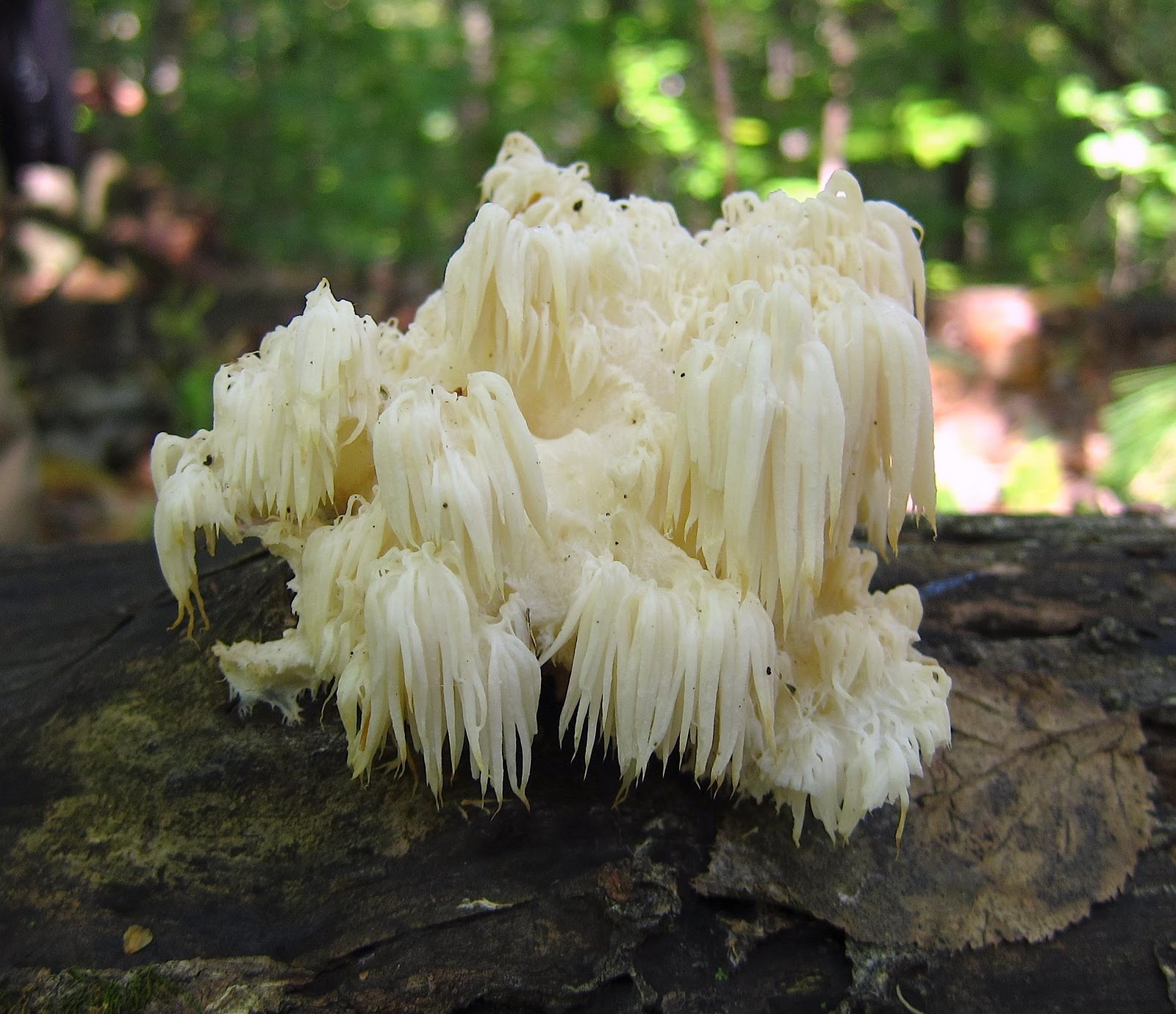
We found a nice fat Bear's Head toothed fungus (Hericium coralloides), which would have made a delicious mushroom meal, if those browning tips hadn't indicated that this fungus had grown too old to eat.
Here's another toothed fungus we found, Purple Tooth Polypore (Trichaptum biformis). Some were white, and others, like these, were more tan, but all had a lovely lavender edge. Way too woody to eat, though.

I wish I could have stayed longer with my friends this morning, but I had to get back to my house to meet electricians. When their work was done, the day was still young and still as lovely as ever, so I hurried out to enjoy a brief afternoon's walk at Bog Meadow Nature Trail in Saratoga.
Just a month ago, this boardwalk that crosses a marshy stretch of the trail was alive with the buzzing and flitting and calling of insects and birds. Today, it was eerily silent, except for the faint trilling of tree crickets far off in the distance. It was blissful to sit on a bench here and bask in the fading sun.

Most of the flowers have disappeared by now, even though we have yet to experience a true killing frost. I did find one plant of Swamp Thistle, one of our native thistles, with its fluffy purple flowerheads as vivid as ever. The color is actually more toward the magenta, but this is the color as my camera renders it.

There were still a few straggling blooms of New England Aster around, as well, which must have made this fat bee very happy, as she loads up with pollen before the autumn's cold arrives in earnest.

I had to stop at the supermarket on the way home, and there near the parking lot was a stand of Jerusalem Artichokes, the very last flower of summer. (The Monkshood in my garden still have yet to bloom, but they don't really count as the last flower around here, since they are not native to Saratoga County and I planted them.)

Somebody else was enjoying this lovely warm day and this splendid yellow flower. And I sure enjoyed the sight of this Candy-striped Leafhopper, which has got to be one of the most beautiful insects of all.

Subscribe to:
Posts (Atom)