Wednesday, December 8, 2010

New friends, A New Trail, A Frosty Hike

Brrr! It was COLD today! But not too cold to join Evelyn Greene and four of her friends near the Hickory Hill ski area in Warrensburg, to explore a wooded trail I had never been on. Evelyn wanted to assess the trail's potential as a ski trail for when we finally get some snow, and I was happy to come along. Any outing with Evelyn is always an adventure, and her fellow nature-loving friends are just as much fun to hike with as she is. We parked at a beautiful bed-and- breakfast called Country Road Lodge, right on the banks of the Hudson, with a splendid view of the river and a rugged mountain across the way called Sugar Loaf.

It was thanks to the folks who own this B&B, Steve and Sandy Parisi, that we had access to the trail we hiked today, which starts on their property and eventually connects with Forest Preserve land. I think we probably walked about five miles in all, round trip.

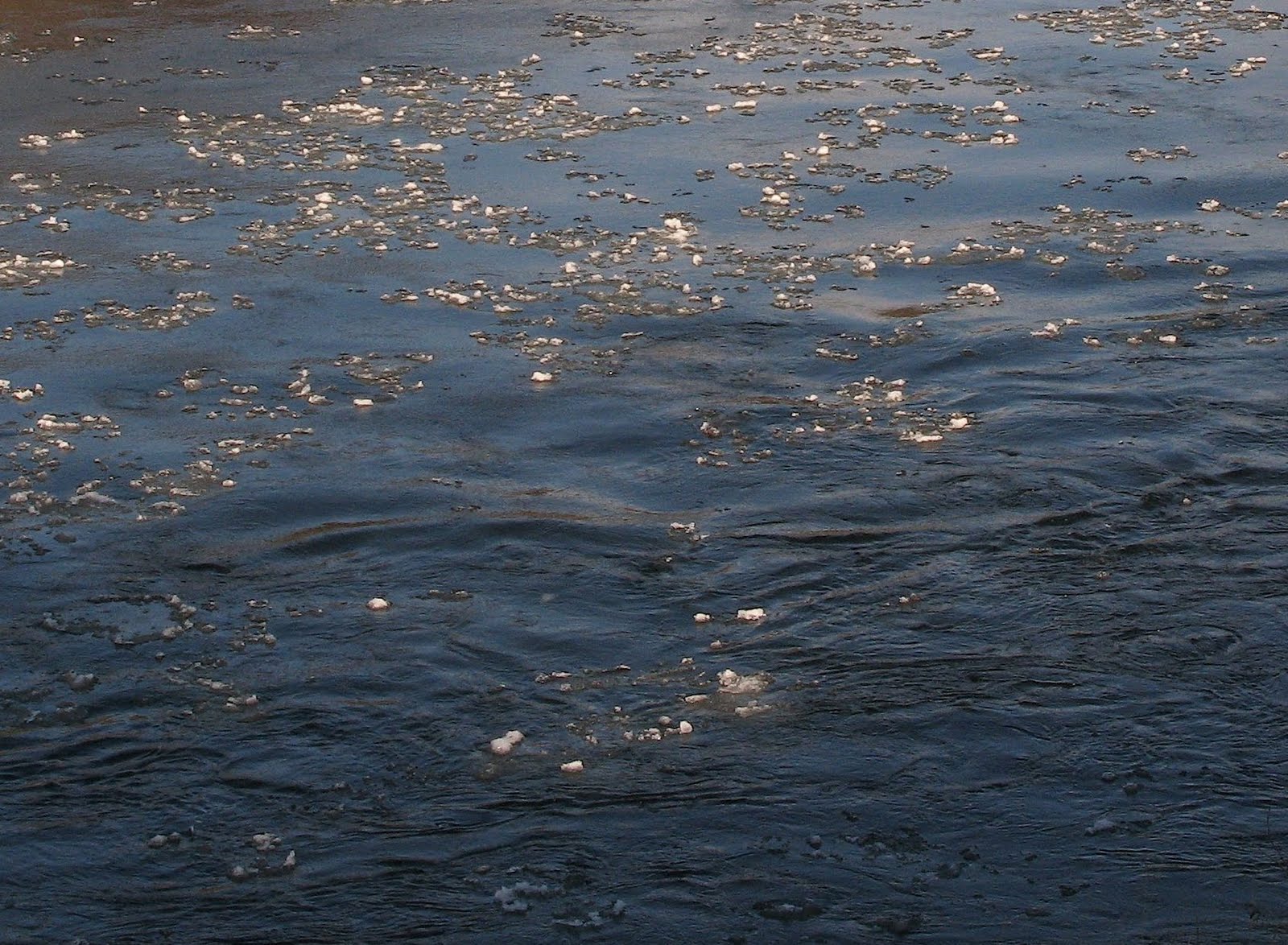
As the above photo shows, we don't have any snow yet, but the "frazil" ice this section of the Hudson is famous for is already starting to form. Frazil ice is a kind of fluid ice that forms in rapidly moving water, and its separate clumps eventually stick together to dam the river, causing the water level to rise and deposit the ice in deep masses along the shore. This photo shows the still-separate rafts of slushy ice moving swiftly along with the current.


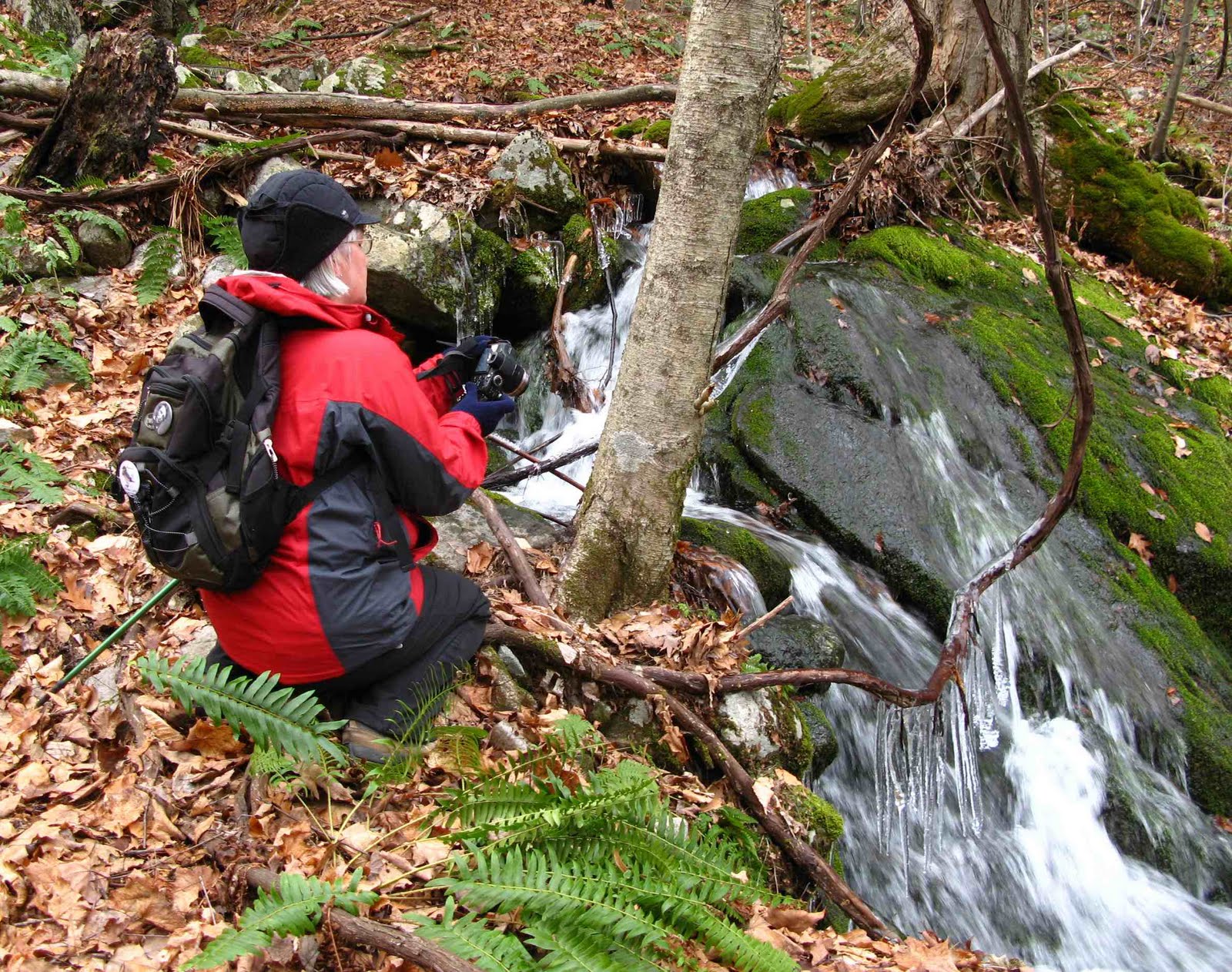
With the temperature down in the 20s today, ice was forming wherever there was water, taking on beautiful crystalline forms wherever it collected on stream- and riverside vegetation.


Long thin icicles, fed by seeps and springs, plunged down the steep vertical surfaces of rocky cliffs that rose to one side of our forested trail.


Most of the trail followed relatively level ground, with a few rises and dips and occasional deep ravines, where little streams came tumbling down to make their way toward the river.


Underfoot, the trail was lumpy and crunchy from the shards and needles of ice that formed in the soil.


Our crunching footfalls (not to mention our convivial chatter) would surely have scared off any resident wildlife, but this shredded tree indicates that a Black Bear was here not too long ago, clawing this dead snag apart in its search for inhabiting insects.


We found another dead tree in the process of being destroyed, but this time by some kind of growth that neither Evelyn nor I could identify. The tree, lying on the ground, had its upper surface covered with what looked like coal-black paint, pebbled with these pinhead-size pimply growths.

Is it a slime mold? Maybe a sac fungus? Nothing in my mushroom books really comes close, except maybe a sac fungus called Hypoxylon multiforme. I wish I had noticed which kind of tree it was growing on.


There's an awful lot of stuff in the woods I still don't know the names of, although with Evelyn as my guide I'm starting to recognize some liverworts and mosses. Luckily, she was there to correct me when I asked her what was that shaggy moss climbing the trunk of this tree. "Moss?! That's not a moss," she told me. "This is a liverwort!"


Well, it sure looked like a moss to me, until I peered at it closely. Then I could see the overlapping sacs that typify a liverwort's structure. This particular liverwort, I now know, is called Porella.


At least I was right when I called this a moss, these pretty, ferny, feathery fingers climbing the face of this rock. One of my hiking companions, Ann, remarked that it looked like a landscape painting of snowy hills surmounted by a spruce forest with a winter-dark sky behind.

Yes, I can certainly see that. And thanks to Evelyn, I even know the moss's name: Callicladium haldanianum. Now let's see if I can remember it.

Sunday, December 5, 2010

Sue Helps Me Find the Caves

Whew! I found those caves and that Walking Fern I was looking for in my last post. My friend Sue took me right to them today. And they weren't where I remembered them at all. I'm afraid I'm getting very forgetful in my old age. Plus, the forest looks very different now than it did when covered in snow, which it was the last time Sue and I visited the site, following a porcupine trail right into the mouth of one of those caves.

Here's Sue photographing that Walking Fern. The fern gets its name from the way it sprouts new plants from where the tips of its long narrow fronds touch the moss it grows on. This particular plant had walked about two feet from where I first found it last fall. Although Sue and I searched and searched among many boulders, we never found another one of these unusual ferns.


There are quite a few caves up there on the ridge overlooking Moreau Lake. Sue wondered if they might all be connected underground. I don't think I'd want to crawl in to find out.


Some folks believe these caves are the remnants of graphite mines, but I tend to think they were formed by running water. In fact, we found a little stream running out of the mouth of one cave.


That rushing stream that Evelyn and I followed up the ridge two days ago? Today it was lined with ice, with beautiful icicles hanging down over the water and streamside mosses beaded with crystal drops. Of course, we had to take pictures.


Saturday, December 4, 2010

Mosses and Lichens and Liverworts, Oh My!

This time of year, the darkness stays late and falls early. The flowers of spring and summer are gone, the colorful fungi of autumn have withered away, and there's no snow yet to preserve the tracks of wandering forest creatures. In short, there are fewer and fewer temptations to call me away from the warmth of my fireside and sofa. Except for Evelyn. Whenever Evelyn calls, I'm out the door, eager for whatever nature adventure she has in mind. Just yesterday, it was rocks. Not the mysterious holey boulder she led us to last month near Thirteenth Lake, but rather the rocky outcroppings riddled with caves that line the Red Oak Ridge Trail in the woods high above Moreau Lake.

I had told her about some caves up there where I'd found Walking Fern, an evergreen plant that indicates a limestone substrate, and that piqued her interest for sure. Evelyn lives in the Adirondacks, where there's plenty of granite and marble, but precious little limestone, so she was curious to see what we might find growing there. Meaning mosses and liverworts, mostly, since these bryophytes are one of Evelyn's special interests. And a wonderful thing about mosses and liverworts, they stay green all year, thus giving us something to hunt for out there, whatever the season.

Climbing the trail, we followed a pretty stream that was full and rushing from this past week's torrential rains.


Close by the stream, we found a patch of Conocephalum liverwort covering a dampened rock, a species of liverwort that Evelyn told me typically grows on limestone or marble. The liverwort is the flat green patch in the upper right of this photo, which also shows other evergreen plants, such as Plantain-leaved Sedge and Marginal Wood Fern, plus the over-wintering leaves of Foamflower peeking out from under the brown fallen leaves of poplar, hickory, and maple.


We found lots of different kinds of mosses, some growing on rocks, some covering rotting logs, and I wish I had recorded all that we found. Only a few of my photos came out, however (the light in the woods was quite dim), but I did get one shot that included three mosses at once. On the left, the long finger-like moss is Hedwigia (sp?), while the soft furry stuff on the right is Dicranum scoparium. I can't remember the name of the one in the middle, with flat glossy leaves. I hope Evelyn sees this photo and fills me in. (Update: Evelyn's friend Ruth Schottman did see this photo and informed me that this middle moss is Mnium. Thanks, Ruth.)


Here's more of the Dicranum moss encroaching on a patch of glossy liverwort called Scapania.


Growing on the bark of many trees along our trail were dark patches of what I thought might be lichens or fungus, but Evelyn corrected me, informing me that these patches were instead a liverwort called Frullania fragifolia. On some of the trees, the liverwort extended in thready branchings that looked like tree limbs.


Here's a closer view of those branchings, revealing the tiny braided sacs that distinguish this liverwort.


We did find one mushroom, a small one with a globular head and long stem, popping up among the dry leaves. I have no idea what it is. I should have dismantled it to gain more clues to its species, but I usually like to leave things the way they are.


Evelyn found it remarkable that this lichen, called Peltigera canina, was displaying wide-open fruiting bodies this late in the year. Its common name is Dog Lichen, and yes, those fruiting bodies do look a bit like dogs' ears.


We found the pretty evergreen leaves of such low-growing flowering plants as Pipsissewa and Striped Wintergreen (pictured here).

Evelyn later informed me she was told there was no record of Striped Wintergreen (also called Spotted Wintergreen) growing in Saratoga County. I find that a little hard to believe, since I have found it growing abundantly in several areas of Moreau Lake State Park. But I hope not too many other folks find it. It's so attractive it could be exploitably vulnerable.


So what about that Walking Fern and those caves I promised to show to Evelyn? She told me she had seen this fern only once before, so I was eager to find it. But I didn't. I thought I knew exactly which boulder I'd found it growing on, one I'd visited many times. But there are lots of boulders up on that ridge, many of them flecked with garnet. I did find a nice patch of garnets.


And we also found another unusual fern that likes to grow on limestone, called Ebony Spleenwort. We were amazed to see it so green and sprightly this close to winter. Maybe it's one of the evergreen ferns, like Walking Fern.


Well, I'm just going to have to go back up that Red Oak Ridge Trail to find those caves and that Walking Fern, another good excuse to get me outdoors. In the meantime, to prove that I really did find it up there, there's a blog post about it you can read by clicking here.

Thursday, December 2, 2010

Nice Day for a Brisk Walk

A beautiful day: crisp and cool, with a bright sun and clear blue sky. My husband Denis had business in Glens Falls this morning, so I came along to have lunch with him at Rock Hill Cafe, then on the way home we stopped at Moreau Lake State Park for a brisk walk around the lake. And I mean brisk! We got around the whole lake in about the same time it usually takes me to go about a hundred yards. When I'm by myself, poking along looking for stuff, I probably spend as much time on my knees as my feet. But when my husband leads the way, we hustle. There he goes, in the photo above, charging ahead as I dawdle behind. (Note that there's no more ice on the lake; pouring rain and warm temperatures since Tuesday had melted it all away.)

We did stop together to look up close at some things, including this sweet baby Pitch Pine cone, as prickly to touch as it was cute to look at.


And of course I had to stop at this fallen log, since it called out HI! to me in such big, bold letters.


The log, long fallen and denuded of bark, showed lots of tunnels from some kind of bark beetles. I hope they're not the tunnels of Emerald Ash Borers. I think they're not, since as far as I know, that dreaded beetle has not yet been reported at Moreau park. At any rate, this tree has been dead a long, long time, probably longer than EABs have been found in Saratoga County. Whatever chewed these tunnels, they do look like some kind of ancient hieroglyphics, spelling out some tale that will ever remain a mystery.

Maybe this is a waving hand, to go with that HI! up above.

Wednesday, December 1, 2010

Acid-Buffering, Bum-Breathing Turtles

The turtles are buried under the mud for the winter. How do they survive down there?

While walking around Mud Pond on Monday, I knew very well I would not see any turtles. I know that by this late in autumn, turtles have buried themselves deep in mud to hibernate until spring. What I did not know, however, was just how they manage to do that, since the rest of the year they breathe with their lungs and have to come up for air. And just as I was pondering this mystery, my Winter issue of Northern Woodlands magazine arrived in the mail, with a fascinating description of just how turtles do this. I wish I could offer a link to the article, but since Northern Woodlands won't show the Winter issue's articles on its website until next season, I'm reproducing much of the article here.


Bum breathers
by Bill Amos

As northerners, our turtles must contend with frigid winters. Unable to maintain the necessary body temperature to carry out essential metabolic activities, a turtle settles down into the mud for a long winter's sleep. Its heart rate slows to almost nothing, and its organ systems more or less shut down.

Finding food is not a problem -- like all hibernators, a turtle lives on the rich body fat that was stored in the previous summer's season of plenty. But finding oxygen with which to metabolize this fat is a challenge. Unlike a terrestrial hibernator, a turtle winters in an oxygen-deficient environment for four or five months. When fat is metabolized in the absence of oxygen, the process creates lactic acid, and when too much of this acid builds up, the resulting condition -- known as acidosis -- can be fatal to an animal.

A pond turtle finds a remedy to this problem in its shell and skeleton, which together account for over a third of the animal's weight. The shell of a turtle is not just for protection -- being heavy, it also helps with buoyancy control by counteracting the air-filled lungs, and it acts as a hydrofoil when the animal swims.

For hibernating turtles, the shell is also vitally important in a chemical sense. Just as we take buffering tablets, like Tums, to relieve an acid stomach, a hibernating turtle uses its shell and bone, composed of limy compounds, to release carbonates into its increasingly acidic body fluids. This buffers the acid buildup in a non-breathing turtle, when it snoozes down in the oxygenless mud of a winter pond, and deadly acidosis in the animal's tissues is prevented. Furthermore, the shell stores accumulations of this buffered lactic acid where it can do no harm.

In effect, a hibernating turtle is a closed system independent of the environment, an extraordinary feat of biochemical juggling that allows metabolism to continue throughout winter.

But wait. There's more.

All reptiles (also amphibians and birds) have a sizeable rear opening called a cloaca. It is a common, muscular chamber into which the rectum, urinary, and reproductive systems empty. It serves as a mating and egg-laying opening as well as one through which urinary and digestive wastes are excreted. It's a good design that has served these animals well for millions of years.

The cloaca in some kinds of freshwater turtles, such as our Eastern Painted Turtle, has fingerlike extensions that are abundantly supplied with blood vessels. The muscular walls of the cloaca contract and relax, forcing water in and out of the chamber. If a Painted Turtle hibernates in a pond where some dissolved oxygen is available, the cloaca will serve as respiratory device. As a substitue "lung," the cloaca allows for the transfer of oxygen and carbon dioxide between the animal and the surrounding water.

* * *

Imagine that! A turtle can breathe through its butt! Isn't Nature amazing? And so is that magazine Northern Woodlands, which is just full of fascinating information for nature lovers. You can check it out at northernwoodlands.org and even read whole articles from past issues there. Even better, you can subscribe.

Another good site for nature lovers to visit is "Ask a Naturalist," where you can find out anything you ever wanted to know about the natural world. Check it out here.

Tuesday, November 30, 2010

Finds in the Late Autumn Woods

At first glance, the woods looks pretty dull this time of year. The wildflower season's long past, the trees are bare, the migrating birds have flown away with their songs, and there's no snow yet to reveal the woodland residents' whereabouts. Ho hum! Nothing of interest, right? Well, actually, there's plenty of neat stuff out there in the woods right now, but you might have to hunt around to find it.

This moss, for example, with its long fern-like runners, can be found on lots of rotting downed trees. But you probably wouldn't notice its delicate structures unless you bent down to peer close, because it's so small.


The same could be said for this dainty green lichen, growing amid the moss.


Because I have very poor eyesight, I never noticed these fruiting stalks growing among the green leafy structures of the lichen, until I took a macro photo and blew it up.


When I saw these brown clumps amid the dead leaves, I assumed at first they were some creature's feces, although I couldn't recall any critter that left piles this blobby in shape.


I reached for a stick to poke the feces apart to see what food remnants were in it, but the stick was attached to more of the same brown blobs. They were hard and woody, with no detectable odor.


Then I looked up, remembering that this was the area where last year I found large blobby galls infesting the Bitternut Hickories. And there they were, dozens and dozens of them, caused by some kind of phomopsis fungus. Not very pretty, but hey, a fascinating find, nevertheless.


Here are some more blobby things that are maybe not so pretty but still kind of fascinating. These are the dried fruits of Wild Cucumber, a pretty but rather pestiferous vine that swarms over roadside shrubbery in late summer.


And here's the insides of one of those fruits, with the external membrane worn off, although the thorns remained intact. So intricate and lacy!


As the sun headed down, it lit up these streamside plants -- yellow willow, green ground cover, and bright Red Osier Dogwood stems -- revealing a landscape as colorful as an Italian flag.

Quite an unexpected burst of color for late on a late-autumn afternoon.

Monday, November 29, 2010

Frozen Over!

Mud Pond, frozen over from shore to shore

Mother Nature must have heard my prayer. After a whole week indoors preparing for and enjoying the holiday, I just HAD to get outside today, and she gave me the perfect day for doing so: sunny and calm, with frost in the morning but the promise of warming through the day. Up early, I hurried up to Mud Pond in Moreau, hoping to catch the curling petals of frozen vapor on Frostweed stems, but too late, the plant has spent its vapor supply, so I missed it this year. (For photos of what it looked like last year, click here.) What I did find, though, much to my surprise, was the season's first ice on the pond -- all across the pond, from shore to shore, with crinkled plates of thin ice where waves had lapped against the beach.


I walked around the pond and through the woods to Moreau Lake and found that the ice was also covering the back bay of the lake -- except where beavers had kept open a channel by swimming again and again from their lodge to the woods.


So winter is definitely on its way. But nobody told these baby St. Johnsworts, so tiny and pretty and pink, sprouting all over the muddy flats at the edge of Mud Pond. They look so fragile, but I imagine they will winter over quite happily under the snow, then get a head start on the growing season come spring.


Wednesday, November 24, 2010

A Saratoga Stroll

What with holiday cooking and cleaning, I didn't get to the woods this week, and I was beginning to feel kind of cranky about it. I need a dose of sky over my head every day, or I start to go nuts. So today, when the last pie came out of the oven, I was out the door to enjoy what was left of a gorgeous blue-sky afternoon. No time to run off to the woods, but a nice long walk around town would suit me fine. And what a town I live in! I step out my front door, and just see what splendid houses greet me right across the street.


Both of these mansions were seedy rooming houses when we bought our house in 1971, then were abandoned to pigeons and rot for many years, until they were finally restored to their former glory. They are currently single-family homes for folks who live in them maybe three or four weeks each summer. Nice quiet neighbors, that's for sure.


At the end of my block I turn toward downtown, and only one block away is this magnificent public library.


Right around the corner from the library are great places for food and live music. Hattie's restaurant won a fried chicken "throw down" against Food Network's Bobby Flay, and Caffe Lena is the oldest continuously running coffee house in the country, where folks like Bob Dylan once got their start.


Just a stone's throw from Caffe Lena is another venue for live music of the rowdy rock-and-roll variety. In just a few weeks, my son's band The Figgs will be playing here to promote their new record. December 11. Don't miss them!


Broadway, the main street of downtown Saratoga Springs, is lined with many beautiful old 19th-century buildings, and is just three blocks from my home.


One of my favorite stores downtown is G. Willikers, a really terrific toy store that sells the kinds of toys you don't have to compromise your principles to buy -- and spares me from ever having to go to a mall for the kids' birthday presents. (And they even give me a grandma discount, now that I shop there for so many grandchildren.)


G. Willikers' window is always a delight, and never more so than at holiday time.


Our downtown post office is a splendid old building, with beautiful architectural details and murals by French-American painter William Pene du Bois, who is probably best known as the author-illustrator of such children's books as The Three Policemen and Twenty-one Balloons.


Heading north on Broadway, I pass many beautiful old "cottages" that were once the summer homes of prominent thoroughbred racing families, although many are now occupied year-round by Saratoga residents.

Our bank's president lives in this lovely white house.


I don't know who lives in this house now, but it used to belong to Penny Tweedy, owner of the famous racehorse Secretariat, a Triple Crown winner who lost to a longshot named Onion in Saratoga's Travers Stakes. There was a major-studio movie this year about Secretariat, but I don't think the script included anything about that Travers loss.


I keep heading north on Broadway, which, just beyond where this photo was taken, turns into a rutted dirt road impassable to autos but perfect for folks who love to walk in the woods.


Skidmore College is out here at the far end of Broadway. The college's many cultural offerings -- art exhibits, concerts, lectures, dance and theater performances -- certainly add to the quality of living in Saratoga Springs.


Heading home, I return downtown and stop in at the world's best coffee shop, Uncommon Grounds, to warm up and just smell the great coffee aroma from roasting beans.


From world's best coffee shop to world's best bakery: Mrs. London's. Why do you suppose everyone here is smiling?


Mmmm! I'll bet this is why. I often stop in here to just gaze at these pastries, almost too pretty to eat.


Home again. The aroma of fresh-baked pies greets me as soon as I open my door. They may not be as pretty as Mrs. London's cakes, but I know they'll taste mighty good. But I have to wait until tomorrow, when we go to our daughter's in-laws in Vermont for Thanksgiving dinner.

I have so much to be thankful for: my dear husband and children and grandchildren, above all, and also good health and contentment. And a beautiful place to call home.

Happy Thanksgiving to all!