Thursday, April 22, 2010

Get Well, Mother Earth

Earth Day! With all the massive earthquakes, 100-year floods, and world-interrupting volcanic eruptions we've been having lately, it seems like Mother Earth is not feeling very well. I think she may be doing all she can to rid herself of this pestiferous human race. It's as if we humans were infectious germs that have stimulated her immune system to attack us. And we deserve it.

Sorry to be so glum. But I spent the afternoon paddling the shores of Moreau Lake, fishing the most disgusting stuff out of the water and off the beach. Beer cans and bait boxes are one thing, but jeez! If you go to the trouble to pick up your dog's poop in a plastic bag, why not carry it off to a trash container instead of flinging it into the stands of Phragmites? Grrrr!

Actually, I had a great time, joining Moreau Lake State Park staffers Ben Snyder and Rebecca Mullins on an Earth Day clean-up of the shoreline. I'm always game for a paddle, made even more fun today by the pleasure of their company and the satisfaction of doing something useful.


And of course, there were other companions to add to the task's enjoyment. Like this Red Winged Blackbird guarding his nesting site.


And this log-full of Painted Turtles. I couldn't believe they hadn't dived off, as the dozen others sharing a nearby log had done.


This Mother Goose didn't dive off, either, and for very good reason. No doubt that's a nest full of eggs she's sitting on, perched on top of this active beaver lodge. We could tell the lodge was still active because of the recent addition of new sapling limbs and the piles of newly peeled branches.


So despite my despair about slobby humans despoiling this beautiful place, I found much to be happy about, with all this evidence of continuing life. For example, I reached down into the water to grab what I thought was some plastic trash, and discovered a diaphanous egg mass instead. (Anyone know whose eggs these might be?)


So life goes on. Hurrah! The signs are everywhere.

I am reminded of a poem by Gerard Manley Hopkins:


God's Grandeur

The world is charged with the grandeur of God.
It will flame out, like shining from shook foil;
It gathers to a greatness, like the ooze of oil
Crushed. Why do men then now not reck his rod?
Generations have trod, have trod, have trod;
And all is seared with trade; bleared, smeared with toil;
And wears man's smudge and shares man's smell: the soil
Is bare now, nor can foot feel, being shod.

And for all this, nature is never spent;
There lives the dearest freshness deep down things;
And though the last lights off the black West went
Oh, morning, at the brown brink eastward, springs --
Because the Holy Ghost over the bent
World broods with warm breast and with ah! bright wings.


Wednesday, April 21, 2010

Catching Up on the Week's Adventures

A busy week has kept me from blogging since Friday, but that doesn't mean I haven't been getting outdoors. On Monday, I took a friend to the Ballston Creek Preserve over near Ballston Lake, a forested parcel preserved by Saratoga PLAN that leads to a Great Blue Heron rookery. We didn't quite make it to the rookery, since the trail turned too mucky for my friend to navigate, but we still enjoyed walking through this beautiful woods, which was carpeted with more Carolina Spring Beauties than I've ever seen in my life.
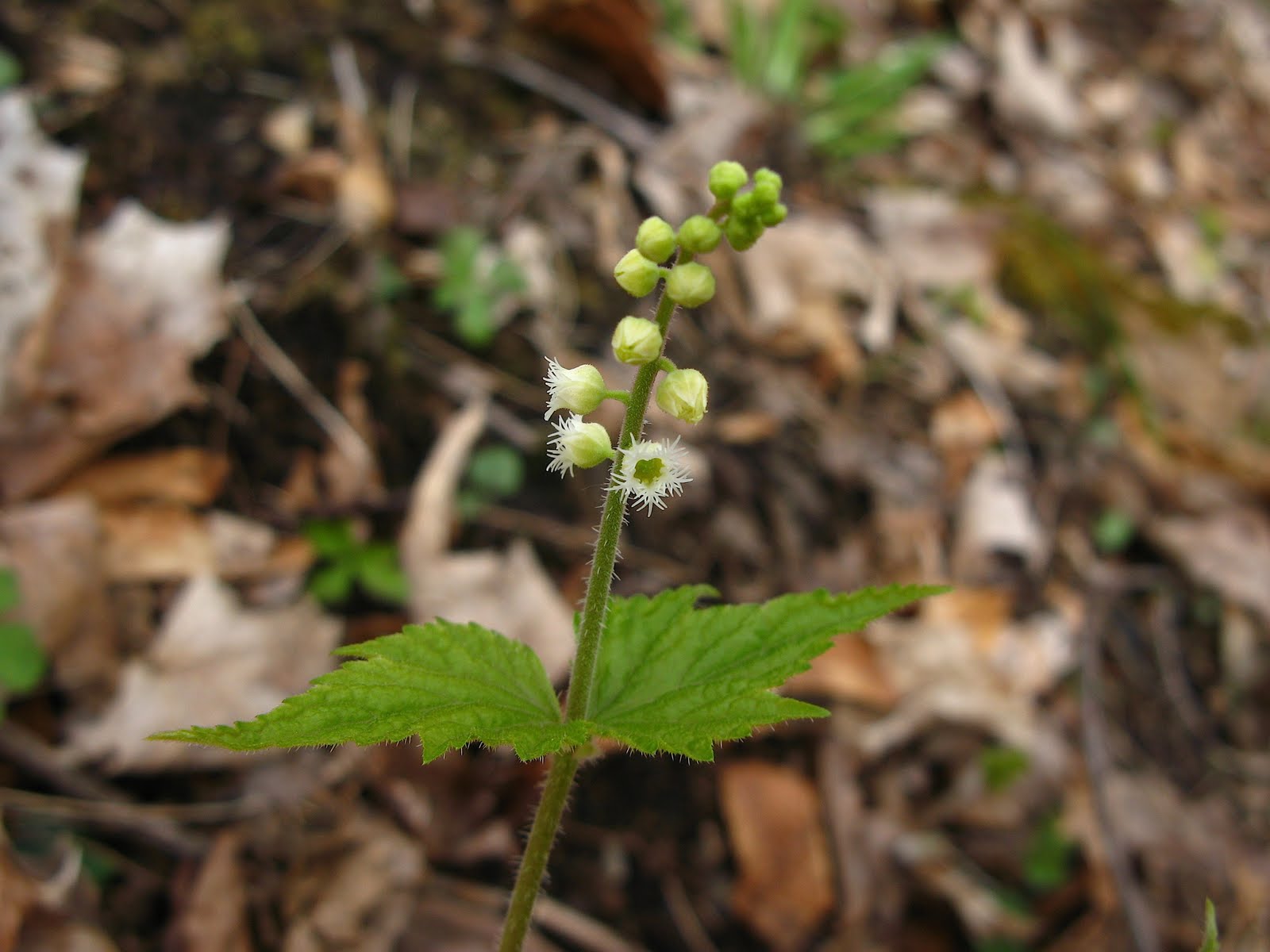


Another flower gracing that Ballston woods on Monday was Barren Strawberry. True, this plant bears a fruit that is dry and inedible, but I wish it could have a more positive common name that truly represents how pretty it is.


Tuesday was busy with Hospice volunteer work and preparing to celebrate my son Philip's birthday, but today was all mine to enjoy a hike with friend Laurie, exploring trails in Moreau Lake State Park that took us to marshy pools high in the mountains.


Lining the rocky trail we climbed were many wildflowers just coming into bloom, including clumps of snowy white Early Saxifrage.


When we reached the pools, the first thing that struck me was how GREEN it was all around them, with mosses thickly covering fallen logs and bright grasses growing lushly on the banks.


These are not, strictly speaking, vernal pools, since they don't dry completely over the summer, but remain marshy enough to support the growth of Sphagnum Moss, among other mosses.


Low Blueberry grows abundantly here, its tight pink buds just now beginning to open.


Another flower that loves damp spots is Goldthread, with glossy evergreen leaves and a corolla that bears very odd-looking petals. Those white parts around the outside are, in fact, sepals. Those yellow, jelly-like little clubs are the actual petals. In this photo, the stamens are white, and the pistillate parts are the prettiest apple green.


Many large ferns of several kinds were unfurling their fronds, most of them covered with fuzz. These teeny, tiny coils, maybe half an inch high and growing out of a clump of moss, were bald and glossy exceptions.


The moss those tiny ferns were inhabiting was a shiny dark green and leafy, each leaf with a dark midrib. The filaments holding the spore caps were dark red and the spore caps were lemon yellow. I have never seen this moss before, and of course, I don't know its name.


Here's a close-up of some of those spore stalks. They remind me of tiny lemons. I wonder if those shiny green shoots will develop into spore stalks.


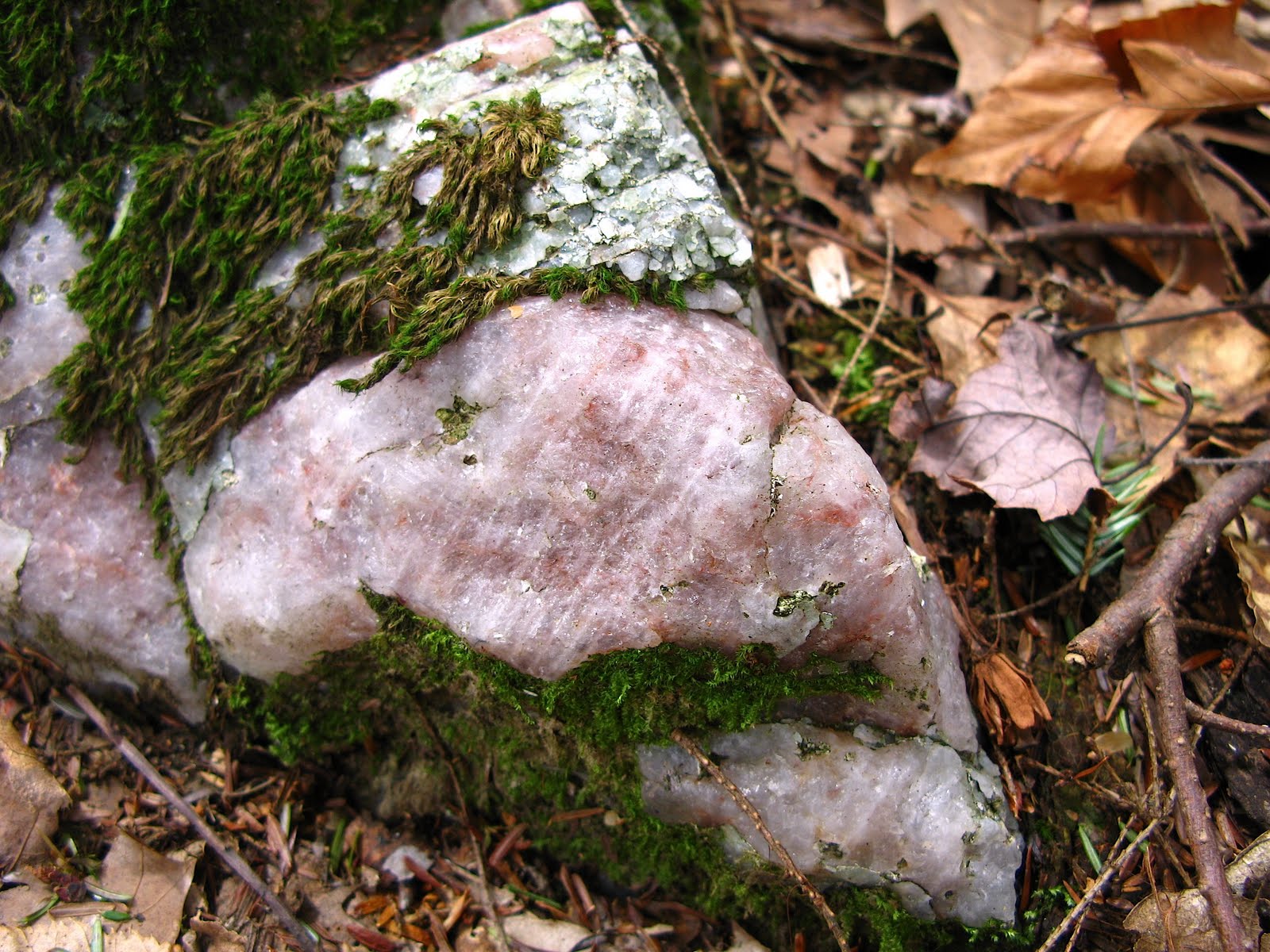
My friend Laurie is a geologist, so of course we stopped to examine the rocks as we walked along. This beautiful quartzite boulder, with its fringes of moss, is representative of much of the rocky outcropping that surrounds the marshy pools.


On our way down the mountain, we crossed a small rushing stream, where I noticed these underwater plants flowing and swirling with the current. I could have sat mesmerized by their motion for hours, but we both needed to make our way home.


One errand I had to accomplish today was to pick up brochures from the Wilton Wildlife Preserve and Park. My friend Sue Pierce and I are presenting a program of photos and commentary about our nature adventures at 6:30 on Friday evening at the Unitarian Church in Queensbury, and we want to have brochures available from many different parks and preserves in the surrounding area. So off I went to Wilton. And of course, I had to visit the woods while I was there. That's where I found these Dwarf Ginseng growing abundantly along the path.


On my way home from Wilton, I passed a cemetery where vivid pink patches of Moss Phlox are spreading among the graves. So naturally, I had to pull over and take their picture.

My Newcomb's Wildflower Guide tells me that this flower is native to our area, although it grows in New England only where it escapes from cultivation. Aren't we lucky to be able to claim such a beautiful flower as our own?


Friday, April 16, 2010

Some Girls Know How to Have Fun

Chilly and damp today, but that didn't dampen Ellen's and my plan to walk around Moreau Lake. Ellen lives way up in Newcomb, where she writes the wonderful blog Adirondack Naturalist, but every so often she comes down to Glens Falls for shopping and auto service. So we met there today and took off together to Moreau Lake State Park while her car underwent repairs.

Even under a cold grey sky the lake shore was lovely, with white clouds of Shadblow drifting out from the edge of the woods. Along the banks, Highbush Blueberry shrubs were studded with bright pink sputniks of buds, and Trailing Arbutus still held a few little fragrant clusters of white and pink waxy blooms. A noisy pair of Canada Geese came surfboarding down on the lake, while a Wood Duck went hooting across the water and a pair of Mallards blithely bobbed on the waves. We met a couple who told us a Loon had been seen on the lake, but alas, we never saw it. We did, however, see swarms of tiny Mayflies flitting over the water, as well as a swirling mob of Suckers in close enough to the sandy shore that a fin stuck up out of the water. My friend Sue and I caught their spawning frenzy a few days ago (see Sue's blog Water Lily for terrific photos), but today the fish seemed a little less riotous.

All in all, a fun walk with a fine friend who knows how to enjoy an amble: meaning, we stop every few feet to take photos of flowers or drop to our knees to peer closely at mosses or pick up a stick to poke at dead fish or lift pieces of poop to smell if it's otter scat. As I said, a fine friend who really knows how to have fun.

Because the day was so dark, most of the photos I shot were blurry. But I did get a few I liked.


Ellen identified these leaves as Wild Black Cherry. I love their elegant shape, their cherry-red tinge, and the deeper red flap where the leaves join the twig. (Anybody know the botanical name for that little flap?)


I know I posted a photo of this Haircap Moss a few days ago, but this patch was even more photogenic, those cinnamon-brown star-packed cups surrounded by bright green spikes, all so neatly arrayed. These are the moss's male shoots, where the sperm develops and is splashed out of the cups by raindrops to land on nearby female shoots.


Here are the female shoots of Haircap Moss, where the fertilized egg cells develop into spores. These spores will be contained in a capsule at the top of the stalk, which later in the year will open to spill the spores on the wind.


Here's a closer look at those spore stalks. Note how fuzzy and frayed they are. Do you suppose that's how this moss got its common name of Haircap? Folks once thought that this moss could be used as an agent to strengthen the hair, a use no doubt suggested by the plant's appearance. The stalks of this moss also can be woven into baskets, which must be quite lovely, considering the deep color of those stalks.


I posted a photo of Red Maple keys a few days ago, too, but that former photo didn't show the ruffled pink collar that circles the twin purplish seeds. What amazing colors!


I wanted to show Ellen the patch of Whitlow Grass (Draba verna) that grows almost invisibly along a park road, but the tiny four-petaled flowers were closed up on this damp dark day. Thanks to Ellen's much sharper eyes, she noted the minute little pea-pod-shaped things protruding from many blossoms. These flowers are already fruiting.

For more photos and another account of our adventures around Moreau Lake, be sure to check Ellen's blog.

Thursday, April 15, 2010

Sunstruck and Splendid


Just one photo today. I'm not even sure what species these leaves belong to. Some kind of dogwood, I think. Whatever they are, they were sunstruck and splendid and they filled me with delight.

Wednesday, April 14, 2010

Home Again to the River

Sunny and warm, just a bit of a breeze, not a cloud to be seen in a deep blue sky: a perfect day to haul my canoe from the cellar and head to the river. Such a feeling of freedom, those first strokes of the paddle against the bright clear water! I slip along close to the bank like a water snake, so silent, so smooth, so almost without any effort. I rest my paddle on the gunwales and drift with the current, relax against the backrest, turn my face to the sun, and b-r-e-a-t-h-e. Home again!

But these old familiar banks are changed from when last I paddled here. Over the fall and winter, beavers have cleared wide swaths, leaving just stumps of Birch and Beech and Red Osier. On this little island, the shrubs that once leaned over the water are now reduced to a few chewed sticks. It will be interesting to watch how the shrubs recover.


Not all the shrubs have been felled. I wonder if Sweet Gale's resin, which makes it so fragrant to us and so repellent to many insects, also tastes bad to a beaver. I found Sweet Gale blooming along the banks today, chubby little tan male catkins on some shrubs, bright red spiky female tufts on others. And then I found one shrub that had both male and female flowers growing on the same branch. What a surprise! I know that the sexes can shift shrubs from year to year, but I didn't know that both sexes could occur on one bush. I learn something new every day.


Red Maples hung over the water, their flowers spent and the tiny keys just beginning to form. How intensely colored they were, all aglow, with the sunlight shining behind them.


Just look at these fat yellow Sassafras buds on lime-green twigs! Gorgeous! They'll sprout into cascading clusters of yellowish flowers, which much later on produce dark blue berries on hot pink pedicels. And their leaves in autumn turn the most glorious colors. Sassafras offers delights in every season. Plus, their leaves are tasty to chew on.


So my year on the water begins anew. How happy I am to be back in my dear little boat again! Just as I was happy to rejoice in autumn's splendor, and marvel at all the lovely forms that ice assumes in winter's cold. The cycle of the year turns round and round, and I can't believe how lucky I am to be able to immerse myself in it. As usual, Henry Thoreau once said it best:

"Live in each season as it passes; breathe the air, drink the drink, taste the fruit, and resign yourself to the influences of each."


Tuesday, April 13, 2010

Christmas in April

Oh burgeoning Spring! Each April day is like Christmas morning, when I bound out of bed eager to see what beautiful gifts Mother Nature has left for me under the trees. You'd think I'd be bored by the hunt by now, after more than ten years of keeping wildflower journals. But no, I'm just as excited as ever to greet each returning flower as if it were a long-lost friend. And wow, when I find a new one, I wouldn't trade diamonds or pearls for the sheer delight that brings me. Even when it's just a drab little weed, like that Draba verna I wrote about a few posts back.

What I found today was no drab little weed, but a genuine treasure for wildflower enthusiasts. Not a new find for me, but a rare one, because Twinleaf often waits to bloom until just when you've averted your gaze, then quick! drops its petals before you can turn around. I've been stalking this one in the shade garden at Yaddo for days, and bless my stars, I caught its brief moment of bloom today. Many other years, I am not so lucky.

I suppose in some ways it doesn't count as a wildflower find, when a specimen grows in a planted garden. Maybe some day I will find this rare flower in the wild. But I wouldn't count on it.


Bloodroot is hardly a rare flower. A brief bloomer, true, but profligate in its season. I find it strewn by the hundreds along many roadsides, yet never do I pass it by without rejoicing in its beauty.


Bellwort also blooms in masses, thronging damp creeksides before the tree canopy closes in. This is the Sessile-leaved Bellwort, so called because of the way its leaves clasp the stem.

There are two other bellworts that bloom a little later in the spring: Large-flowered (which I'll post a photo of when it comes into season) and Perfoliate Bellwort, so called for the way its stem appears to pierce (perforate) its leaf. I'm posting its photo now to show how it differs from Sessile-leaved.


I was truly startled to find Rue Anemone in bloom today, since I've never found it before the first week of May. True, it's just beginning to flower and won't come into its full glory for some days yet. But there it was, peeking out of the dead leaf litter on a rocky roadside bank. This seems to be much less common an anemone than other native species, like Wood or Canada Anemones. I know of only one place to find it around here.


Well, flowers are certainly my great joy, but the truth is I could survive without finding them. Not so for the pollinators. They were out in force today, feasting away in a sunny Wild Strawberry patch. Here are just two that sat still long enough for me to take their picture.

This little green bee was as bright and shiny as a piece of jewelry.


I love the slender elegance of this bug. Species unknown, I'm calling it Fred Astaire.


Monday, April 12, 2010

Rock Garden

I was clambering today among limestone boulders where Saratoga's broad and beautiful North Broadway peters out to a rutted dirt road, impassable to autos. Here's where I find all kinds of flowers that love that limey soil. Many, in fact, seem to sprout right out of the rocks, although I'm sure that their roots have wormed down through cracks and crannies to find enough soil to feed on. Here's what was blooming today, a good week or more earlier than in years past.

Wild Ginger. Not related to the ginger sold as a culinary spice, but the roots have a gingery smell and spicy taste that is similar. Usually, the flower is hidden under the leaves. This was my lucky day, to find one so exposed and easily photographed.


Early Meadow Rue. Here is the female version of this lacy-leaved early spring bloomer. All of the flowers on this individual plant are pistillate ones. The pistillate plants seem to occur less frequently than the staminate ones in this location. I have never found one until today.


Here are the staminate flowers of Early Meadow Rue, with pollen-laden anthers dangling down like wind chimes, set all aflutter with the slightest breeze.


Miterwort. I have never been able to capture both flowers and leaves of this plant in the same photo until today, when I found this very small specimen just starting to bloom. What a stunning little blossom, with spiky rays as delicate as those of a snowflake. Be sure to click on this photo to get a closer view.


Long-spurred Violet. It's pretty obvious how this violet got its common name. Paler than most other purple violets, the bloom shows darker purple toward the center.


Blue Cohosh. These brownish flowers are easy to miss in the spring woods, but they certainly rate a closer look. Those six pointed "petals" are really the sepals, and the real petals are those greenish little worm-shaped things nestled at the base of each sepal. The yellow things are the stamens, and the tiny green turnip in the center is the pistil. The early leaves and stems of the plant are greenish purple. So what's blue about this plant? It has beautiful blue berry-like seeds in the summer.

* * *

I did not include the Latin names of these flowers, because I'm not sure if they still apply. Steve Young, chief botanist for New York's Natural Heritage Program, has recently sent me a list of updated scientific names for plants included in Newcomb's Wildflower Guide, with changes on almost every page. I confess I have not yet amended my Newcomb's. One of these days I will. In the meantime, though, I'm using the common names only. At this moment in taxonomic history, the common names change much less often.

Sunday, April 11, 2010

Posies and Puzzles

How I love the spring woods just as the new leaves are opening. Translucent as stained glass, the baby leaves cast little shade, but instead catch and transmit the sunlight, so the forest appears as if strung with twinkling lights.

The flowers that live on the forest floor take advantage of all this light and burst into bloom as soon as they can, before the shade darkens around them. At Bog Meadow Nature Trail, the Carolina Spring Beauties were reveling in today's warmth and sunshine and opened their buds by the dozen.

Last year, I didn't find these flowers until the first week of May, so they're blooming a little early. No matter when they bloom, they certainly live up to their name.


Another flower that's appearing ahead of schedule is Purple Trillium, also known as Wake Robin.
Most of the trilliums were still in bud today, but I did find a few that were already open.


Yesterday, at Moreau Lake State Park, the Dutchman's Breeches were just coming into bloom.

This plant grows abundantly along a small stream in the park, so it will make quite a sight when all those plants start dangling these little white pantaloons.


I had hoped to put my canoe in the river today, but a blustery wind discouraged me, so I hiked along the shore instead, skirting the bays by heading deep into the woods. While walking along, I had quite a start when I saw this heap of porcupine quills.

Could that be a baby? I wondered at first, but then noticed it wasn't moving. Good heavens, it's just a tail! So what happened to the rest of it?


Here's what I found nearby: another heap of quills. Just quills. No flesh, no bones, no sign of them. Not even any skin.

How odd! And such an orderly pile, not strewn about as you'd expect if some predator had attacked and eaten the porcupine. This sight had me puzzled, for sure!


Here's a little prettier sight: a ring of False Hellebore. I love these deeply creased, bright green leaves, so swirly and curvaceous.

In some ways, they're prettier now than when they grow tall and gangly and bear greenish nondescript flowers in June.


Bluets are always pretty. One of our earliest flowers to bloom, they'll put on a marvelous show through May, when, perched on almost invisible stems, they drift in masses across the grass, holding their sky-blue blossoms horizontally, as if to mirror the sky.

And they'll keep on blooming (though not so abundantly) through spring and summer and fall. I even have a photo of one dated December 12. But this is the earliest date I've ever recorded seeing them.


Are these little red caps flowers? Does moss have flowers? I've certainly seen the spore stalks of other mosses, so I'm assuming maybe these tiny (1/8 inch) structures function in a similar manner. But I can't be sure. Mosses are mysteries to me.


One thing I am sure of, though: they sure are cute!